
Introduction
The high-pass approximation (HPA) interpolates between a Rayleigh low-frequency term and a bounded, reflection-controlled high-frequency scale (Johnson 1977; Stanton 1989). It is a rational approximation to backscattering cross-section, not an exact boundary-value solution. It therefore captures broad frequency trends but not individual modal resonances.
Material ratios and scattering quantities follow Notation and symbols. The assumptions behind the Rayleigh and reflected-wave limits are summarized in the Acoustic scattering primer.
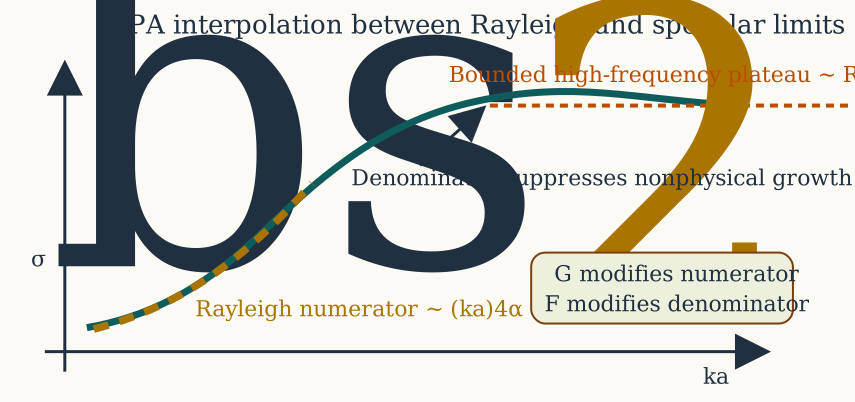
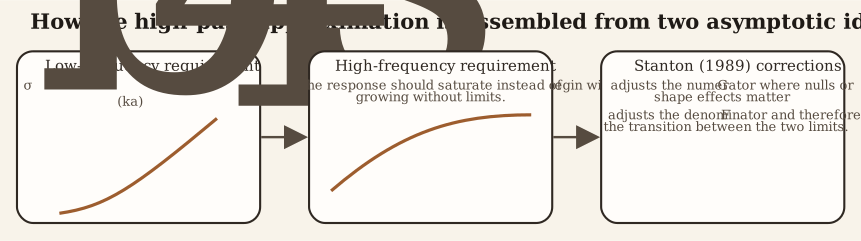
The construction has a Rayleigh numerator proportional to (ka)^4\alpha_\pi^2, a denominator that bounds its growth, and optional Stanton corrections \mathcal F and \mathcal G.
Geometry determines the prefactor and coherence term. Spheres use one radius, prolate spheroids use their length and radius scales, straight cylinders use the transverse size Ka and directivity s, and bent cylinders use the curvature factor \mathcal H.
Low-frequency scattering ingredients
Contrast ratios
Let the surrounding medium be labeled 1 and the scatterer 2. Define the density and sound-speed contrasts by:
g_{21} = \frac{\rho_2}{\rho_1}, \qquad h_{21} = \frac{c_2}{c_1}.
These ratios enter the Rayleigh coefficients and the impedance reflection coefficient.
Reflection coefficient
At sufficiently large acoustic size, the dominant contribution is associated with reflection from the body surface. The normal-incidence reflection coefficient is therefore introduced as:
\mathcal{R} = \frac{g_{21}h_{21} - 1}{g_{21}h_{21} + 1}.
\mathcal R is the pressure-amplitude reflection coefficient at normal incidence. In the Stanton forms, it sets the scale of the large-ka limit.
Rayleigh coefficients for spheres and cylinders
In the low-frequency limit, the scattering amplitude of a weakly contrasting body can be expanded in powers of ka. The first nonzero backscattering term is proportional to (ka)^2, so the cross-section scales like (ka)^4.
For a sphere, the material coefficient multiplying that low-frequency term is:
\alpha_{\pi s} = \frac{1 - g_{21}h_{21}^2}{3g_{21}h_{21}^2} + \frac{1 - g_{21}}{1 + 2g_{21}}.
For a cylinder, and more generally for elongated bodies in the cylindrical limit, the corresponding coefficient is:
\alpha_{\pi c} = \frac{1 - g_{21}h_{21}^2}{2g_{21}h_{21}^2} + \frac{1 - g_{21}}{1 + g_{21}}.
These coefficients collect the monopole-like compressibility contrast and the dipole-like density contrast in the leading Rayleigh backscatter term (Johnson 1977).
Johnson (1977) sphere approximation
Rayleigh numerator
For a fluid sphere of radius a, the Rayleigh backscattering cross-section has the form:
\sigma_\text{bs} \sim a^2 (ka)^4 \alpha_{\pi s}^2 \qquad \text{as } ka \to 0.
This expression fixes the numerator of the interpolation.
High-pass denominator
Johnson (1977) (Johnson 1977) introduced the simplest rational completion of that numerator by writing:
\sigma_\text{bs} = \frac{a^2 (ka)^4 \alpha_{\pi s}^2}{1 + \tfrac{3}{2}(ka)^4}.
The denominator prevents the Rayleigh term from growing without bound. It is an interpolation chosen for the two limiting regimes, not a resummation of the exact modal series.
Two limits follow immediately. In the Rayleigh regime, where:
ka \ll 1,
the denominator tends to unity, so the cross-section reduces to:
\sigma_\text{bs} \sim a^2 (ka)^4 \alpha_{\pi s}^2.
In the large-ka limit, where:
ka \gg 1,
the same expression tends toward:
\sigma_\text{bs} \to \frac{2}{3}a^2\alpha_{\pi s}^2,
so the response approaches a bounded contrast-weighted geometric scale.
Stanton (1989) generalization
Stanton (1989) extended this construction to spheres, spheroids, straight cylinders, and bent cylinders by changing the geometric prefactors and coherence terms.
Deviation and null functions
Two multiplicative functions are introduced: \mathcal{F} and \mathcal{G}. \mathcal{F} modifies the denominator and therefore controls the transition between the Rayleigh and large-ka regimes. \mathcal{G} adjusts the numerator to account for destructive-interference minima and shape-dependent departures from the simplest interpolation.
These are phenomenological corrections, not independent modal quantities.
Spherical form
For a sphere, the generalized expression from Stanton (1989) is:
\sigma_\text{bs} = \frac{a^2 (ka)^4 \alpha_{\pi s}^2 \mathcal{G}}{ 1 + \dfrac{4(ka)^4 \alpha_{\pi s}^2}{\mathcal{R}^2 \mathcal{F}} }.
The numerator retains the Rayleigh term. The denominator sets the reflection-controlled limit and includes \mathcal F and \mathcal G.
Prolate spheroid form
For a prolate spheroid of total length L, the corresponding formula is:
\sigma_\text{bs} = \frac{\tfrac{1}{9}L^2 (ka)^4 \alpha_{\pi c}^2 \mathcal{G}}{ 1 + \dfrac{\tfrac{16}{9}(ka)^4 \alpha_{\pi c}^2}{\mathcal{R}^2 \mathcal{F}} }.
The factor L^2 accounts for the longitudinal extent of the elongated body, while \alpha_{\pi c} retains the cylindrical Rayleigh contrast.
Straight cylinder form
For a straight cylinder, orientation enters through the transverse wavenumber:
K = k \sin\theta,
and the finite-length directivity factor:
s = \frac{\sin(kL\cos\theta)}{kL\cos\theta}.
The resulting cross-section is:
\sigma_\text{bs} = \frac{\tfrac{1}{4}L^2 (Ka)^4 \alpha_{\pi c}^2 s^2 \mathcal{G}}{ 1 + \dfrac{\pi (Ka)^3 \alpha_{\pi c}^2}{\mathcal{R}^2 \mathcal{F}} }.
The sinc factor follows from integrating a uniform phase along the finite axis. Away from broadside, longitudinal phase cancellation reduces coherence.
Bent-cylinder form
For a bent cylinder of curvature radius \rho_c, the straight-cylinder directivity is replaced by an effective curvature factor:
\mathcal{H} = \frac{1}{2} + \frac{1}{2}\left(\frac{\rho_c}{L}\right) \sin\left(\frac{L}{\rho_c}\right).
This yields:
\sigma_\text{bs} = \frac{\tfrac{1}{4}L^2 (ka)^4 \alpha_{\pi c}^2 \mathcal{H}^2 \mathcal{G}}{ 1 + \dfrac{L^2 (ka)^4 \alpha_{\pi c}^2 \mathcal{H}^2}{\rho_c a \, \mathcal{R}^2 \mathcal{F}} }.
\mathcal H replaces straight-axis coherence with a curvature-weighted effective length.
Why the approximation is called high-pass
The name follows directly from the frequency dependence. In every HPA form above, the numerator vanishes as (ka)^4 when ka \to 0, so low frequencies are strongly attenuated. As ka grows, the denominator prevents divergence and the response approaches a bounded level. The shape of the curve therefore resembles that of a high-pass filter with a finite plateau.
That analogy is only qualitative. The HPA is not derived from circuit theory. It is derived by matching low- and high-frequency acoustic asymptotes.
Target strength
Each HPA branch returns a backscattering cross-section. Target strength follows the same reporting convention as the other models (MacLennan et al. 2002):
TS = 10\log_{10}\left( \frac{\sigma_{\mathrm{bs}}}{1\ \mathrm{m}^2}\right).
Mathematical assumptions
The HPA rests on the following assumptions:
- The target is fluid-like or weakly contrasting.
- The low-frequency behavior is dominated by the leading Rayleigh term.
- The large-ka behavior is governed by reflected-wave scaling.
- Intermediate frequencies can be represented by a rational interpolation between those two limits.
- Shape effects enter primarily through explicit geometric factors such as L, s, and \mathcal{H}.
HPA is appropriate for broad trends and inexpensive comparisons. It does not resolve fine resonances, exact boundary-condition structure, or detailed internal waves.