
acousticTS implementation
HPA exposes Johnson’s fluid-sphere approximation and Stanton’s generalized high-pass formulas (Johnson 1977; Stanton 1989).
The acousticTS package uses object-based scatterers, so the HPA
workflow follows the same broad pattern used throughout the package:
define the geometry, attach fluid-like material properties, evaluate the
model over the frequency range of interest, and then inspect the
returned results carefully enough to confirm that the approximation is
being used in a sensible way. For HPA, the most important additional
choice is the approximation method: johnson for the compact
sphere expression of Johnson (1977), or stanton for the
broader sphere, prolate-spheroid, and cylinder approximations of Stanton
(1989).
This matters because HPA is an asymptotic model family rather than an exact solution family. The implementation should therefore be read as a workflow for setting up and checking an approximation, not as a black-box replacement for every modal or boundary-value model in the package.
Object generation
The Johnson (1977) and Stanton (1989) sphere formulations can be
compared using the same spherical FLS object.
library(acousticTS)

sphere_shape <- sphere(
  radius_body = 4e-3,
  n_segments = 80
)

fluid_sphere <- fls_generate(
  shape = sphere_shape,
  density_body = 1045,
  sound_speed_body = 1520,
  theta_body = pi / 2
)

fluid_sphere
## FLS-object
## Fluid-like scatterer
## ID:UID
## Body dimensions:
## Length:0.008 m(n = 80 cylinders)
## Mean radius:0.004 m
## Max radius:0.004 m
## Shape parameters:
## Defined shape:Sphere
## L/a ratio:2
## Taper order:N/A
## Material properties:
## Density: 1045 kg m^-3 | Sound speed: 1520 m s^-1
## Body orientation (relative to transducer face/axis):1.571 radiansThis object definition is already carrying most of the physical assumptions. The shape is spherical, the interior is treated as fluid-like, and the orientation is broadside. For a sphere, orientation has no effect on the scattering itself, but keeping it explicit is still useful because it reinforces the fact that the same package workflow is shared across anisotropic shapes where orientation does matter.
Calculating a TS-frequency spectrum
frequency <- seq(18e3, 200e3, by = 7e3)

hpa_johnson <- target_strength(
  object = fluid_sphere,
  frequency = frequency,
  model = "hpa",
  method = "johnson"
)


hpa_stanton <- target_strength(
  object = fluid_sphere,
  frequency = frequency,
  model = "hpa",
  method = "stanton"
)
These two calls are useful as a first implementation check because they keep the target fixed while changing only the approximation formula. That isolates the effect of the HPA method choice itself. If the two curves disagree materially, the difference should be interpreted as a difference in asymptotic construction, not as a difference in target geometry or material bookkeeping.
The selected frequency range should also be interpreted in light of the approximation. HPA is most informative when readers want the broad frequency response of a weakly contrasting target over a moderate or wide range. It is not designed to reproduce fine resonant structure mode by mode. If the scientific question depends on narrow resonances or exact boundary-condition physics, another model may be more appropriate.
Extracting model results
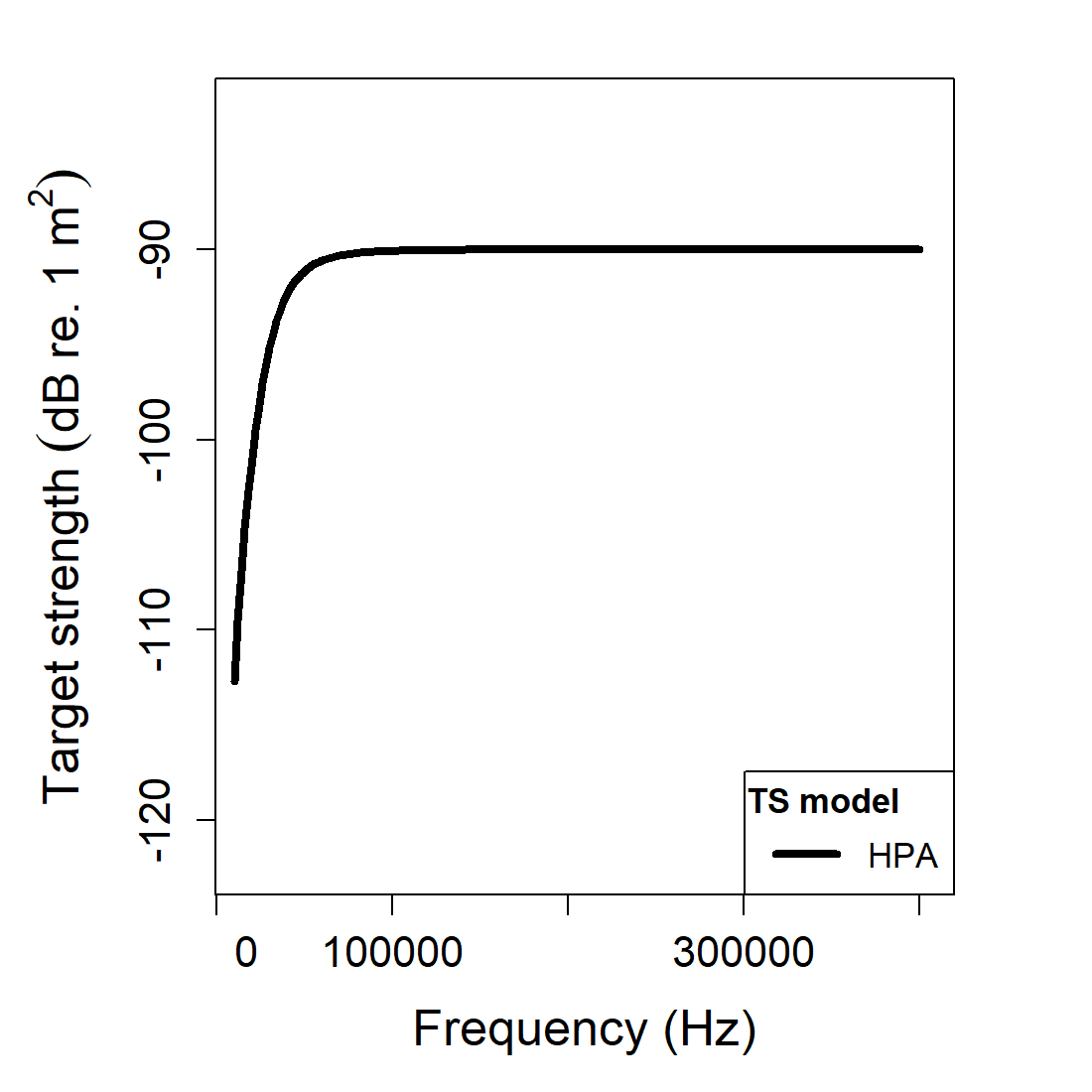
Model results can be extracted either visually or directly through
extract().
Accessing results
johnson_results <- extract(hpa_johnson, "model")$HPA
stanton_results <- extract(hpa_stanton, "model")$HPA

head(johnson_results)
## frequency sigma_bs TS
## 1 18000 5.610139e-11 -102.51026
## 2 25000 2.020199e-10 -96.94606
## 3 32000 5.047644e-10 -92.96911
## 4 39000 9.828843e-10 -90.07498
## 5 46000 1.584067e-09 -88.00227
## 6 53000 2.208800e-09 -86.55844
head(stanton_results)## frequency sigma_bs TS
## 1 18000 5.373935e-11 -102.69708
## 2 25000 1.744142e-10 -97.58418
## 3 32000 3.617171e-10 -94.41631
## 4 39000 5.552833e-10 -92.55485
## 5 46000 7.068360e-10 -91.50681
## 6 53000 8.089283e-10 -90.92090At this stage, it helps to inspect more than just the plotted curve.
Readers should check that the result object contains the expected
frequencies, that the returned target-strength levels are physically
plausible for the assumed target size and contrast, and that comparisons
are being made in the intended domain. HPA results are often discussed
in TS, but for some comparisons it is more informative to
examine sigma_bs in the linear domain as well.
Comparison workflows
Sphere formulations
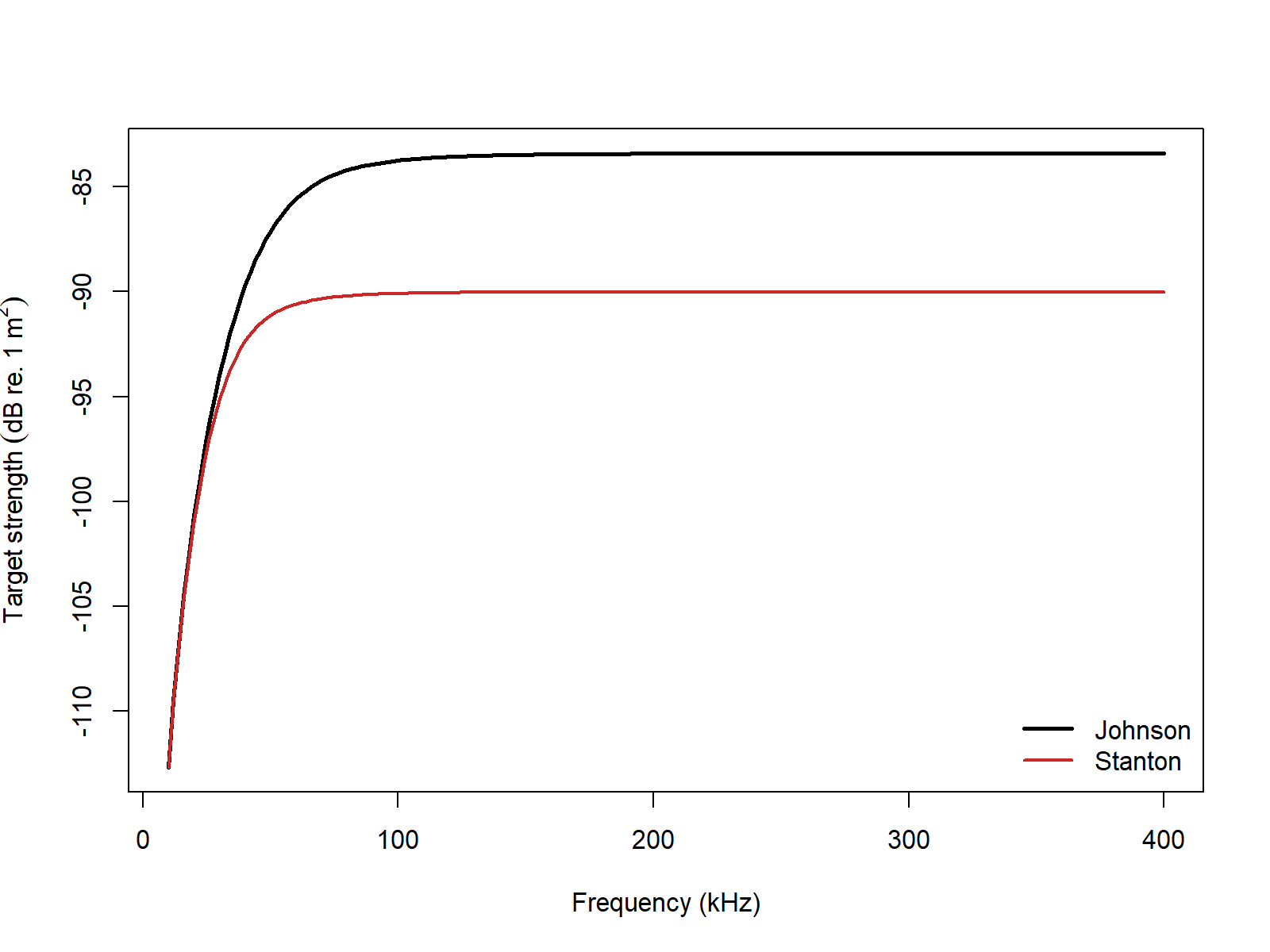
This comparison is most useful as a model-behavior check. Because the geometry and material properties are the same, any difference between the curves reflects the difference between the compact sphere interpolation of Johnson (1977) and the more general asymptotic form of Stanton (1989). That makes the comparison a good way to judge whether the added flexibility of the Stanton (1989) formulation materially changes the interpretation over the frequency band of interest.
Elongated-body Stanton formulation
The stanton method is the one to use when the shape is
not spherical.
cylinder_shape <- cylinder(
  length_body = 25e-3,
  radius_body = 2e-3,
  n_segments = 60
)

elongated_object <- fls_generate(
  shape = cylinder_shape,
  density_body = 1045,
  sound_speed_body = 1520,
  theta_body = pi / 2
)

elongated_object <- target_strength(
  object = elongated_object,
  frequency = seq(18e3, 200e3, by = 7e3),
  model = "hpa",
  method = "stanton",
  deviation_fun = 1,
  null_fun = 1
)

head(extract(elongated_object, "model")$HPA)
## frequency sigma_bs TS
## 1 18000 7.500806e-11 -101.24892
## 2 25000 2.615103e-10 -95.82511
## 3 32000 6.321965e-10 -91.99148
## 4 39000 1.208685e-09 -89.17687
## 5 46000 1.964059e-09 -87.06845
## 6 53000 2.842944e-09 -85.46232This second example shows one of the main reasons the Stanton (1989) formulation is useful in practice. It extends the same asymptotic logic to elongated shapes without forcing the user into a sphere-only approximation. That does not make it exact for every elongated target, but it does allow gross geometric effects such as aspect ratio and orientation to enter the approximation in a structured way.
When fitting HPA behavior to measurements, the first quantities to revisit are usually:
- the shape choice, because the geometric prefactor is part of the approximation itself,
- the orientation, because elongated targets can change coherence and projected response substantially with angle, and
- the empirical
deviation_funandnull_fun, because those control how aggressively the approximation departs from the default smooth-response form.
Those checks are especially helpful when HPA is being used alongside more detailed models. A disagreement does not automatically mean the HPA run is wrong. It may simply indicate that the question has moved beyond the regime where an asymptotic interpolation is the most informative representation.
Benchmark comparisons
HPA is an approximation family, not an exact boundary-value solution. The table compares its broad response with the weakly scattering benchmark curves summarized by Jech et al. (2015).
| Case | Max abs. \Delta TS (dB) | Mean abs. \Delta TS (dB) |
|---|---|---|
| Johnson (1977) sphere | 42.20232 | 6.34274 |
| Stanton (1989) sphere | 35.46445 | 5.48942 |
| Stanton (1989) prolate spheroid | 46.13636 | 5.57418 |
| Stanton (1989) cylinder | 46.97943 | 5.65639 |
Those numbers make the role of HPA very clear. It is extremely fast, but it is not a mode-by-mode benchmark reproducer. Its value is in reproducing broad asymptotic trend and scale, not in matching the exact benchmark null structure or narrow resonant detail of the benchmark curves summarized by Jech et al. (2015).
The other documented HPA arguments, deviation_fun and
null_fun, are empirical fitting controls rather than
canonical benchmark switches. Johnson (1977), Stanton (1989), and Jech
et al. (2015) do not prescribe a single authoritative benchmark
parameterization for those functions, so this implementation page keeps
them at their neutral value of 1 when reporting \Delta TS benchmark summaries. That leaves
method and target geometry as the defensible comparison
dimensions for validation.
Treat those arguments as a separate sensitivity or calibration
exercise. First check the base formula with
deviation_fun = 1 and null_fun = 1. Then test
whether an empirical adjustment improves agreement with a specified
dataset.
Cross-software and formula checks
echoSMs::HPModel provides a software comparison for the
spherical Stanton (1989) branch (Macaulay and
contributors 2024). For the other HPA paths, the
validation target is the published Johnson and Stanton algebra. The
echoSMs version used for this comparison did not return prolate-spheroid
or cylinder spectra, so those cells are reported as
N/A.
| Case | Mean abs. \Delta
acousticTS vs echoSMs (dB) |
Max abs. \Delta
acousticTS vs echoSMs (dB) |
Mean abs. \Delta vs published algebra (dB) | Max abs. \Delta vs published algebra (dB) |
|---|---|---|---|---|
| Johnson (1977) sphere | N/A |
N/A |
2.33e-13 | 2.98e-13 |
| Stanton (1989) sphere | 3.43e-14 | 4.69e-13 | 3.43e-14 | 4.69e-13 |
| Stanton (1989) prolate spheroid | N/A |
N/A |
2.46e-14 | 1.28e-13 |
| Stanton (1989) cylinder | N/A |
N/A |
2.39e-14 | 8.53e-14 |
The HPA picture is explicit. The spherical Stanton branch agrees with the available external software implementation to practical machine precision, and every canonical branch matches the published Johnson (1977) or Stanton (1989) algebra to the same order. That does not make HPA an exact replacement for the benchmarked modal-series models above, but it does confirm that the package is implementing the intended asymptotic formulas correctly.