Skip to contents

Introduction

The bundled example objects are anchored to published fish, krill, and benchmark resources that make it easier to reproduce known workflows before introducing custom geometry (clay_horne_1994?; mcgehee_effects_1998?; jech_etal_2015?).

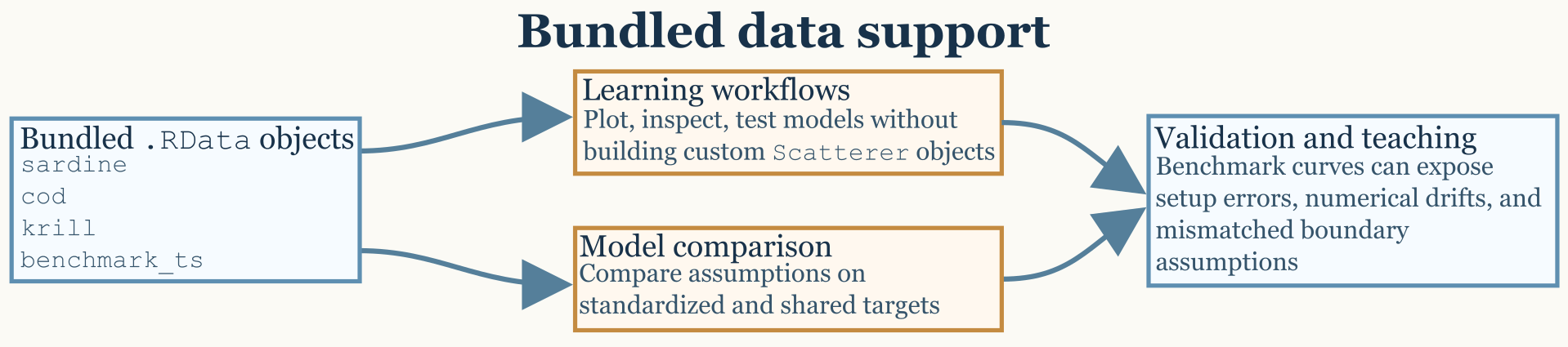
The package includes bundled data objects that are useful for learning the workflow, benchmarking model behavior, and reproducing examples without first building every target from scratch. Those objects are not meant to replace careful object construction, but they do reduce the distance between installation and a meaningful first calculation.

Example data workflow map

Bundled objects

The most obvious data entry points are sardine, cod, krill, and benchmark_ts. These objects are valuable because they span different target types and different use cases. Some are pre-built scatterers meant for workflow practice, while others are benchmark resources meant for validation and regression-style checking.

The important thing is that these datasets do not all play the same role. sardine and cod are composite fish-like targets. krill is a fluid-like elongated target. benchmark_ts is not a scatterer at all, but a stored collection of benchmark model outputs.

What each dataset actually contains

The sardine dataset is a pre-generated SBF scatterer representing a sardine-like target with a fully inflated swimbladder. Its stored structure includes separate body and bladder components, each with its own position matrix, material properties, and orientation. The associated shape_parameters slot also preserves body and swimbladder lengths and the number of discrete cylinders used to represent each component. The packaged geometry follows the sardine entry distributed through the NOAA Fisheries KRM reference collection and archived in echoSMs, and the object metadata identifies the target as Sardinops sagax caerulea following Conti and Demer (2003). That makes sardine especially useful when the goal is to practice workflows for anatomically composite fish-like targets rather than for single-component bodies.

The cod dataset plays a similar role. It is also a pre-generated SBF scatterer with separate body and swimbladder components and with the same general object structure: metadata, model-parameter container, model-results container, body component, bladder component, and shape metadata. In practical terms, the packaged object corresponds to the Atlantic cod example used by Clay and Horne (1994) and matches the Cod D entry preserved in the historical KRM shape collection archived in echoSMs. Because both cod and sardine are composite fish-like objects, they are natural starting points for workflows in which a user wants to inspect component structure, test fish-body modeling assumptions, or compare body-plus-bladder targets against simpler approximations.

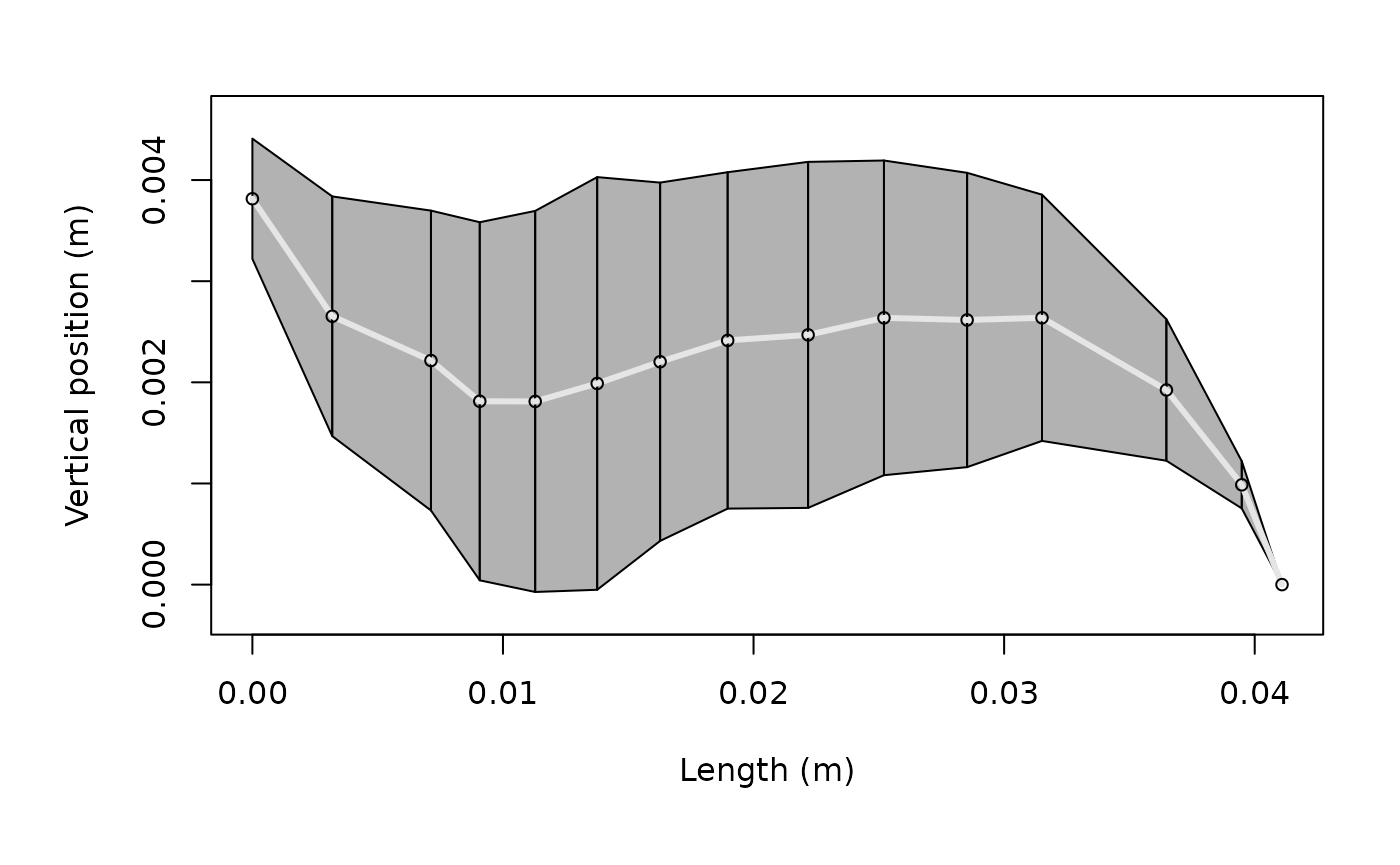
The krill dataset is different. It is a pre-generated FLS scatterer representing a krill-like body shape based on the McGehee et al. (1998) geometry. Instead of separate body and bladder components, it stores a single fluid-like body with a position matrix, local cylinder radii, density contrast g, sound-speed contrast h, and an orientation angle. Its shape_parameters record body length, number of cylinders, and units. This makes krill a natural demonstration object for DWBA, SDWBA, and related weak-scattering workflows.

The benchmark_ts dataset serves a different purpose again. It is a packaged list of benchmark model outputs associated with Jech et al. (2015). In practical package use, it functions as a stored reference resource rather than as a target object. The validation workflow uses it to compare canonical model outputs against expected benchmark curves, especially for sphere, finite-cylinder, and prolate-spheroid cases. The packaged object follows the Jech benchmark definitions and tabulated comparison curves as archived in the echoSMs reference resources.

Why example objects matter

Bundled objects shorten the distance between installation and a meaningful first model run. They also make it easier to compare the behavior of different models on a shared target definition, which is often the cleanest way to understand whether a discrepancy comes from model assumptions or from the target itself. Because the objects are already part of the package, they also make it easier to write reproducible examples that do not rely on external files or undocumented preprocessing steps.

They are especially useful because they expose several distinct object patterns that recur throughout the package. A user can see what a composite SBF object looks like by inspecting sardine or cod, and can see what a fluid-like segmented FLS object looks like by inspecting krill. That object-level familiarity makes later custom workflows much easier.

A practical way to use them

For a first pass, it is often useful to treat the example objects as workflow fixtures rather than as final scientific targets. Load the object, inspect its structure, run or review a model call, and then compare the plotted result against your physical expectations. Once that sequence is comfortable, the same workflow can be transferred to custom shapes and scatterers with much less risk of confusing a setup error for a model problem.

For example, sardine and cod are useful when learning how composite fish-like scatterers are organized and when checking workflows that depend on separate body and bladder geometry. krill is useful when learning elongated fluid-like workflows and when exploring how orientation or weak-scattering assumptions affect model output. benchmark_ts is most useful when the question is whether a known reference solution can be reproduced rather than whether a target object can be manipulated.

The benchmark-oriented dataset deserves a slightly different mindset from the pre-built scatterers. When using benchmark_ts, the goal is not simply to obtain a plausible curve. The goal is to verify agreement with a stored reference under the same assumptions, grid, and numerical settings.

Why these distinctions help

These datasets are most helpful when they are matched to the right question. If the question is “what does an SBF object look like in practice?”, then sardine or cod are natural starting points. If the question is “what does a weakly scattering elongated target look like in object form?”, then krill is the better choice. If the question is “can a canonical benchmark curve be reproduced?”, then benchmark_ts is the relevant dataset.

That distinction may sound small, but it often determines whether a user reaches for the right example at the right stage of the workflow.