
Finite cylinder modal series solution (FCMS) theory
Source:vignettes/fcms/fcms-theory.Rmd
fcms-theory.RmdIntroduction
The finite-cylinder modal-series solution (FCMS) combines an exact cylindrical-harmonic solution for a circular cross-section with an approximate finite-axis coherence factor (Stanton 1988, 1989). It does not solve the fully three-dimensional endcap problem.
The construction has two pieces:
- an exact two-dimensional modal solution for the circular cross-section, and
- a finite-length axial phase integral that accounts for the coherent summation of contributions along a segment of length L.
In the cross-sectional problem, a rigid cylinder enforces zero normal velocity at r = a, a pressure-release cylinder enforces zero pressure there, and a fluid-filled cylinder enforces continuity of pressure and normal velocity between the exterior and interior media. The role of this vignette is to show how those cylindrical boundary conditions determine the coefficients B_m and how the resulting cross-sectional response is combined with finite-axis coherence.
Medium 1 is the surrounding fluid and medium
2 is the cylinder interior.
Symbols and medium indexing follow Notation and Symbols. The interface conditions used below are contextualized in Boundary Conditions.
Physical basis of the FCMS
Infinite-cylinder scattering as the local starting point
The FCMS begins from the exact two-dimensional scattering problem for an infinite cylinder. In that reduced problem, the acoustic pressure satisfies the Helmholtz equation on the circular cross-section and the field separates naturally in polar coordinates (r,\phi). Each azimuthal order m then contributes an independent cylindrical harmonic, and the boundary condition at the cylinder surface r=a determines the corresponding modal coefficient.
That part of the construction is exact for the idealized cross-section. If the radius is constant and the material properties do not vary around the circumference, the cross-sectional modal basis is the natural one, and the boundary-value problem is solved mode by mode without approximation.
The finite-cylinder step is different. The model assumes that the local cross-sectional response can be extended uniformly along a straight axis over a finite interval of length L. The endcaps are therefore not resolved as independent scattering surfaces in a fully coupled three-dimensional solution. Instead, their main effect is represented through longitudinal phase accumulation and cancellation. The three-dimensional backscatter is then built by multiplying the exact cross-sectional modal response by the coherent axial phase integral for a finite segment.
Why the factorization works
This factorization is most natural when the cylinder is straight, of constant radius, and sufficiently regular that the dominant finite-length effect is phase cancellation along the axis rather than strong endcap scattering that feeds back into the entire boundary solution. In that regime, the circular cross-section controls the local scattering physics, while the finite axis controls how those local contributions add coherently in the backscattering direction.
The FCMS is therefore exact with respect to the circular cross-section but approximate with respect to the endcaps. That distinction matters physically. If the scientific question depends mainly on how material contrast and radius control the modal structure of the circular cross-section, FCMS is often very useful. If the question depends strongly on detailed end geometry or on full three-dimensional coupling near the cylinder tips, then the separated finite-axis factor becomes the main approximation to keep in mind.
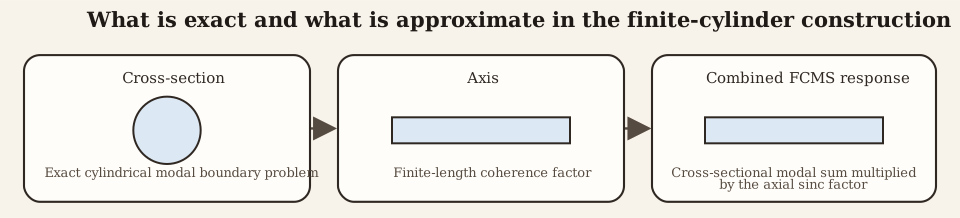
The construction therefore has two distinct layers. The circular cross-section determines the cylindrical modal coefficients B_m. The finite axis of length L and the orientation angle \theta contribute the separate coherence factor \sin(kL\cos\theta)/(kL\cos\theta). Radius a, transverse wavenumber K = k\sin\theta, and the axial phase scale kL\cos\theta are the variables that keep those two layers connected without turning them into the same approximation.
Finite-cylinder reduction
Geometry and orientation
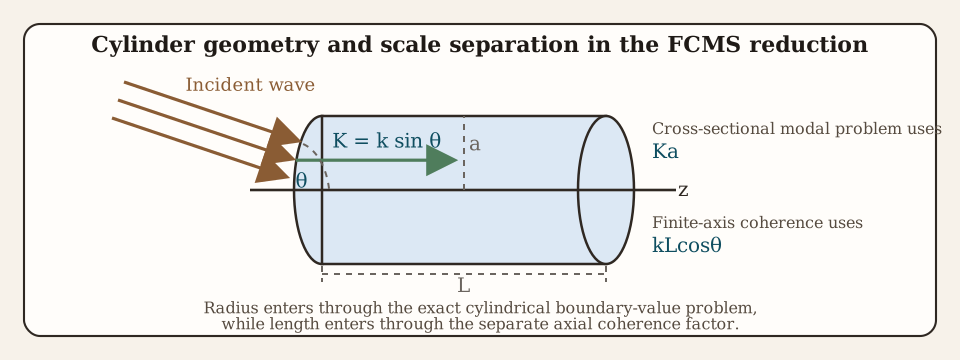
Consider a cylinder of radius a and length L. Let \theta denote the angle between the cylinder axis and the incident direction, so that \theta = \pi/2 corresponds to broadside incidence and \theta \to 0 corresponds to a direction increasingly aligned with the cylinder axis. Let k = \omega/c_1 denote the exterior acoustic wavenumber in the surrounding fluid of sound speed c_1.
The component of the incident wavenumber normal to the axis is:
K = k\sin\theta,
while the phase variation along the axis is controlled by:
kL\cos\theta.
Thus the cross-sectional scattering depends on the transverse size parameter Ka, while the finite-length directivity depends on the longitudinal phase difference kL\cos\theta. This separation of scale variables is one of the simplest ways to understand the model: radius enters through the cylindrical boundary-value problem, whereas length enters through coherent summation along the axis.
Axial integration
If the cross-sectional scattering amplitude is taken to be uniform along the cylinder, then integrating the two-way phase factor along the axis gives:
\int_{-L/2}^{L/2} e^{2ikz\cos\theta}\,dz = L\frac{\sin(kL\cos\theta)}{kL\cos\theta}.
This is the origin of the finite-length directivity factor. It is exactly the same sinc response that appears whenever a uniformly weighted segment is integrated coherently. The argument kL\cos\theta states how much phase is accumulated from one end of the cylinder to the other in the backscattering geometry.
Therefore the backscattering amplitude is written as:
\mathcal{f}_\text{bs} = -\frac{L}{\pi} \frac{\sin(kL\cos\theta)}{kL\cos\theta} \sum_{m=0}^{\infty} i^{m+1}B_m.
The derivation of the model is therefore reduced to deriving the cross-sectional modal coefficients B_m.
The modal sum enforces the boundary condition around the circumference. The sinc factor describes interference among those local responses along a finite segment. It does not resolve the endcaps as coupled scattering surfaces.
Cylindrical modal expansion
Separation of variables on the cross-section
For the infinite-cylinder cross-section, the acoustic pressure satisfies:
\nabla^2 p + K^2p = 0,
where K=k\sin\theta is the transverse wavenumber. In polar coordinates (r,\phi):
\frac{\partial^2 p}{\partial r^2} + \frac{1}{r}\frac{\partial p}{\partial r} + \frac{1}{r^2}\frac{\partial^2 p}{\partial\phi^2} + K^2p = 0.
Writing the cross-sectional field as a product of radial and angular factors:
p(r,\phi) = R(r)\Phi(\phi).
Substituting and dividing by R\Phi gives:
r^2\frac{R''}{R} + r\frac{R'}{R} + K^2r^2 = -\frac{\Phi''}{\Phi}.
Since the left-hand side depends only on r and the right-hand side only on \phi, both must equal the same separation constant, say m^2. Hence:
\Phi'' + m^2\Phi = 0,
with periodic solutions \cos(m\phi) and \sin(m\phi), and the radial equation:
r^2R'' + rR' + (K^2r^2-m^2)R = 0.
This is Bessel’s equation, whose solutions are J_m(Kr), Y_m(Kr), and the outgoing combination H_m^{(1)}(Kr) (Folver and Maximon 2026). Regularity at the axis r=0 excludes the singular solution Y_m from the incident and interior regular fields, while the outgoing radiation condition selects the Hankel function of the first kind for the scattered field (Sommerfeld 1949).
Incident field in cylindrical coordinates
For the cross-sectional problem, the incident plane wave is expanded in cylindrical harmonics:
e^{iKr\cos\phi} = \sum_{m=0}^{\infty} \epsilon_m i^m J_m(Kr)\cos(m\phi),
where the Neumann factor is:
\epsilon_0 = 1, \qquad \epsilon_m = 2 \quad (m\ge1).
This expansion is the cylindrical counterpart of the spherical partial-wave expansion of a plane wave.
The Neumann factor \epsilon_m permits the cosine series to be written over nonnegative mode numbers while retaining the contributions from positive and negative angular orders.
Scattered field
The outgoing scattered field is expanded as:
p_{scat}(r,\phi) = \sum_{m=0}^{\infty} \epsilon_m i^m B_m H_m^{(1)}(Kr)\cos(m\phi).
The coefficients B_m are determined by the boundary condition on the cylinder surface r=a.
Because the cosine functions are orthogonal on 0 \le \phi \le 2\pi, each azimuthal order can be solved independently once the relevant boundary condition is imposed. That mode independence is one of the main practical advantages of the circular geometry. The FCMS does not require a coupled dense matrix across all azimuthal orders. Instead, one solves either a scalar modal equation or, for fluid-filled cylinders, a small mode-local system.
Explicitly, the orthogonality relation is:
\int_0^{2\pi} \cos(m\phi)\cos(n\phi)\,d\phi = \begin{cases} 2\pi, & m=n=0, \\ \pi, & m=n\ge 1, \\ 0, & m\ne n. \end{cases}
This is the reason the boundary condition decouples mode by mode.
Boundary-condition derivations
Fixed rigid cylinder
For a rigid cylinder, the surface does not admit normal motion. In an inviscid acoustic fluid, normal particle velocity is proportional to the normal pressure gradient, so on the circular boundary r=a the condition becomes:
\left.\frac{\partial}{\partial r}(p_{inc}+p_{scat})\right|_{r=a}=0.
Using the cylindrical modal expansion and orthogonality of the cosine functions gives, for each m:
J_m'(Ka) + B_m H_m^{(1)\prime}(Ka)=0.
The rigid-boundary coefficient is therefore:
B_m = -\frac{J_m'(Ka)}{H_m^{(1)\prime}(Ka)}.
Including the parity convention of the backscattering geometry yields the usual coefficient form:
B_m = (-1)^m\epsilon_m\frac{J_m'(Ka)}{H_m^{(1)\prime}(Ka)}.
Pressure-release cylinder
For a pressure-release boundary, total pressure vanishes at the surface:
p_{inc}(a,\phi)+p_{scat}(a,\phi)=0.
Mode by mode, this gives:
J_m(Ka) + B_m H_m^{(1)}(Ka)=0,
The pressure-release coefficient is therefore:
B_m = -\frac{J_m(Ka)}{H_m^{(1)}(Ka)}.
Again including the backscattering parity convention gives:
B_m = (-1)^m\epsilon_m\frac{J_m(Ka)}{H_m^{(1)}(Ka)}.
Fluid-filled cylinder
For a fluid-filled cylinder, the interior field must also be expanded because the incident wave excites pressure fluctuations inside the cylinder as well as outside it. Let \rho_1 and c_1 denote the exterior density and sound speed, and let \rho_2 and c_2 denote the corresponding interior properties. Define the density contrast g_{21}=\rho_2/\rho_1 and sound-speed contrast h_{21}=c_2/c_1.
The interior transverse wavenumber is then:
K' = \frac{K}{h_{21}},
where h_{21}=c_2/c_1 is sound-speed contrast. The interior field is then written as:
p_{int}(r,\phi) = \sum_{m=0}^{\infty}\epsilon_m i^m C_m^{(int)} J_m(K'r)\cos(m\phi).
At the boundary r=a, continuity of pressure gives:
J_m(Ka) + B_m H_m^{(1)}(Ka) = C_m^{(int)}J_m(K'a),
and continuity of normal velocity gives:
\frac{K}{\rho_1}\left[J_m'(Ka)+B_m H_m^{(1)\prime}(Ka)\right] = \frac{K'}{\rho_2}C_m^{(int)}J_m'(K'a).
Solving the pressure-continuity equation for the interior coefficient gives:
C_m^{(int)} = \frac{J_m(Ka)+B_mH_m^{(1)}(Ka)}{J_m(K'a)}.
Substituting this into the velocity condition gives:
J_m'(Ka)+B_mH_m^{(1)\prime}(Ka) = \\ \frac{1}{g_{21}h_{21}}\frac{J_m'(K'a)}{J_m(K'a)} \left[J_m(Ka)+B_mH_m^{(1)}(Ka)\right],
where g_{21}=\rho_2/\rho_1 and h_{21}=c_2/c_1. Rearranging yields:
B_m \left[H_m^{(1)\prime}(Ka)-\frac{1}{g_{21}h_{21}}\frac{J_m'(K'a)}{J_m(K'a)}H_m^{(1)}(Ka)\right] = \\ \frac{1}{g_{21}h_{21}}\frac{J_m'(K'a)}{J_m(K'a)}J_m(Ka)-J_m'(Ka).
Solving for the exterior scattering coefficient gives:
B_m = \frac{\dfrac{1}{g_{21}h_{21}}\dfrac{J_m'(K'a)}{J_m(K'a)}J_m(Ka)-J_m'(Ka)} {H_m^{(1)\prime}(Ka)-\dfrac{1}{g_{21}h_{21}}\dfrac{J_m'(K'a)}{J_m(K'a)}H_m^{(1)}(Ka)}.
After expressing the Hankel function as:
H_m^{(1)} = J_m + iY_m,
and separating real and imaginary parts, this coefficient is commonly rewritten as:
B_m = -\frac{\epsilon_m}{1+iC_m},
The auxiliary ratio is:
C_m = \frac{ \left[J_m'(K'a)Y_m(Ka)\right]/\left[J_m(K'a)J_m'(Ka)\right] - g_{21}h_{21}\left[Y_m'(Ka)/J_m'(Ka)\right] }{ \left[J_m'(K'a)J_m(Ka)\right]/\left[J_m(K'a)J_m'(Ka)\right] - g_{21}h_{21} }.
Multiplying the preceding numerator and denominator by g_{21}h_{21} and separating H_m^{(1)}=J_m+iY_m produces this auxiliary ratio. Thus the g_{21}h_{21} factors in C_m are consistent with the reciprocal factor in the normal-velocity equation.
The physics is the same as for any fluid-fluid modal scattering problem: one imposes continuity of pressure and normal velocity, solves for the unknown interior coefficient, and substitutes back to obtain the scattered-field coefficient. The difference from the rigid and pressure-release cases is that the boundary condition couples exterior and interior fields rather than imposing a single vanishing quantity at the boundary.
The associated linear algebra remains mode-local. For each azimuthal order m, the rigid and pressure-release boundaries give a single scalar coefficient equation, while the fluid-filled boundary gives a 2\times2 system for the exterior and interior amplitudes. Unlike problems with noncircular cross-sections, no cross-mode coupling appears here because the circular boundary preserves the orthogonality of the cylindrical harmonics exactly.
Modal truncation
The modal series is infinite, but at finite acoustic size only a finite number of modes contribute materially. The required number of retained modes grows with Ka, reflecting the broader angular spectrum of larger cylinders as the cross-sectional acoustic size increases.
A practical truncation rule is of the form:
m_{max} \approx \lceil ka \rceil + C,
with a modest positive constant C chosen to ensure convergence.
Once m_{\max} is fixed, solve the scalar or 2\times2 coefficient problem for each m=0,1,\ldots,m_{\max}, evaluate the cross-sectional modal sum, and apply the finite-length coherence factor. Truncation does not create a dense cross-mode system.
Truncation leaves the boundary condition unchanged. Too few modes under-resolve the cross-sectional field, especially at larger acoustic size.
Backscattering cross-section and target strength
Once the modal sum is evaluated:
\sigma_\text{bs} = |\mathcal{f}_\text{bs}|^2,
The corresponding target strength is (MacLennan et al. 2002):
TS = 10\log_{10}\left( \frac{\sigma_\text{bs}}{1\ \mathrm{m}^2}\right).
Mathematical assumptions
The FCMS rests on several assumptions:
- The cross-sectional scattering is represented by the infinite-cylinder modal solution.
- The finite length enters through a separate axial phase integral.
- The cylinder is straight and of uniform radius.
- Material properties are homogeneous within each region.
- Linear acoustics applies.
These assumptions explain both the strength and the limitation of the FCMS. It captures boundary-condition physics around the cylinder surface exactly within the cross-sectional modal description, but it treats the finite length through a separated directivity factor rather than through a fully three-dimensional separable solution.
FCMS therefore has exact circular-boundary physics within its cross-sectional problem and approximate finite-length physics. Strongly varying radii, influential endcaps, or axial material variation fall outside that factorization.