
SOEMS theory for a solid calibration sphere
Source:vignettes/calibration/calibration-theory.Rmd
calibration-theory.RmdIntroduction
Standard-target calibration uses a target whose backscatter can be predicted independently of the echosounder (Foote 1990; Demer et al. 2015). Tungsten carbide spheres are common in fisheries acoustics, while copper, aluminum, steel, and other elastic solids are used for particular frequency ranges and calibration requirements (Foote 1982; MacLennan 1981).
The surrounding fluid supports acoustic pressure, while the solid
supports longitudinal and shear motion. Matching those fields at a
spherical interface produces the elastic resonances used in the
SOEMS calculation (Hickling 1962).
Symbols and medium indexing follow Notation and Symbols. Material inputs for calibration standards are covered in Material Properties.
Governing fields
In the surrounding fluid, the acoustic pressure field, p(\mathbf{x}, \omega), satisfies the scalar Helmholtz equation:
\nabla^2p + k^2_{1}p = 0,
where \omega is angular frequency, \mathbf{x}=(r,\theta,\varphi) is position in spherical coordinates, c_1 is the exterior sound speed, and k_1=\omega/c_1. In Cartesian components, the gradient is:
\nabla = \left( \frac{\partial}{\partial x} , \frac{\partial}{\partial y} , \frac{\partial}{\partial z} \right).
Within the solid elastic sphere, the displacement field \mathbf{u}(\mathbf{x}, \omega) satisfies the Navier equation:
(\lambda + 2 \mu)\nabla(\nabla \cdot \mathbf{u}) - \mu \nabla \times (\nabla \times \mathbf{u}) + \rho_2 \omega^2 \mathbf{u} = 0,
where \lambda and \mu are the Lamé elastic constants and \rho_2 is the sphere density. The elastic field is then decomposed into compressional and shear potentials:
\mathbf{u} = \nabla \phi + \nabla \times \mathbf{\Psi}.
After that decomposition, the interior problem separates into two Helmholtz equations:
\nabla^2 \phi + k_\ell^2 \phi = 0, \qquad \nabla^2 \mathbf{\Psi} + k_\tau^2 \mathbf{\Psi} = 0,
where k_\ell=\omega/c_\ell and k_\tau=\omega/c_\tau are the longitudinal and transverse wavenumbers. Both potentials contribute to the fluid-solid interface conditions (Achenbach 1973).
Separability of the Helmholtz equation in spherical coordinates
Because the geometry is spherical, the exterior and interior Helmholtz equations are separable in spherical coordinates. For a sphere centered at the origin, their solutions can be written as products of single-variable functions:
\psi(r, \theta, \varphi) = R(r) \Theta(\theta) \Phi(\varphi).
This separation leads to angular eigenfunctions that are spherical harmonics, \mathcal{Y}^n_m(\theta, \varphi), and radial functions that are spherical Bessel or Hankel functions. Thus the separable solutions take the form:
\psi(r, \theta, \varphi) = \sum_{m=0}^\infty \sum_{n = -m}^m R_m(r) \mathcal{Y}_{m}^n(\theta, \varphi),
where the radial solutions (R_m(r)) correspond to j_m(kr) and h_m^{(1)}(kr) for the regular solutions and outgoing waves, respectively. In this notation, m represents the angular mode number and n is the azimuthal order.
For axisymmetric plane-wave incidence, the angular dependence reduces to Legendre polynomials, so each field can be written as a modal sum over angular order m:
\psi(r,\theta) = \sum_{m=0}^{\infty} R_m(r) P_m(\cos \theta),
where P_m is the Legendre polynomial of degree m. Consequently, the spatial dependence of each field can be decomposed into independent radial and angular parts.
Modal field expansion
Because the angular functions P_m(\cos \theta) are orthogonal, the boundary conditions at surface r = a decouple by angular order:
\int\limits_{-1}^1 P_n(\mu) P_m(\mu) d\mu = 0 ~ \text{for } n \neq m, \quad \mu = \cos \theta
where a is the sphere radius. The boundary conditions then enforce:
\begin{aligned} \mathbf{u}_2(r) &= \mathbf{u}_1(r) ~ \text{(continuity of normal displacement)} , \\ \sigma_{rr}^{(2)} &= -p_1 ~ \text{(continuity of normal stress)} , \\ \sigma_{r\theta}^{(2)} &= 0 ~ \text{(zero tangential stress)} , \end{aligned}
where \sigma_{rr}^{(2)} is the normal solid traction and \sigma_{r\theta}^{(2)} is its tangential component.
For axisymmetric incidence, write the exterior pressure as the known incident field plus an outgoing modal expansion:
p_1(r,\theta) = p_{\mathrm{inc}}(r,\theta) + P_0\sum_{m=0}^{\infty}(2m+1)i^m B_m h_m^{(1)}(k_1r)P_m(\cos\theta).
Projecting each interface condition onto the Legendre basis gives:
\int\limits_{-1}^1 P_m(\cos \theta)\underbrace{(\text{boundary condition})}_{\text{function of }\theta} d(\cos \theta),
where orthogonality removes contributions from every degree other than the projected degree. Here h_m^{(1)} is the outgoing spherical Hankel function and B_m is its scattering coefficient.
The interior elastic potentials are expanded with regular spherical Bessel functions:
\phi(r,\theta) = \sum_{m=0}^{\infty} C_m j_m(k_\ell r) P_m(\cos \theta), \qquad \mathbf{\Psi}(r,\theta) = \sum_{m=0}^{\infty} D_m j_m(k_\tau r) P_m(\cos \theta).
The unknown coefficients B_m, C_m, and D_m are determined by the boundary conditions at the sphere surface.
Boundary conditions
At the fluid-solid interface r = a, the calibration sphere problem imposes continuity of normal displacement, continuity of normal stress, and vanishing tangential traction on the fluid side:
u_r^{(2)} = u_r^{(1)}, \qquad \sigma_{rr}^{(2)} = -p_1, \qquad \sigma_{r\theta}^{(2)} = 0.
These conditions couple the exterior acoustic field to the compressional and shear motions inside the sphere. After projection onto a single Legendre mode, the boundary conditions reduce to a small linear algebra problem for each angular order:
\mathbf{M}_m \left[ \begin{matrix} B_m \\ C_m \\ D_m \end{matrix} \right] = \mathbf{F}_m,
where \mathbf{M}_m is a mode-dependent coefficient matrix and \mathbf{F}_m is a forcing vector determined by the incident field. This linear system is used to solve for B_m, which is ultimately the scattering coefficient for that mode, as a function of the incident field and material properties.
Far-field scattering
Place a point source at r_0 on the negative polar axis. Its field admits the addition-theorem expansion (Hickling 1962):
\begin{aligned} p_\text{inc}(r, \theta) &= P_0 \frac{e^{-i k_1 \mathcal{D}}}{\mathcal{D}} \\ &= ik_1 P_0 \sum\limits_{m=0}^\infty (2m + 1) (-1)^m j_m(k_1r) h_m^{(1)}(k_1 r_0) P_m(\cos \theta), \quad (0 < r < r_0), \end{aligned}
where k_1 = \omega / c_1 is the acoustic wavenumber in the surrounding fluid, P_0 is the incident pressure amplitude, and the function \mathcal{D} is defined explicitly as:
\mathcal{D} = \left(r_0^2 + 2 r r_0 \cos \theta + r^2 \right)^{1/2}.
Here, r is the radial distance from the origin to the field point, r_0 is the distance from the origin to the source point, and \theta is the polar angle measured from the positive z-axis to the position vector of the field point. The source is taken to lie along the negative z-axis. The quantity \mathcal{D} therefore represents the distance between the source and the field point.
This spherical source is an intermediate construction. Moving it to
the far field while holding its incident amplitude fixed produces the
plane wave used by SOEMS.
Using the spherical-wave addition theorem, the incident field can be expanded as: p_\text{inc}(r, \theta) = i k_1 P_0 \sum\limits_{m=0}^\infty (2m + 1)(-1)^m j_m(k_1 r)\, h_m^{(1)}(k_1 r_0)\, P_m(\cos \theta), \quad (0 < r < r_0).
In the limit that the source is far from the scattering region (r_0 \to \infty), the incident field approaches a plane wave. This allows h^{(1)}_m(k_1r_0) and \frac{e^{-i k_1 \mathcal{D}}}{\mathcal{D}} to be expressed using asymptotic forms: h_m^{(1)}(k_1 r_0) \sim (-i)^{m+1} \frac{e^{i k_1 r_0}}{k_1 r_0}, \qquad \frac{e^{-i k_1 \mathcal{D}}}{\mathcal{D}} \sim e^{i k_1 r_0} \frac{e^{i k_1 r \cos \theta}}{r_0}.
Consequently, the incident field reduces to: p_\text{inc}(r, \theta) = P_0 e^{i k_1 r \cos \theta},
which has the standard plane-wave expansion:
p_\text{inc}(r, \theta) = P_0 \sum\limits_{m=0}^\infty (2m + 1) i^m j_m(k_1 r) P_m(\cos \theta).
The same limit can be shown by collecting the two asymptotic relations. Here \mathcal D remains the source-to-field distance, i=\sqrt{-1}, and P_0 is the incident pressure amplitude:
\begin{aligned} \frac{e^{-i k_1 \mathcal{D}}}{\mathcal{D}} &\sim e^{ik_1 r_0} \frac{e^{i k_1 r \cos \theta}}{r_0}, \\ h_m^{(1)}(k_1r_0) &\sim (-i)^{m+1} \frac{e^{i k_1 r_0}}{k_1r_0}. \end{aligned}
They reproduce the plane-wave limit and its partial-wave expansion:
\begin{aligned} p_\text{inc}(r, \theta) &= P_0 e^{ik_1 r \cos \theta} \\ &= P_0 \sum\limits_{m=0}^\infty (2m + 1) i^m j_m(k_1 r) P_m(\cos \theta). \end{aligned}
Phase-shift form of the solution
It is often more informative to parameterize each partial wave by a real phase shift \eta_m than by the raw complex coefficient B_m (Faran 1951; Rudgers 1969). In that representation, the elastic boundary conditions determine how far the outgoing partial wave is shifted relative to the free spherical solution.
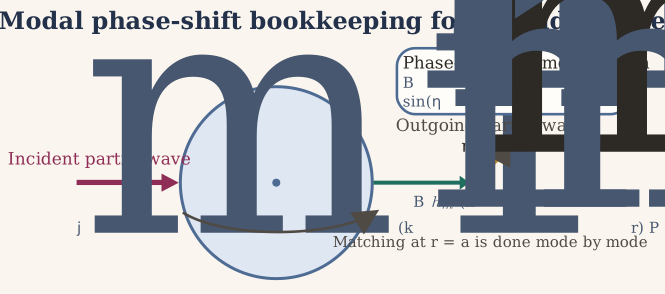
The scattered acoustic field can be expressed as a sum of partial waves: p_\text{scat}(r, \theta) = P_0 \sum\limits_{m=0}^\infty B_m h_m^{(1)}(k_1 r) P_m(\cos \theta).
In the backscattering direction where \theta = \pi, the Legendre polynomials simplify to:
P_m(\cos \pi) = P_m(-1) = (-1)^m.
It is convenient to define a phase-shift angle, \eta_m, of the mth scattered wave to compute B_m (Rudgers 1969). For each angular order, the exterior field can be recast as a regular spherical solution plus an outgoing partial wave. Matching that combination to the elastic boundary conditions determines the relative phase of the outgoing term, so the scattering problem may be parameterized by a real phase shift rather than by an unconstrained complex coefficient. This phase-shift angle is expressed using: \tan \eta_m = \tan \delta_m(k_1a) \left[ \frac{ \tan \Phi_m + \tan \alpha_m(k_1 a) }{ \tan \Phi_m + \tan \beta_m(k_1 a) } \right],
where \alpha_m, \beta_m, and \delta_m are the scattering phase-angles, and \Phi_m is the boundary impedance phase-angle. These angles are defined as: \begin{aligned} \delta_m(k_1a) &= \tan^{-1} \left[ \frac{-j_m(k_1a)}{y_m(k_1a)} \right] ,\\ \alpha_m(k_1a) &= \tan^{-1} \left[ \frac{-k_1 a ~j^\prime_m(k_1a)}{j_m(k_1a)} \right] ,\\ \beta_m(k_1a) &= \tan^{-1} \left[ \frac{-k_1 a ~y^\prime_m(k_1a)}{y_m(k_1a)} \right] , \\ \tan \Phi_m &= -\frac{\rho_1}{\rho_2} \tan \zeta_m(k_\ell a, \sigma), \end{aligned}
where \zeta_m(k_\ell a,\sigma) is the boundary-impedance phase angle induced by the elastic interior (Faran 1951). Once \eta_m is known, the source-normalized modal coefficient is:
B_m = k_1 (-1)^m (2m + 1) h_m^{(1)}(k_1 r_0) \sin \eta_m e^{-i \eta_m}.
With the finite-range phase convention used in this derivation, the corresponding intermediate form function is:
\mathcal{f}_\infty(k_1 a) = -2 \frac{k_1 r}{k_1 a} e^{i k_1 r} \sum\limits_{m=0}^\infty (-i)^{m+1} h_m^{(2)}(k_1 r) (-1)^m (2m + 1) \sin \eta_m e^{i \eta_m}.
Applying the radial far-field asymptotic and selecting the backscattering direction gives the dimensionless backscattering form function:
\mathcal{f}_\text{bs}(k_1 a) = -\frac{2}{k_1a} \sum\limits_{m=0}^\infty (-1)^m (2m + 1) \sin \eta_m e^{i \eta_m}.
The details vary by notation across the literature, but the interpretation is the same: the sphere material and elastic wave speeds determine a modal phase lag, and the total backscatter is a coherent sum over those lagged partial waves.
Backscattering length, cross-section, and target strength
Calibration literature often first defines the scattering cross-section from the dimensionless form function \mathcal f_{\mathrm{bs}}:
\sigma_s = \pi a^2 |\mathcal f_{\mathrm{bs}}|^2.
The package stores the dimensional backscattering length and its associated backscattering cross-section:
f_{\mathrm{bs}} = \frac{a}{2}\mathcal f_{\mathrm{bs}}, \qquad \sigma_{\mathrm{bs}} = |f_{\mathrm{bs}}|^2 = \frac{a^2}{4}|\mathcal f_{\mathrm{bs}}|^2 = \frac{\sigma_s}{4\pi}.
Target strength is therefore (MacLennan 1981):
\mathit{TS} = 10 \log_{10} \left(\frac{\sigma_{\mathrm{bs}}}{1\ \mathrm{m}^2}\right).
Thus the calibration convention \sigma_s/(4\pi) and the package convention |f_{\mathrm{bs}}|^2 are identical after the form-function scaling is made explicit.
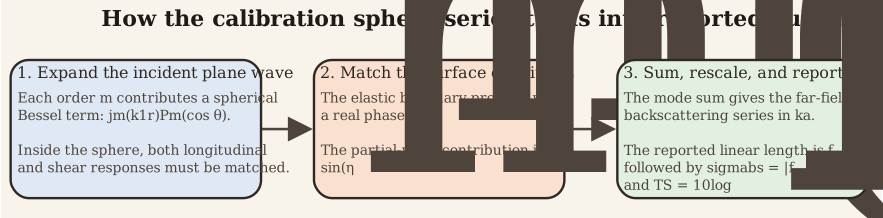
The modal bookkeeping proceeds in a fixed order. The incident plane wave is decomposed into modal terms, each mode acquires an elastic phase shift at the sphere surface, the far-field series is summed, and the final result is reported as a linear backscattering length, a backscattering cross-section, and target strength.
Mathematical assumptions
The SOEMS derivation assumes a homogeneous, isotropic, linearly elastic sphere in a homogeneous inviscid fluid. The interface is perfectly spherical, the material properties are frequency independent unless supplied otherwise, and the reported amplitude is a far-field quantity. Numerical evaluation also requires enough partial waves to resolve the largest retained acoustic size.