
Introduction
The bent-cylinder modal series solution (BCMS) extends
Stanton’s finite-cylinder treatment to a uniformly curved axis near
broadside (Stanton
1988, 1989). It retains the
straight-cylinder cross-sectional modes and changes the phase coherence
along the axis.
That separation leads to a two-level theory:
- a straight finite-cylinder modal backscatter kernel, and
- a curvature-dependent coherent-length correction applied to that kernel.
Medium indices and scattering quantities follow Notation and symbols. The local fluid-cylinder coefficients are derived in FCMS theory.
Straight-cylinder starting point
Local cross-sectional modal content
BCMS inherits its local cross-sectional response from
the straight finite-cylinder modal series. For a circular cylinder of
radius a and length L, the near-broadside backscattering
amplitude can be written schematically as:
f_{\mathrm{bs}}^{(\mathrm{straight})} = \frac{L}{\pi} \frac{\sin(k_1 L \cos\theta)} {k_1 L \cos\theta} \sum_{m=0}^{\infty} (-1)^m \epsilon_m B_m.
Here k_1 = \omega/c_1 is the seawater wavenumber, \theta is the incidence angle measured relative to the cylinder axis, \epsilon_m is the Neumann factor, and B_m is the straight-cylinder modal coefficient of order m.
The boundary condition determines B_m. For a fluid-like cylinder, these are the FCMS coefficients. BCMS changes only the along-axis factor.
Why curvature can be isolated
For a gently and uniformly bent cylinder near broadside, the local radius and cross-sectional boundary condition still look straight at the scale of the cross-sectional modal solve. What changes is the two-way phase accumulated by different points along the curved axis.
BCMS therefore treats curvature as an axial-coherence problem. This requires the local radius of curvature to be large enough that each cross-section is well represented by the straight-cylinder solution.
Uniformly bent geometry
Centerline and curvature
Let s \in [-L/2, L/2] denote arc length along the cylinder centerline, and let \kappa = 1/\rho_c denote the constant curvature, where \rho_c is the radius of curvature. A convenient planar representation of the bent centerline is:
\mathbf{r}_c(s) = \begin{bmatrix} \rho_c \sin(s/\rho_c) \\ 0 \\ \rho_c \left[1 - \cos(s/\rho_c)\right] \end{bmatrix}.
A rigid translation changes only the common phase and not the scattered intensity.
The local tangent direction is then:
\hat{\mathbf{t}}(s) = \frac{d\mathbf{r}_c}{ds} = \begin{bmatrix} \cos(s/\rho_c) \\ 0 \\ \sin(s/\rho_c) \end{bmatrix}.
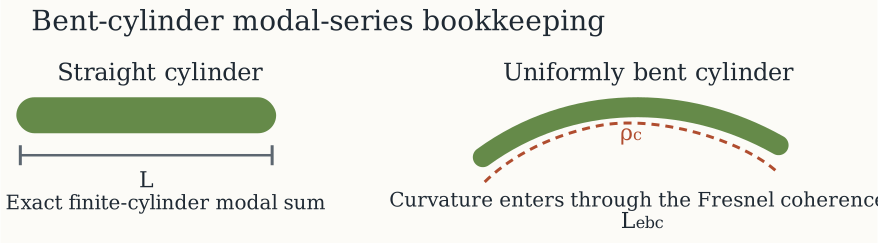
Broadside phase bookkeeping
For monostatic backscatter, each point on the centerline contributes a two-way phase proportional to its projection onto the backscatter direction. If \hat{\mathbf{q}} denotes the relevant unit look direction, the coherent length is:
L_{\mathrm{ebc}} = \int_{-L/2}^{L/2} \exp\left[ 2 i k_1 \hat{\mathbf{q}}\cdot \mathbf{r}_c(s) \right] ds.
When the centerline is straight, \mathbf{r}_c(s) becomes linear in s and this integral reduces to the ordinary sinc-style axial factor. For a bent centerline, the phase becomes nonlinear in s, which is why the coherence is reduced even when the local cylinder physics is unchanged.
Equivalent coherent length and Fresnel form
For a uniformly bent cylinder near broadside, Stanton’s reduction gives (Stanton 1989):
f_{\mathrm{bs}}^{(\mathrm{bent})} = \frac{L_{\mathrm{ebc}}}{L} f_{\mathrm{bs}}^{(\mathrm{straight})}.
The ratio L_{\mathrm{ebc}}/L is the fraction of the nominal length that contributes coherently, including its phase.
Near broadside, constant curvature gives a quadratic phase and reduces the integral to Fresnel functions. Weak curvature or low frequency gives L_{\mathrm{ebc}}\approx L. Increasing either curvature or frequency makes more distant axial sections dephase.
Backscatter and target strength
Once the straight modal kernel and bent coherent-length factor are known, the backscattering cross-section and target strength follow the standard monostatic definitions (MacLennan et al. 2002):
\sigma_{\mathrm{bs}} = \left|f_{\mathrm{bs}}^{(\mathrm{bent})}\right|^2, \qquad \mathrm{TS} = 10\log_{10}\left(\frac{\sigma_{\mathrm{bs}}}{1\ \mathrm{m}^2}\right).
The complex coherence multiplier changes both magnitude and phase before the cross-section is formed.
Mathematical assumptions
The family rests on a narrow but physically useful set of assumptions:
- the cross-section remains circular,
- the curvature is uniform,
- the target is treated near broadside,
- the straight-cylinder modal coefficients remain the correct local kernel,
- curvature modifies only the axial phase coherence.
BCMS is therefore an approximate curvature extension of FCMS, not an exact solution of the wave equation in toroidal coordinates.