
Introduction
The two-ray cylinder model (TRCM) is a high-frequency approximation for an elongated fluid-like body. It retains a prompt near-interface reflection and the first return that traverses the body diameter (Stanton et al. 1993). Their coherent interference produces the principal spectral structure. Low-order resonances and later internal returns are omitted.
Medium 1 is the exterior fluid and medium 2 is the body. Interface and scattering symbols follow Notation and symbols.
The local reflection and transmission factors follow from pressure and normal-velocity continuity at a fluid-fluid interface. TRCM inserts them into a two-path asymptotic reduction rather than solving the finite-cylinder boundary-value problem.
The amplitude combines an interface coefficient, a two-ray interference factor, finite-axis directivity, and specular asymptotic scaling. Curvature changes the axial coherence term.
Physical basis of the TRCM
High-frequency starting point
For a smooth, acoustically large body, stationary-phase neighborhoods around specular points dominate the surface integral. TRCM applies that picture to a locally cylindrical cross-section and truncates the internal path series after the first through-body return (Stanton et al. 1993).
The approximation weakens at small acoustic size, for noncylindrical local geometry, or when omitted internal paths and resonances are appreciable.
From multiple internal paths to a two-ray interference factor
A more complete internal-reflection picture would contain a geometric series of transmitted paths with phases corresponding to repeated diameter traversals. After the prompt near-face reflection has been used as the reference contribution, the first retained through-body return has relative complex weight:
\mathcal{T}_{12} \mathcal{T}_{21} e^{i \mu} e^{4 i k_2 a \cos \hat{\theta}},
where \mathcal{T}_{12} and \mathcal{T}_{21} are the pressure-transmission coefficients for entry into and exit from the cylinder, \mu is an empirical phase correction, k_2 is the interior wavenumber, a is the cylinder radius, and \hat{\theta} is the broadside-referenced incidence angle. The normalized two-ray interference factor is then:
\mathcal{I}_{TR} = 1 - \mathcal{T}_{12} \mathcal{T}_{21} e^{i \mu} e^{4 i k_2 a \cos \hat{\theta}}.
The leading 1 does not represent a separate dimensional amplitude. It represents the prompt reflected path after the common reflection scaling has been factored outside the bracket. The second term represents the first transmitted return written relative to that reflected reference contribution.
Straight-cylinder formulation
Acoustic contrasts and interface coefficients
Let medium 1 denote the surrounding fluid and medium 2 denote the cylinder interior. Let \rho_1 and c_1 be the exterior density and sound speed, and let \rho_2 and c_2 be the corresponding interior quantities. Define the density and sound-speed contrasts by:
g_{21} = \frac{\rho_2}{\rho_1}, \qquad h_{21} = \frac{c_2}{c_1},
and define the corresponding acoustic impedances by:
Z_1 = \rho_1 c_1, \qquad Z_2 = \rho_2 c_2.
The exterior and interior wavenumbers are then:
k_1 = \frac{\omega}{c_1}, \qquad k_2 = \frac{\omega}{c_2},
where \omega is angular frequency. At normal incidence on a fluid-fluid interface, the pressure reflection coefficient is:
\mathcal{R}_{12} = \frac{Z_2 - Z_1}{Z_2 + Z_1} = \frac{g_{21} h_{21} - 1}{g_{21} h_{21} + 1}.
This coefficient controls the prompt reflected contribution. The associated pressure-transmission coefficients for entry into and exit from the cylinder are:
\mathcal{T}_{12} = 1 + \mathcal{R}_{12}, \qquad \mathcal{T}_{21} = 1 - \mathcal{R}_{12},
so their product is:
\mathcal{T}_{12} \mathcal{T}_{21} = 1 - \mathcal{R}_{12}^2.
That product weights the path that enters the body, traverses it, and exits again.
Geometry and shifted angle
Consider a locally straight cylinder of radius a and length L. Let \theta denote the incidence angle measured so that broadside occurs at \theta = \pi / 2. Define the broadside-referenced angle by:
\hat{\theta} = \theta - \frac{\pi}{2}.
This shifted angle is the one that appears naturally in the straight-cylinder TRCM formulas. At \hat{\theta} = 0, the body is at broadside and the two-ray picture is most strongly expressed. As |\hat{\theta}| increases, the axial directivity factor suppresses the response and the specular broadside interpretation becomes progressively less useful.
Through-body phase and empirical correction
The direct ray reflects from the near face. The second ray penetrates the cylinder, traverses the projected diameter twice, and accumulates additional phase:
4 k_2 a \cos \hat{\theta}.
The through-body contribution therefore carries the factor:
e^{4 i k_2 a \cos \hat{\theta}}.
This is the two-way interior path of the first transmitted return. An empirical phase correction accounts for finite-size departure from geometric optics:
\mu = -\frac{(\pi / 2) k_1 a}{k_1 a + 0.4}.
The through-body contribution is therefore multiplied by:
e^{i \mu}.
This term is an empirical phase adjustment rather than a separate ray path. Its role is to shift the phase of the through-body contribution so that the two-ray approximation better matches the finite-frequency behavior described in the Stanton-model literature.
Interference factor
Combining transmission and phase accumulation yields the two-ray interference factor:
\mathcal{I}_{TR} = 1 - \mathcal{T}_{12} \mathcal{T}_{21} e^{i \mu} e^{4 i k_2 a \cos \hat{\theta}}.
After the common reflection scaling has been factored outside the bracket, destructive or constructive interference is determined by the phase difference between the retained prompt reflection and the retained through-body return.
Finite-length directivity
The straight cylinder also has a finite longitudinal extent L. If the scattered phase is integrated over a uniformly illuminated body axis, the axial phase increment is:
\Delta = k_1 L \sin \hat{\theta}.
The resulting finite-length directivity factor is:
s = \frac{\sin \Delta}{\Delta}.
This is the standard sinc directivity factor for coherent integration over a finite segment. It is the exact result of integrating a constant-amplitude phase factor along the axis, and it explains why the straight-cylinder response decays rapidly once the body rotates away from broadside.
Straight-cylinder amplitude
Kirchhoff-type specular approximations for smooth convex surfaces produce an amplitude proportional to the square root of local acoustic size. For the TRCM straight-cylinder construction, the specular scaling factor is:
\sqrt{k_1 a \cos \hat{\theta}},
The phase of the one-dimensional stationary-phase contribution contributes:
e^{i \pi / 4},
The round-trip phase to the near interface contributes:
e^{-2 i k_1 a \cos \hat{\theta}}.
Putting all of these ingredients together gives the straight-cylinder scattering amplitude:
\mathcal{f}_\text{bs}^{(straight)} = -\frac{i}{2 \sqrt{\pi}} e^{i \pi / 4} e^{-2 i k_1 a \cos \hat{\theta}} L \sqrt{k_1 a \cos \hat{\theta}} \, \mathcal{R}_{12} \, s \, \mathcal{I}_{TR}.
\mathcal R_{12} is the interface reflection, s is axial directivity, the square-root and e^{i\pi/4} terms are the stationary-phase scale and phase, and \mathcal I_{TR} is the two-ray interference.
For either the straight or curved form of the model, the associated backscattering cross-section is:
\sigma_\text{bs} = \left| \mathcal{f}_\text{bs} \right|^2,
and target strength is (MacLennan et al. 2002):
TS = 10 \log_{10}\left( \frac{\sigma_\text{bs}}{1\ \mathrm{m}^2}\right).
Curved-cylinder extension
Curvature as a coherence problem
If the cylinder is bent smoothly, contributions from different axial positions no longer share the same phase as in the straight case. The bent-body extension therefore modifies the coherent axial accumulation, not the local cross-sectional two-ray physics. The same local reflection coefficient, transmission coefficients, empirical phase correction, and diameter-traversal phase are retained, but the effective coherent length of the body is reduced by curvature-induced phase variation.
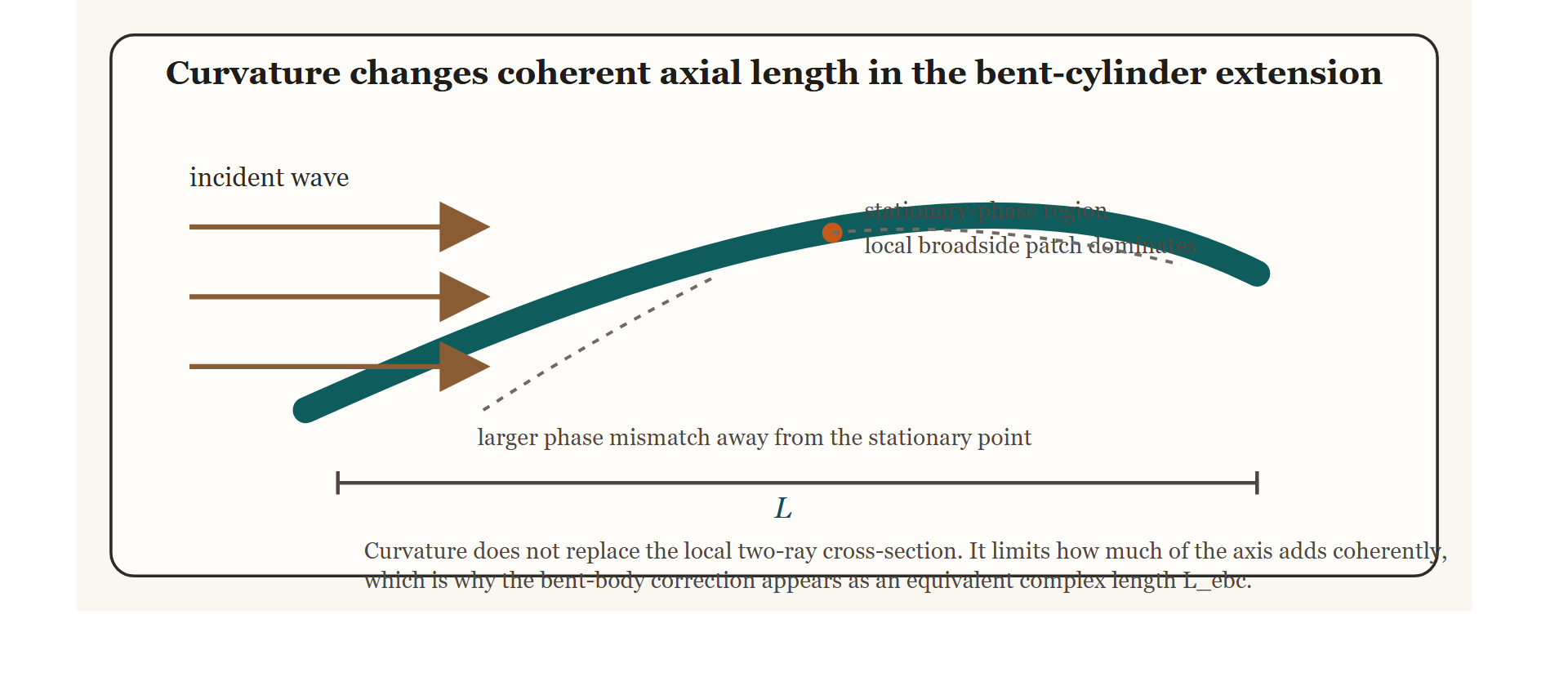
Treat the bent body as a circular arc of radius of curvature \rho_c and total length L. The half-body tangent rotation is then:
\gamma_{max} = \frac{L}{2 \rho_c},
and the maximum sag of the arc away from its chord is:
z_{max} = \rho_c \left( 1 - \cos \gamma_{max} \right).
Let x denote axial coordinate measured from the body midpoint. The curvature-modified equivalent coherent length is then written as:
L_{ebc}(k_1) = \int_{-L/2}^{L/2} \exp \left[ i \, \frac{8 k_1 z_{max}}{L^2} x^2 \right] dx.
This quadratic phase makes contributions away from the dominant specular region dephase.
For gentle curvature, where \gamma_{max} is small, one has:
z_{max} \approx \frac{L^2}{8 \rho_c},
so the quadratic kernel reduces to:
\frac{8 k_1 z_{max}}{L^2} x^2 \approx \frac{k_1}{\rho_c} x^2.
That form makes the coherence penalty especially transparent: tighter curvature, meaning smaller \rho_c, produces more rapid phase variation across the body axis.
Bent-body amplitude
The bent-cylinder backscatter is obtained by replacing the straight-cylinder coherent length L by the curvature-modified equivalent length L_{ebc}:
\mathcal{f}_\text{bs}^{(curved)} = \frac{L_{ebc}}{L} \mathcal{f}_\text{bs}^{(straight)}.
The local two-ray law is unchanged. Only the coherent axial length is replaced.
Stationary-phase reduction
When the bent-body phase oscillates rapidly, a common asymptotic replacement for the equivalent coherent length is:
L_{ebc} \approx \sqrt{\frac{\rho_c \lambda}{2}} e^{i \pi / 4},
where \lambda = 2 \pi / k_1 is wavelength. This is the standard stationary-phase reduction of the bent-body coherence integral.
At exact broadside, this stationary-phase branch is centered on the dominant specular region of the bent body, so the local two-ray factor is evaluated at \hat{\theta} = 0. The resulting approximation may therefore be written as:
\mathcal{f}_\text{bs}^{(curved,\,sp)} \approx \frac{1}{L} \sqrt{\frac{\rho_c \lambda}{2}} e^{i \pi / 4} \mathcal{f}_\text{bs}^{(straight)} \Big|_{\hat{\theta} = 0}.
Mathematical assumptions
The TRCM depends on the following assumptions:
- The body is acoustically large enough that specular contributions dominate over low-order resonance structure.
- A locally cylindrical geometry is adequate for the part of the target that controls the backscatter.
- Two coherent paths dominate the cross-sectional return: the prompt reflection and the first through-body return.
- The boundary is fluid-like, so fluid-fluid reflection and transmission are the right interface coefficients to use.
- Curvature varies slowly enough that the bent-body phase correction can be represented by a quadratic coherence integral or its stationary-phase reduction.
TRCM does not provide a complete modal or reverberant solution for a finite fluid cylinder.