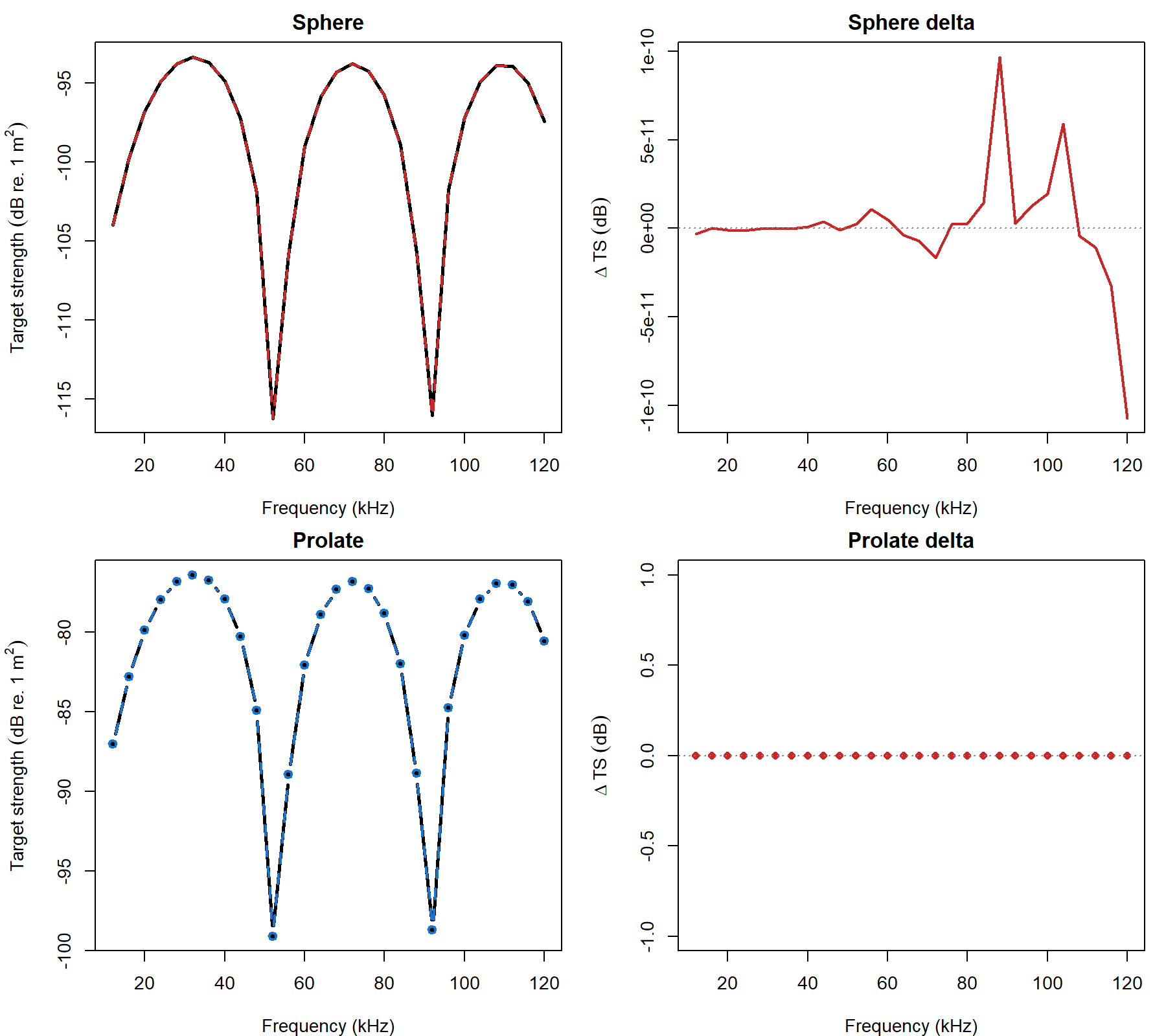
acousticTS implementation
TMM represents a target by the linear map from incident modal coefficients to scattered modal coefficients (Waterman 1969, 2009).
Build a supported canonical scatterer, solve it with
target_strength(), and optionally retain the modal blocks
for angular or orientation post-processing.
Why use TMM over SPHMS or
PSMS?
On a canonical shape, TMM should reproduce the corresponding shape-specific family when both solve the same boundary-value problem. Its added value is the retained coefficient map, which supports bistatic scattering and orientation averaging without repeating the boundary solve.
In other words:
- if the goal is only a sphere target-strength calculation,
SPHMSis the more direct exact model, - if the goal is only a prolate-spheroid target-strength calculation,
PSMSis the more direct exact model, - if the goal is only a finite-cylinder target-strength calculation,
FCMSis the more direct cylinder model, and - if the goal is to stay inside a transition-matrix framework that can
grow into broader scattering workflows while using one common
post-processing layer across spheres, spheroids, and cylinders,
TMMis the relevant model family.
The TMM cylinder branch is intentionally narrower than
the sphere, oblate, and prolate branches. The default monostatic path is
benchmark-matched to FCMS, but full retained-angle cylinder
grids and bistatic summaries remain outside the validated public
scope.
General-angle post-processing is available for sphere,
oblate-spheroid, and prolate-spheroid branches. Spherical
ESS objects also support the documented fluid-shell and
elastic-shell boundaries. Cylinder storage is limited to monostatic
reuse and orientation-averaged monostatic products.
Object generation
library(acousticTS)

density_sw <- 1026.8
sound_speed_sw <- 1477.3

sphere_shape <- sphere(radius_body = 0.01)
oblate_shape <- oblate_spheroid(
  length_body = 0.012,
  radius_body = 0.01,
  n_segments = 80
)
prolate_shape <- prolate_spheroid(
  length_body = 0.14,
  radius_body = 0.01,
  n_segments = 80
)
cylinder_shape <- cylinder(
  length_body = 0.07,
  radius_body = 0.01,
  n_segments = 80
)

sphere_object <- fls_generate(
  shape = sphere_shape,
  density_body = 1028.9,
  sound_speed_body = 1480.3,
  theta_body = pi / 2
)

oblate_object <- fls_generate(
  shape = oblate_shape,
  density_body = 1028.9,
  sound_speed_body = 1480.3,
  theta_body = pi / 2
)

prolate_object <- fls_generate(
  shape = prolate_shape,
  density_body = 1028.9,
  sound_speed_body = 1480.3,
  theta_body = pi / 2
)

cylinder_object <- fls_generate(
  shape = cylinder_shape,
  density_body = 1028.9,
  sound_speed_body = 1480.3,
  theta_body = pi / 2
)
The homogeneous-scatterer branches support:
SphereOblateSpheroidProlateSpheroidCylinder
Calculating a TS-frequency spectrum
sphere_object <- target_strength(
  object = sphere_object,
  frequency = seq(12e3, 120e3, by = 12e3),
  model = "tmm",
  boundary = "liquid_filled",
  density_sw = density_sw,
  sound_speed_sw = sound_speed_sw
)

prolate_object <- target_strength(
  object = prolate_object,
  frequency = c(12e3, 18e3, 38e3, 70e3, 100e3),
  model = "tmm",
  boundary = "liquid_filled",
  density_sw = density_sw,
  sound_speed_sw = sound_speed_sw
)

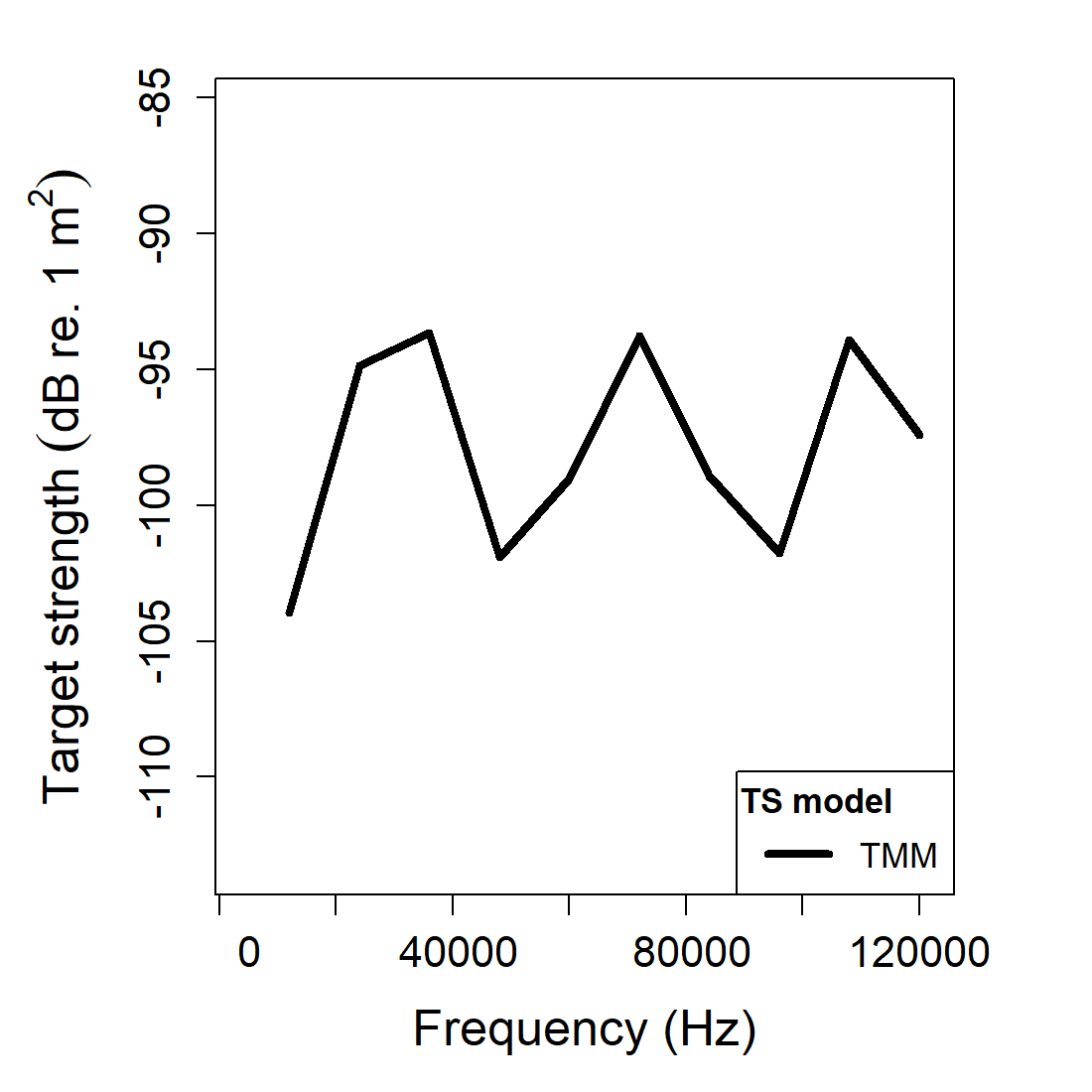
sphere_object@model$TMM
## frequency f_bs sigma_bs TS n_max
## 1 12000 -6.343290e-06+1.231703e-09i 4.023733e-11 -103.95371 6
## 2 24000 -1.805437e-05+2.830355e-08i 3.259611e-10 -94.86834 8
## 3 36000 -2.075053e-05+1.169577e-07i 4.305981e-10 -93.65928 9
## 4 48000 -8.027899e-06+1.690861e-07i 6.447575e-11 -101.90604 10
## 5 60000 1.119724e-05-1.833465e-09i 1.253781e-10 -99.01778 11
## 6 72000 2.046997e-05-3.101531e-07i 4.191160e-10 -93.77666 11
## 7 84000 1.133235e-05-3.356291e-07i 1.285348e-10 -98.90979 12
## 8 96000 -8.152309e-06+1.022055e-07i 6.647058e-11 -101.77371 13
## 9 108000 -2.017964e-05+5.314642e-07i 4.075003e-10 -93.89872 14
## 10 120000 -1.347015e-05+3.698175e-07i 1.815818e-10 -97.40928 14
prolate_object@model$TMM## frequency f_bs sigma_bs TS n_max
## 1 12000 -4.439503e-05+3.114131e-08i 1.970920e-09 -87.05331 4
## 2 18000 -8.709975e-05+1.363906e-07i 7.586386e-09 -81.19965 5
## 3 38000 -1.380278e-04+9.507581e-07i 1.905259e-08 -77.20046 10
## 4 70000 1.420489e-04-1.952261e-06i 2.018169e-08 -76.95042 17
## 5 100000 -9.784203e-05+1.983609e-06i 9.576997e-09 -80.18771 24For spheres, n_max is the spherical-wave cutoff. For
prolates, it is inherited from the spheroidal retained system and
describes the size of that solve, not a spherical-wave truncation.
Extracting model results
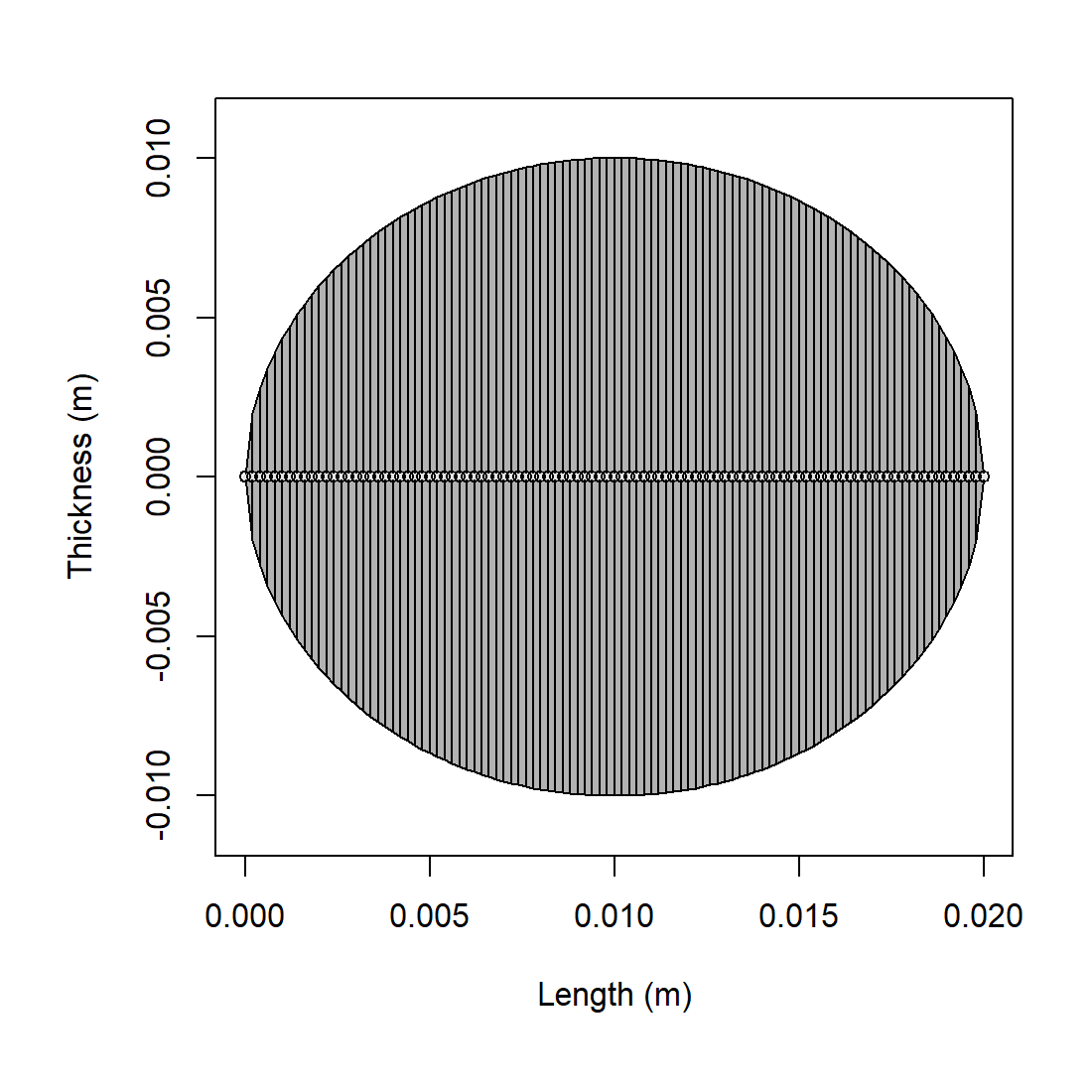
Model results can be extracted either visually or directly through
extract().
Accessing results
##   frequency                        f_bs     sigma_bs         TS n_max
## 1     12000 -6.343290e-06+1.231703e-09i 4.023733e-11 -103.95371     6
## 2     24000 -1.805437e-05+2.830355e-08i 3.259611e-10  -94.86834     8
## 3     36000 -2.075053e-05+1.169577e-07i 4.305981e-10  -93.65928     9
## 4     48000 -8.027899e-06+1.690861e-07i 6.447575e-11 -101.90604    10
## 5     60000  1.119724e-05-1.833465e-09i 1.253781e-10  -99.01778    11
## 6     72000  2.046997e-05-3.101531e-07i 4.191160e-10  -93.77666    11
For a canonical shape, compare the stored monostatic result with the matching shape-specific model before relying on post-processed angular products.
Explicit T-matrix storage
Explicit per-frequency modal-block storage is enabled with
store_t_matrix = TRUE.
sphere_store <- target_strength(
  object = fls_generate(
    shape = sphere(radius_body = 0.01, n_segments = 80),
    g_body = 1,
    h_body = 1,
    theta_body = pi / 2
  ),
  frequency = 38e3,
  model = "tmm",
  boundary = "pressure_release",
  density_sw = density_sw,
  sound_speed_sw = sound_speed_sw,
  store_t_matrix = TRUE
)

length(sphere_store@model_parameters$TMM$parameters$t_matrix[[1]])
## [1] 10For prolate spheroids, the stored blocks live in the same
@model_parameters$TMM$parameters$t_matrix slot and can be
reused through helpers such as tmm_scattering(),
tmm_average_orientation(),
tmm_bistatic_summary(), and tmm_products()
without rebuilding the retained modal solve. Cylinders can also be
stored, but the retained cylinder state is intentionally narrower: it
reuses the exact geometry-matched cylindrical family only for exact
monostatic evaluations and orientation-averaged monostatic products.
Full general-angle cylinder grids and bistatic summaries are not exposed
because a validated retained cylinder angular operator is missing.
Orientation averaging from stored blocks
One of the practical reasons to keep the result in a T-matrix framework is that the same stored blocks can be reused for other single-target summaries without rerunning the boundary solve. The simplest example is an orientation-averaged monostatic cross section.
prolate_store <- target_strength(
  object = fls_generate(
    shape = prolate_spheroid(
      length_body = 0.14,
      radius_body = 0.01,
      n_segments = 80
    ),
    density_body = 1028.9,
    sound_speed_body = 1480.3,
    theta_body = pi / 2
  ),
  frequency = seq(12e3, 100e3, 2e3),
  model = "tmm",
  boundary = "liquid_filled",
  density_sw = density_sw,
  sound_speed_sw = sound_speed_sw,
  store_t_matrix = TRUE
)

orientation_dist <- tmm_orientation_distribution(
  distribution = "uniform",
  lower = 0.45 * pi,
  upper = pi,
  n_theta = 7
)

orientation_avg <- tmm_average_orientation(
  object = prolate_store,
  distribution = orientation_dist
)

orientation_avg
## frequency sigma_bs TS
## 1 12000 4.502163e-10 -93.46579
## 2 14000 6.702413e-10 -91.73769
## 3 16000 9.192786e-10 -90.36553
## 4 18000 1.170862e-09 -89.31494
## 5 20000 1.399276e-09 -88.54097
## 6 22000 1.548806e-09 -88.10003
## 7 24000 1.585990e-09 -87.99700
## 8 26000 1.469957e-09 -88.32695
## 9 28000 1.232136e-09 -89.09341
## 10 30000 9.347098e-10 -90.29323
## 11 32000 6.301750e-10 -92.00539
## 12 34000 3.607924e-10 -94.42743
## 13 36000 1.701901e-10 -97.69066
## 14 38000 8.946596e-11 -100.48342
## 15 40000 1.192773e-10 -99.23442
## 16 42000 2.704566e-10 -95.67902
## 17 44000 5.266602e-10 -92.78470
## 18 46000 8.330752e-10 -90.79316
## 19 48000 1.119975e-09 -89.50792
## 20 50000 1.305324e-09 -88.84282
## 21 52000 1.354505e-09 -88.68219
## 22 54000 1.285562e-09 -88.90907
## 23 56000 1.118337e-09 -89.51427
## 24 58000 8.827687e-10 -90.54153
## 25 60000 6.240222e-10 -92.04800
## 26 62000 3.913264e-10 -94.07461
## 27 64000 2.144002e-10 -96.68775
## 28 66000 1.343882e-10 -98.71639
## 29 68000 1.862644e-10 -97.29870
## 30 70000 3.663744e-10 -94.36075
## 31 72000 6.192308e-10 -92.08147
## 32 74000 8.730832e-10 -90.58944
## 33 76000 1.074125e-09 -89.68945
## 34 78000 1.193339e-09 -89.23236
## 35 80000 1.223384e-09 -89.12437
## 36 82000 1.161184e-09 -89.35099
## 37 84000 1.016937e-09 -89.92706
## 38 86000 8.210382e-10 -90.85637
## 39 88000 5.984286e-10 -92.22988
## 40 90000 3.856175e-10 -94.13843
## 41 92000 2.527349e-10 -95.97335
## 42 94000 2.403773e-10 -96.19107
## 43 96000 3.303472e-10 -94.81029
## 44 98000 4.884121e-10 -93.11214
## 45 100000 6.738344e-10 -91.71447By default, tmm_average_orientation() assumes the exact
monostatic receive direction for each supplied incident angle. So the
helper is averaging the differential backscattering cross section over
the chosen orientation distribution, not rebuilding the underlying
T-matrix solve at every angle.
The distribution helper is there so the main orientation pathways stay explicit and standardized:
-
distribution = "uniform"creates a uniform distribution intheta_bodyover a bounded interval, -
distribution = "normal"creates a normal distribution on[0, pi], -
distribution = "truncated_normal"creates a normal distribution restricted to[lower, upper], and -
distribution = "quadrature"ordistribution = "pdf"lets the user supply their own angle grid and either direct weights or a density.
Because this helper is meant for monostatic orientation-averaged
backscatter, its returned columns follow the same naming convention used
elsewhere in the package: sigma_bs and TS.
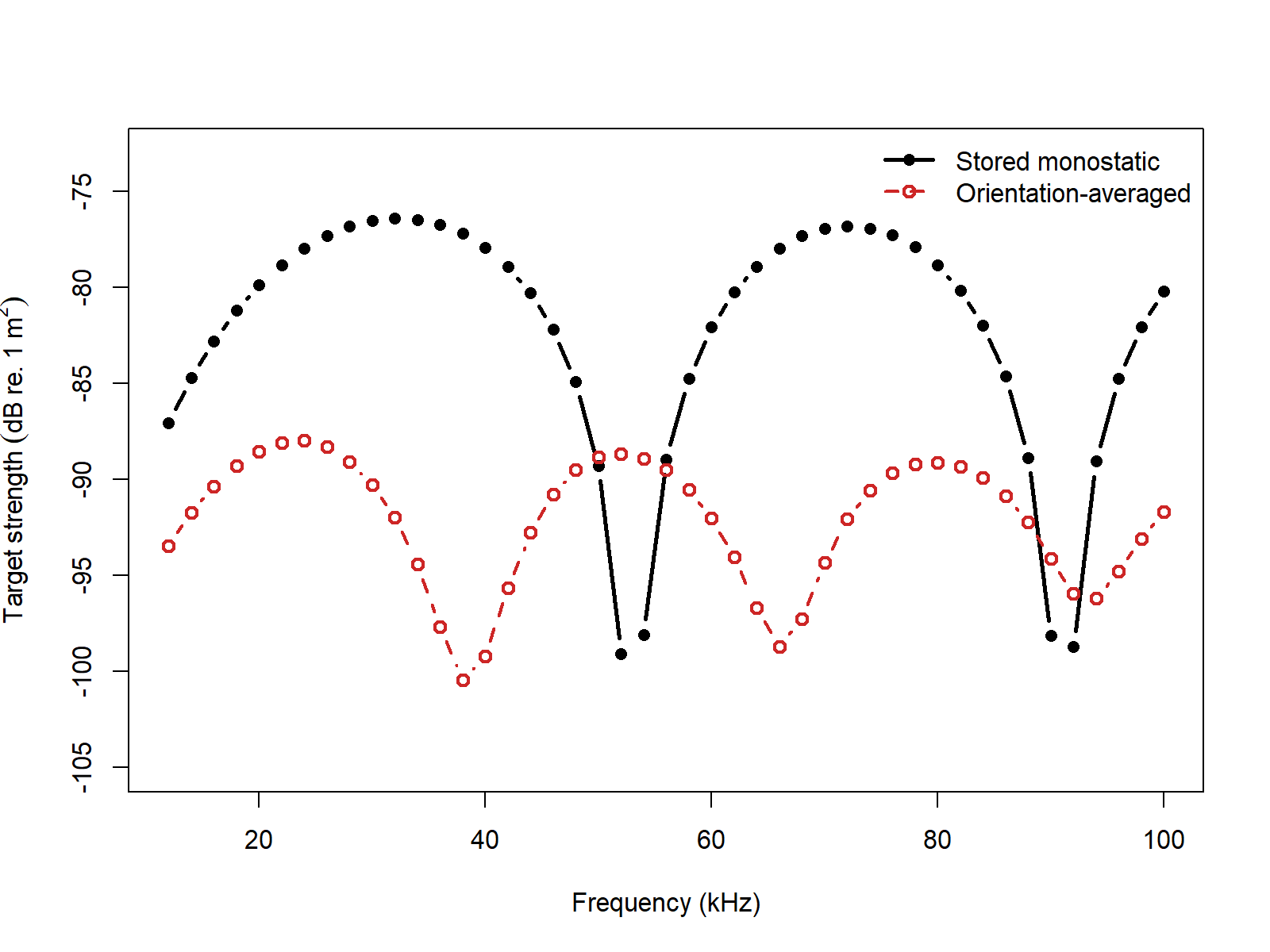
The orientation-averaged line can sit far below the stored monostatic
line, and that is not a bug by itself. The stored monostatic spectrum in
this example is the broadside response of one fixed orientation, while
the orientation-averaged spectrum is a linear average of
sigma_bs over a wide range of body angles. For a long
prolate spheroid, broadside is typically much stronger than the more
oblique and near-end-on views, so the average can be many decibels lower
than the broadside-only curve.
Angular scattering slices from stored blocks
The same stored blocks can also be sent through
plot(..., type = "scattering") to inspect a single angular
slice of the far-field response at a chosen stored frequency.
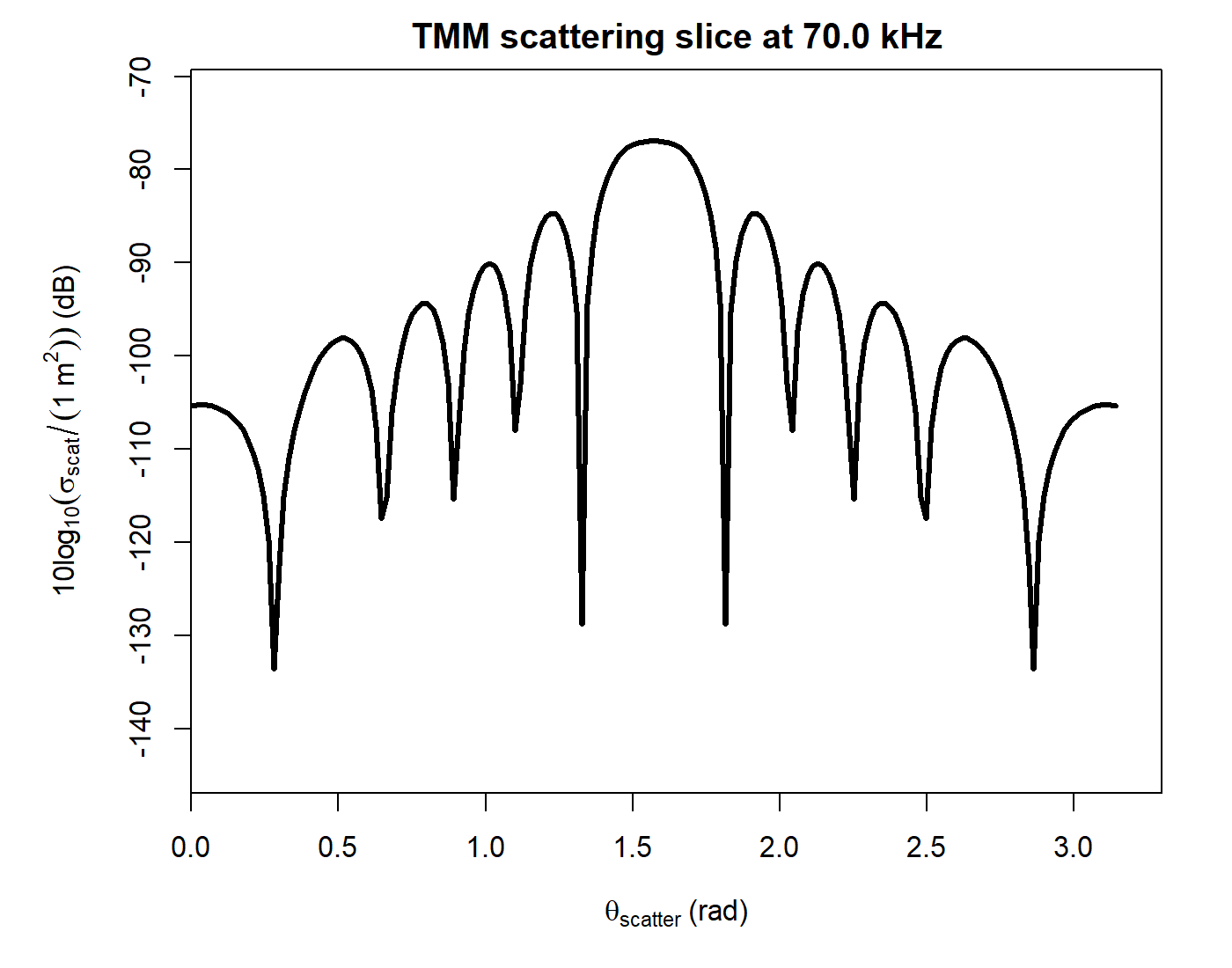
The angular slice shows how a stored operator distributes scattering over receive angle at one frequency.
All of the tmm_scattering()-style helpers use the
body-fixed angular coordinates of the canonical
axisymmetric target, not arbitrary world-frame directions. For the
built-in prolate, oblate, and cylinder shapes in acousticTS, the
symmetry axis is the body x-axis. So when these helpers are
compared against an external BEM/FEM slice generated in a world
x-y plane, the world directions need to be converted to the
body-fixed (\theta, \phi) convention before the comparison
is apples-to-apples.
Higher-level bistatic summaries
Once the stored blocks are available, the next natural step is to
move beyond individual points and slices and ask for higher-level
bistatic summaries. Within the documented package scope, that applies to
the spherical and spheroidal stored branches.
tmm_bistatic_summary() does that for one stored frequency
by returning:
- a forward-centered great-circle slice,
- an orthogonal dorsal/ventral-style great-circle slice,
- the peak-scattering direction on a 2D receive-angle grid,
- the exact monostatic backscatter value,
- a
-3 dBbackscatter-lobe width measured on the forward-centered slice, and - integrated scattering over coarse angular sectors measured relative to the forward direction.
summary_70 <- tmm_bistatic_summary(
  object = prolate_store,
  frequency = 70e3,
  n_theta = 21,
  n_phi = 41,
  n_psi = 41
)

summary_70$metrics
## frequency forward_sigma_scat forward_sigma_scat_dB sigma_bs TS
## 1 70000 7.00483e-07 -61.54602 2.018169e-08 -76.95042
## peak_theta_scatter peak_phi_scatter peak_psi_scatter peak_sigma_scat
## 1 1.570796 3.141593 0 7.00483e-07
## peak_sigma_scat_dB backscatter_lobe_width
## 1 -61.54602 1.021018
summary_70$sector_integrals## sector psi_min psi_max integrated_sigma_scat
## 1 forward_sector 0.000000 1.047198 1.711232e-07
## 2 oblique_sector 1.047198 2.094395 1.659806e-08
## 3 backward_sector 2.094395 3.141593 1.427224e-08These summaries reuse the stored blocks. The monostatic value in
summary_70$metrics$TS should agree with the TS
already stored at 70 kHz.
Single solved target, many post-process products
Use tmm_products() when several post-processing products
are required from the same solved target.
products_70 <- tmm_products(
  object = prolate_store,
  frequency = 70e3,
  orientation = orientation_dist,
  bistatic_summary = TRUE,
  n_theta = 21,
  n_phi = 41,
  n_psi = 41
)

names(products_70)
## [1] "monostatic" "orientation_average" "bistatic_summary"
products_70$bistatic_summary$metrics## frequency forward_sigma_scat forward_sigma_scat_dB sigma_bs TS
## 1 70000 7.00483e-07 -61.54602 2.018169e-08 -76.95042
## peak_theta_scatter peak_phi_scatter peak_psi_scatter peak_sigma_scat
## 1 1.570796 3.141593 0 7.00483e-07
## peak_sigma_scat_dB backscatter_lobe_width
## 1 -61.54602 1.021018The stored operator can therefore supply monostatic, orientation-averaged, and bistatic products without repeating the target solve.
Bistatic scattering grids and polar maps
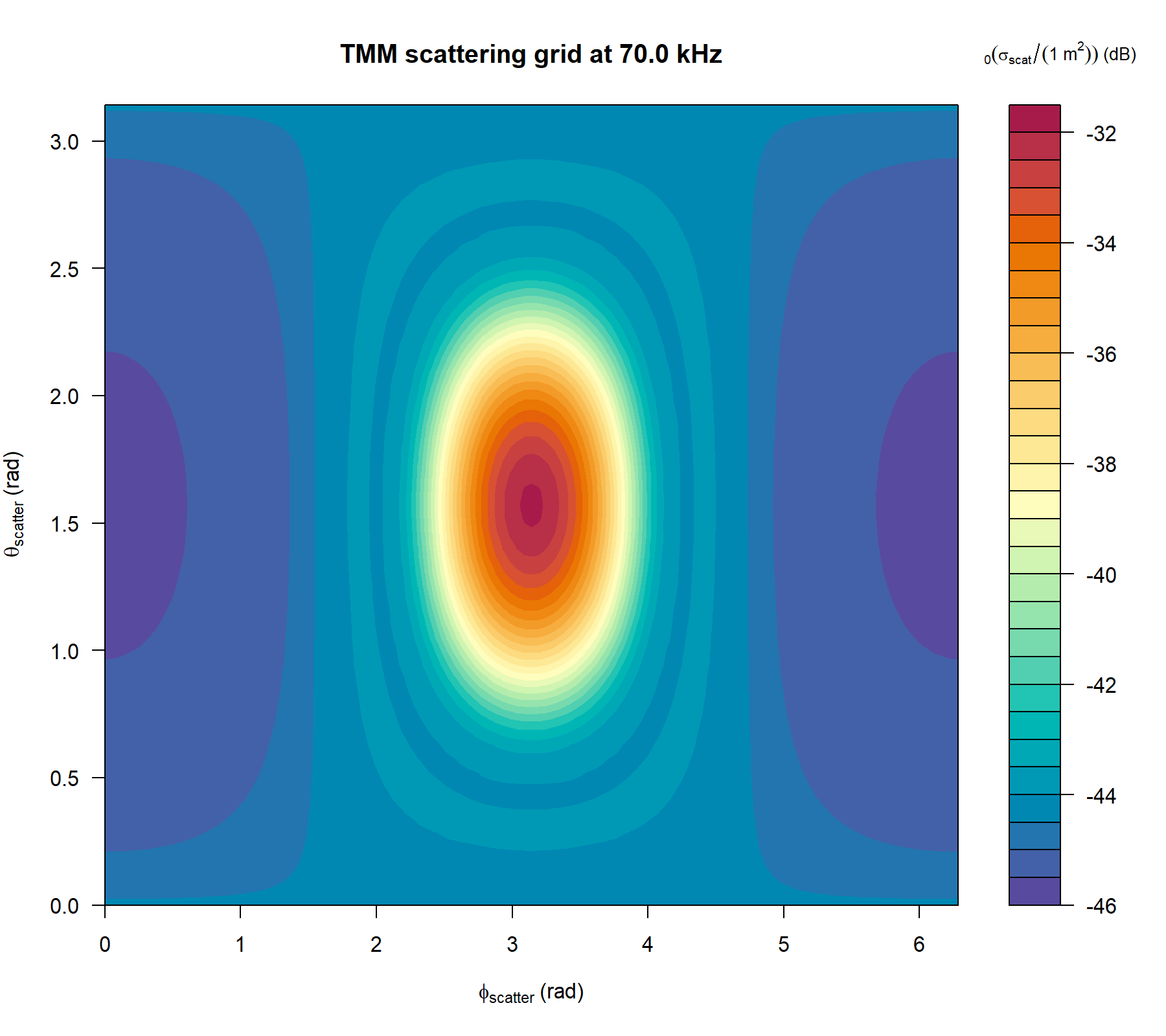
For two-dimensional receive-angle views, the stored blocks can be
reused through tmm_scattering_grid() or displayed directly
through plot(..., type = "scattering", polar = TRUE) or
plot(..., type = "scattering", heatmap = TRUE). The
implementation page uses pre-rendered figures for those heavier views so
the article stays lightweight to build.
The pre-rendered gallery covers the branches that support angular
grids: Sphere, OblateSpheroid, and
ProlateSpheroid. Cylinder is omitted because its retained
state does not expose a validated angular grid.
Shape gallery
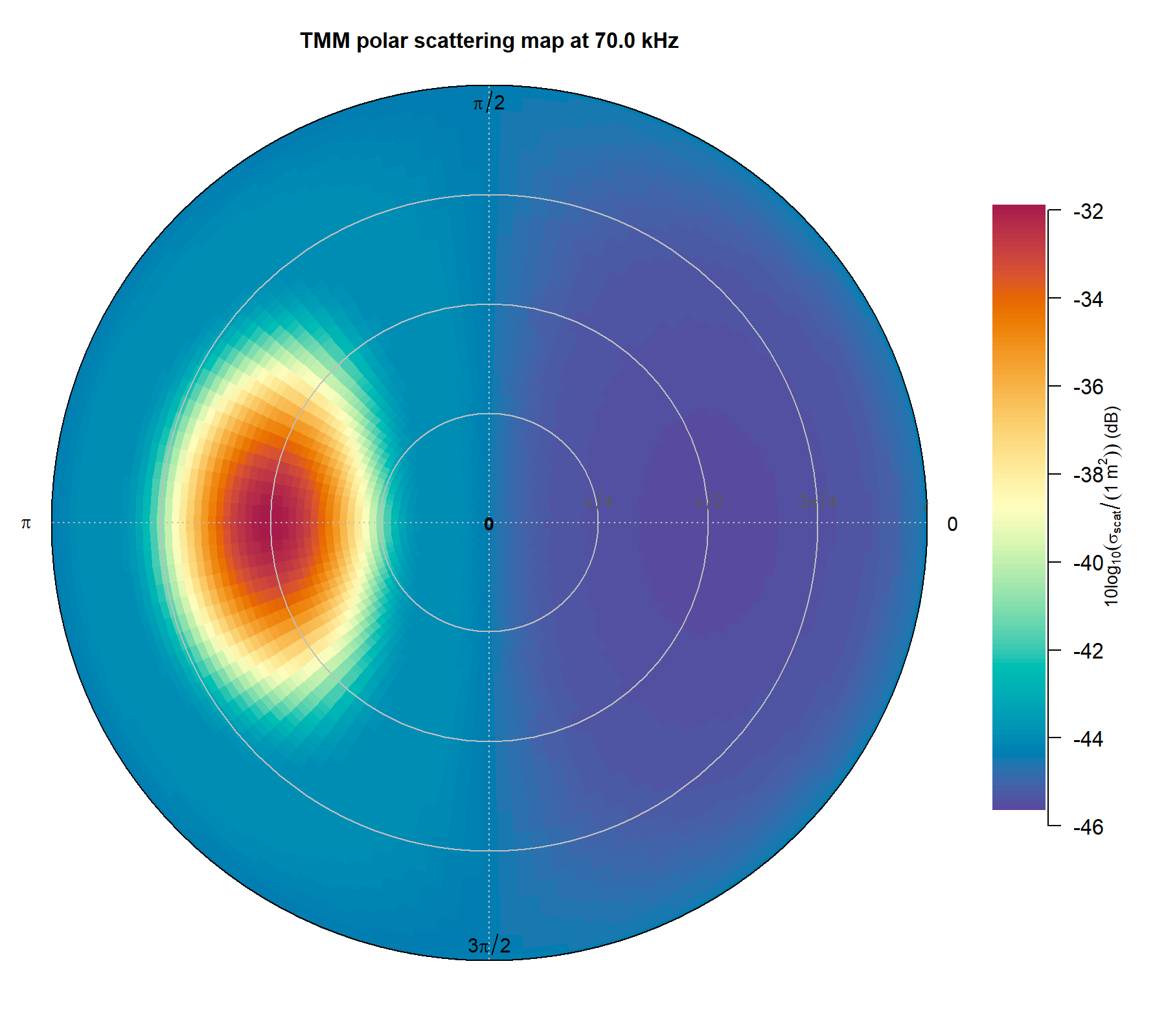
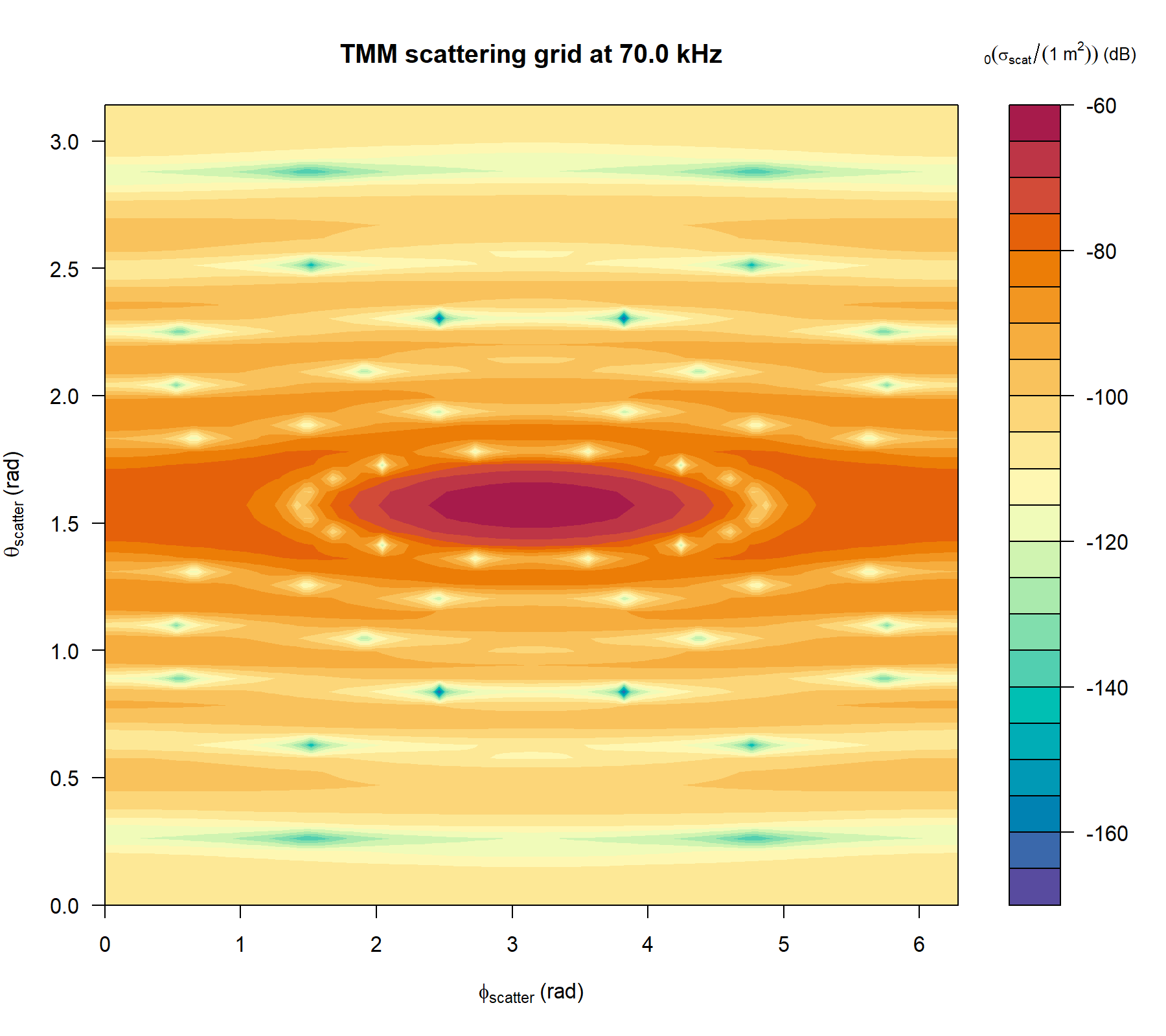
These two views show the stored pressure-release sphere at
70 kHz. The heatmap uses the direct (\phi_\text{scatter}, \theta_\text{scatter}) grid, while the polar
map wraps the same grid into a circular view.
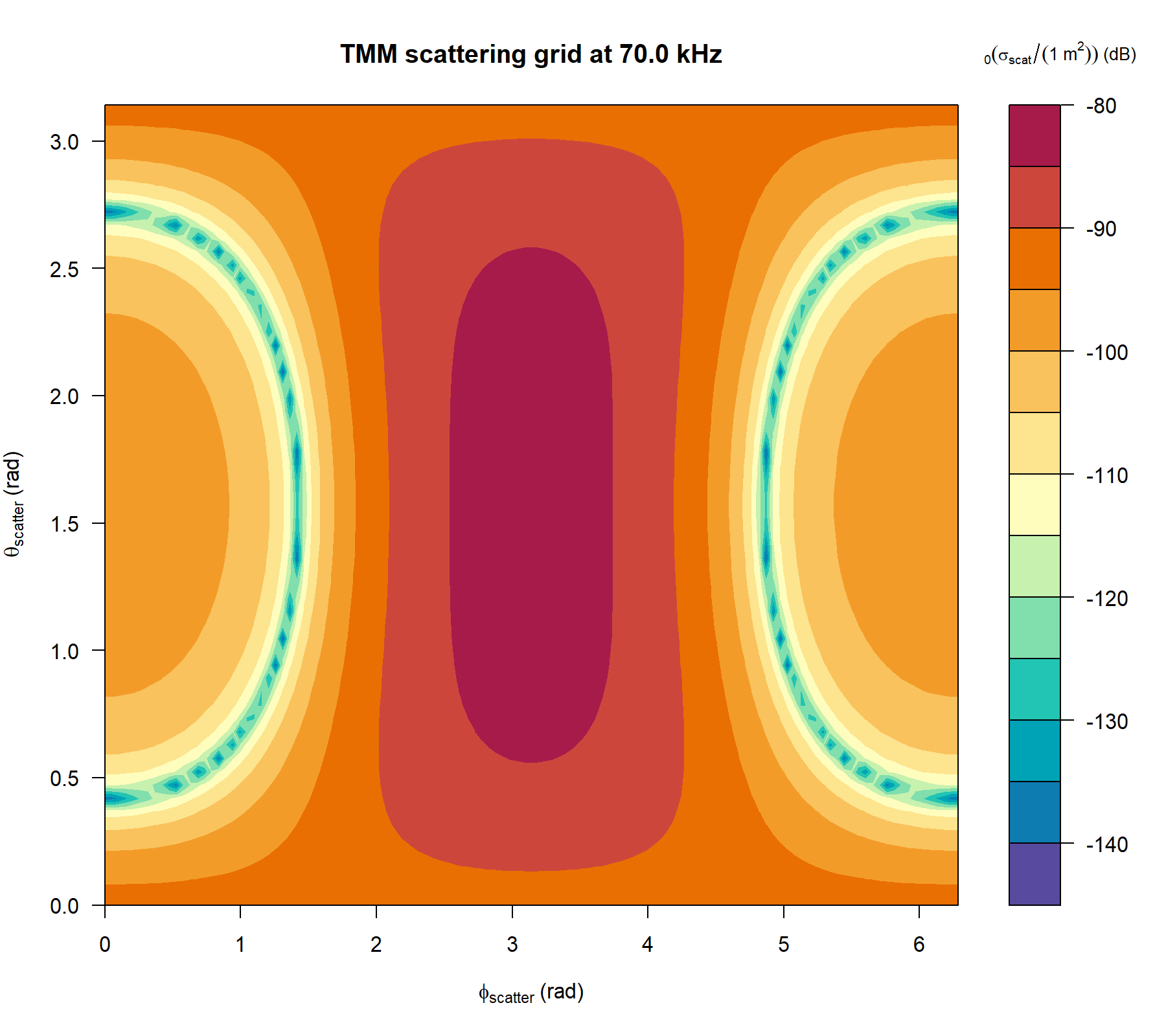
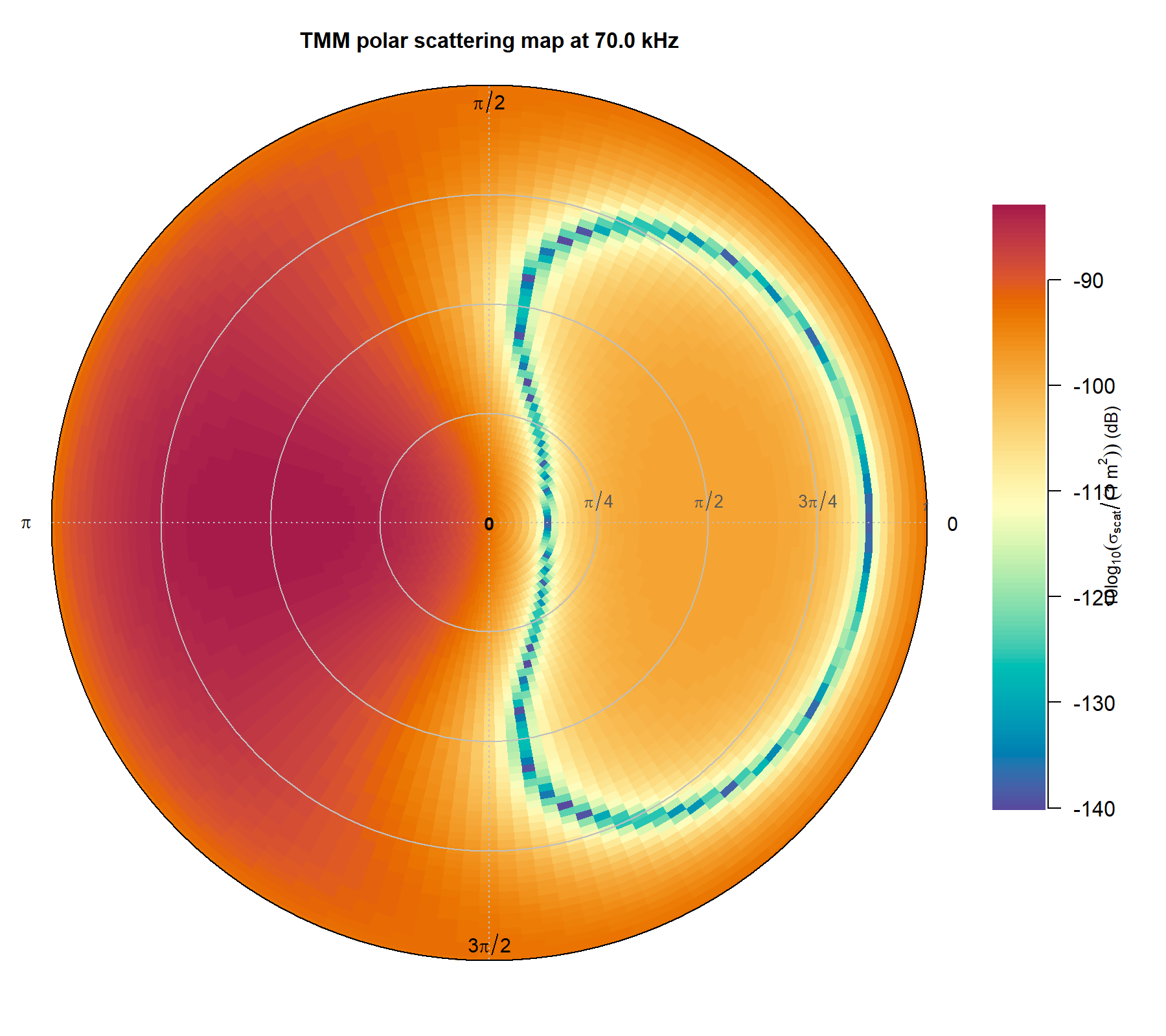
These two views show the stored liquid-filled oblate spheroid at
70 kHz, which is a useful intermediate case because it
still uses the spherical-coordinate retained branch but no longer has
the exact spherical symmetry of the sphere.
These two views show the stored liquid-filled prolate spheroid at
70 kHz, which is the geometry where the retained spheroidal
angular operator is most directly useful.
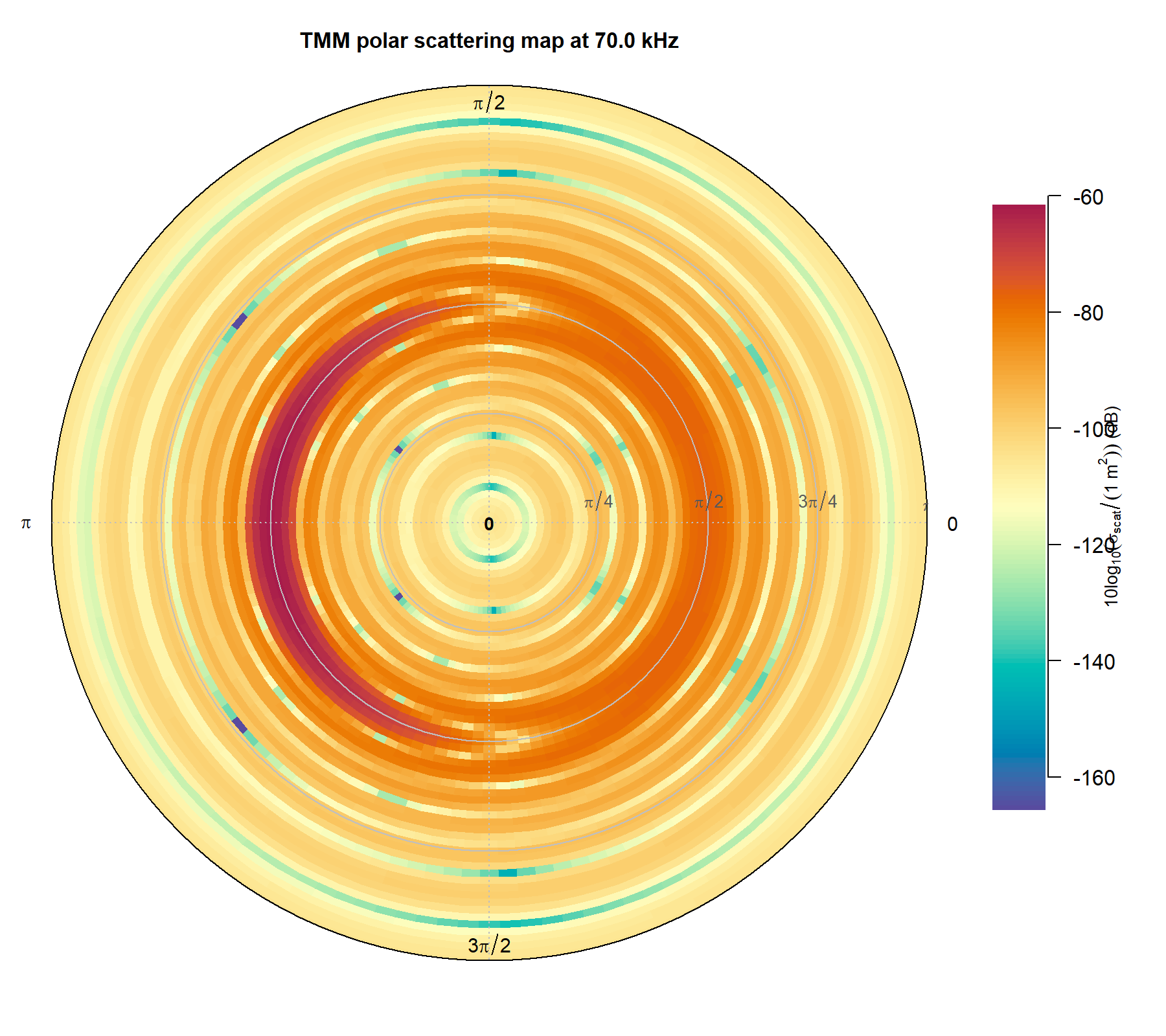
In each polar view, the radius is the scattering polar angle
theta_scatter, not physical distance from the target. So
the center corresponds to theta_scatter = 0, the outer ring
corresponds to theta_scatter = pi, and the target itself is
not drawn as a literal object at the origin.
Benchmark comparisons
The benchmark ladder is intentionally shape-specific and follows the exact-family references already used elsewhere in the package.
- Sphere cases are compared against
SPHMS - Oblate spheroids are checked through both the exact sphere limit and an external pressure-release BEMPP far-field slice for a genuinely nonspherical oblate case
- Prolate spheroid cases are compared against
PSMS - Cylinder cases are compared against
FCMSfor the default monostatic branch over the tested12-200 kHzgrids - Shell-sphere cases (
ESSobjects) are compared against the same published benchmark reference used forESSMS
Benchmark tables
| a (mm) | Boundary | \max \vert \Delta TS \vert ~ (\text{dB}) SPHMS | \vert \overline{\Delta TS} \vert ~ (\text{dB}) SPHMS | \max \vert \Delta TS \vert ~ (\text{dB}) BEM | \vert \overline{\Delta TS} \vert ~ (\text{dB}) BEM | \max \vert \Delta TS \vert ~ (\text{dB}) FEM | \vert \overline{\Delta TS} \vert ~ (\text{dB}) FEM |
|---|---|---|---|---|---|---|---|
5 |
fixed_rigid |
1.66e-11 |
1.95e-12 |
— |
— |
— |
— |
5 |
pressure_release |
1.76e-11 |
1.76e-12 |
— |
— |
— |
— |
5 |
liquid_filled |
4.19e-11 |
6.17e-12 |
— |
— |
— |
— |
5 |
gas_filled |
1.75e-11 |
1.75e-12 |
— |
— |
— |
— |
10 |
fixed_rigid |
2.37e-10 |
2.75e-11 |
0.048 |
0.010 |
0.528 |
0.087 |
10 |
pressure_release |
2.44e-10 |
2.91e-11 |
0.072 |
0.014 |
0.164 |
0.031 |
10 |
liquid_filled |
1.15e-10 |
1.74e-11 |
3.873 |
0.046 |
3.599 |
0.025 |
10 |
gas_filled |
2.45e-10 |
2.86e-11 |
0.030 |
0.004 |
0.007 |
0.0004 |
18 |
fixed_rigid |
7.62e-10 |
8.32e-11 |
— |
— |
— |
— |
18 |
pressure_release |
7.91e-10 |
8.49e-11 |
— |
— |
— |
— |
18 |
liquid_filled |
4.96e-09 |
2.48e-10 |
— |
— |
— |
— |
18 |
gas_filled |
8.46e-10 |
8.71e-11 |
— |
— |
— |
— |
| Boundary | \max \vert \Delta TS \vert ~ (\text{dB}) SPHMS | \vert \overline{\Delta TS} \vert ~ (\text{dB}) SPHMS | \max \vert \Delta TS \vert ~ (\text{dB}) BEM | \vert \overline{\Delta TS} \vert ~ (\text{dB}) BEM |
|---|---|---|---|---|
fixed_rigid |
3.60e-10 |
4.97e-11 |
0.034 |
0.008 |
pressure_release |
3.12e-10 |
5.06e-11 |
0.009 |
0.002 |
liquid_filled |
1.09e-10 |
1.92e-11 |
31.14 |
0.497 |
gas_filled |
3.12e-10 |
5.07e-11 |
0.023 |
0.009 |
| L (mm) | a (mm) | Boundary | \max \vert \Delta TS \vert ~ (\text{dB}) PSMS | \vert \overline{\Delta TS} \vert ~ (\text{dB}) PSMS | \max \vert \Delta TS \vert ~ (\text{dB}) BEM | \vert \overline{\Delta TS} \vert ~ (\text{dB}) BEM |
|---|---|---|---|---|---|---|
60 |
8 |
fixed_rigid |
0.00000 |
0.00000 |
— |
— |
60 |
8 |
pressure_release |
0.00000 |
0.00000 |
— |
— |
60 |
8 |
liquid_filled |
0.00000 |
0.00000 |
— |
— |
60 |
8 |
gas_filled |
0.00000 |
0.00000 |
— |
— |
140 |
10 |
fixed_rigid |
0.00000 |
0.00000 |
16.66 |
0.068 |
140 |
10 |
pressure_release |
0.00000 |
0.00000 |
0.105 |
0.010 |
140 |
10 |
liquid_filled |
0.00000 |
0.00000 |
58.26 |
1.378 |
140 |
10 |
gas_filled |
0.00000 |
0.00000 |
0.295 |
0.028 |
| L (mm) | a (mm) | Boundary | \max \vert \Delta TS \vert ~ (\text{dB}) FCMS | \vert \overline{\Delta TS} \vert ~ (\text{dB}) FCMS | \max \vert \Delta TS \vert ~ (\text{dB}) BEM | \vert \overline{\Delta TS} \vert ~ (\text{dB}) BEM |
|---|---|---|---|---|---|---|
70 |
10 |
fixed_rigid |
0.00e+00 |
0.00e+00 |
63.4 |
15.2 |
70 |
10 |
pressure_release |
0.00e+00 |
0.00e+00 |
38.9 |
12.4 |
70 |
10 |
liquid_filled |
0.00e+00 |
0.00e+00 |
74.9 |
14.3 |
70 |
10 |
gas_filled |
0.00e+00 |
0.00e+00 |
39.7 |
12.3 |
50 |
8 |
fixed_rigid |
3.55e-15 |
5.08e-16 |
— |
— |
50 |
8 |
pressure_release |
0.00e+00 |
0.00e+00 |
— |
— |
50 |
8 |
liquid_filled |
0.00e+00 |
0.00e+00 |
— |
— |
50 |
8 |
gas_filled |
0.00e+00 |
0.00e+00 |
— |
— |
| Boundary | \max \vert \Delta TS \vert ~ (\text{dB}) bistatic grid | \vert \overline{\Delta TS} \vert ~ (\text{dB}) bistatic grid | \max \vert \Delta TS \vert ~ (\text{dB}) published monostatic | \vert \overline{\Delta TS} \vert ~ (\text{dB}) published monostatic |
|---|---|---|---|---|
shelled_pressure_release |
2.1e-14 |
1.9e-15 |
4.97e-03 |
2.43e-03 |
shelled_gas |
2.1e-14 |
2.4e-15 |
5.00e-03 |
2.58e-03 |
shelled_liquid |
8.9e-11 |
3.0e-12 |
4.94e-03 |
2.50e-03 |
elastic_shelled |
0.012 |
0.001 |
— |
— |
Diagnostics and internal validation
Exact-family comparisons are the first validation ladder, but they
are not the whole story for TMM. For the newer branches, it
is also useful to check whether the retained operator is internally
self-consistent. The tmm_diagnostics() helper does that by
reusing the stored blocks and reporting:
- monostatic reconstruction residuals,
- reciprocity residuals under incident/receive-angle exchange,
- an optical-theorem residual for the spherical-coordinate branch, and
- block-level conditioning summaries.
For the rigid and pressure-release prolate branches, the stored-block
TMM angular field can be checked directly against the exact
general-angle spheroidal modal-series solution used by
PSMS. That is the fastest way to constrain off-axis
disagreements, because it removes external meshing and solver
conventions from the loop and asks only whether the retained prolate
operator reproduces the exact scalar spheroidal field at the same
incident and receive angles.
diag_70 <- tmm_diagnostics(
  prolate_store,
  n_theta = 31,
  n_phi = 61
)

diag_70$summary
Independent BEMPP cross-checks were available for the pressure-release sphere, oblate, and prolate branches. The cylinder situation is different because the retained-cylinder scope is intentionally monostatic-only. So the validation ladder for these branches combines:
- exact-family checks where they exist (
SPHMS,PSMS,FCMS), - limiting-case checks such as the oblate sphere limit, and
- theorem-based diagnostics from the stored T-matrix blocks.
The table below shows representative diagnostic summaries for one stored object from each supported branch, where e is the residual.
| Case | \mathscr{f}~(\text{kHz}) | Max monostatic e | Max reciprocity e | Max optical-theorem e | Min block rcond
|
Max block transpose e |
|---|---|---|---|---|---|---|
sphere, fixed_rigid
|
38, 70 |
2.55e-16 |
2.12e-16 |
1.24e-03 |
3.11e-09 |
1.93e-16 |
oblate spheroid, liquid_filled
|
38, 70 |
2.80e-16 |
1.14e-04 |
1.34e-03 |
2.24e-16 |
3.48e-01 |
prolate spheroid, liquid_filled
|
38, 70 |
3.28e-16 |
2.64e-12 |
NA |
3.35e-47 |
1.15e-13 |
finite cylinder, fixed_rigid
|
38, 70 |
0.00e+00 |
NA |
NA |
NA |
NA |
Two points are worth emphasizing.
- The sphere and prolate branches are numerically self-consistent to essentially machine precision on the tested grids.
- The stored-cylinder branch is deliberately narrower than the sphere
and prolate branches. It carries only the geometry-matched monostatic
reuse path, so reciprocity and optical-theorem-style angular diagnostics
are left as
NArather than being computed from an unvalidated cylinder grid operator.
Sphere-to-spheroid continuation
For spheroidal targets, one of the most useful internal checks is to start from the equal-volume sphere limit and then deform the target smoothly to the requested aspect ratio. The monostatic response should move smoothly along that path. Abrupt jumps, non-finite values, or strong zig-zag second differences at modest aspect ratio are a sign that the truncation or angular reconstruction is not under control.
This check is built into tmm_diagnostics() for prolate
and oblate targets. The continuation is generated at constant volume,
beginning from the exact sphere limit and stepping to the requested
spheroidal aspect ratio.
The figure below shows the built-in continuation path for a
pressure-release prolate spheroid with target aspect ratio
3.5.
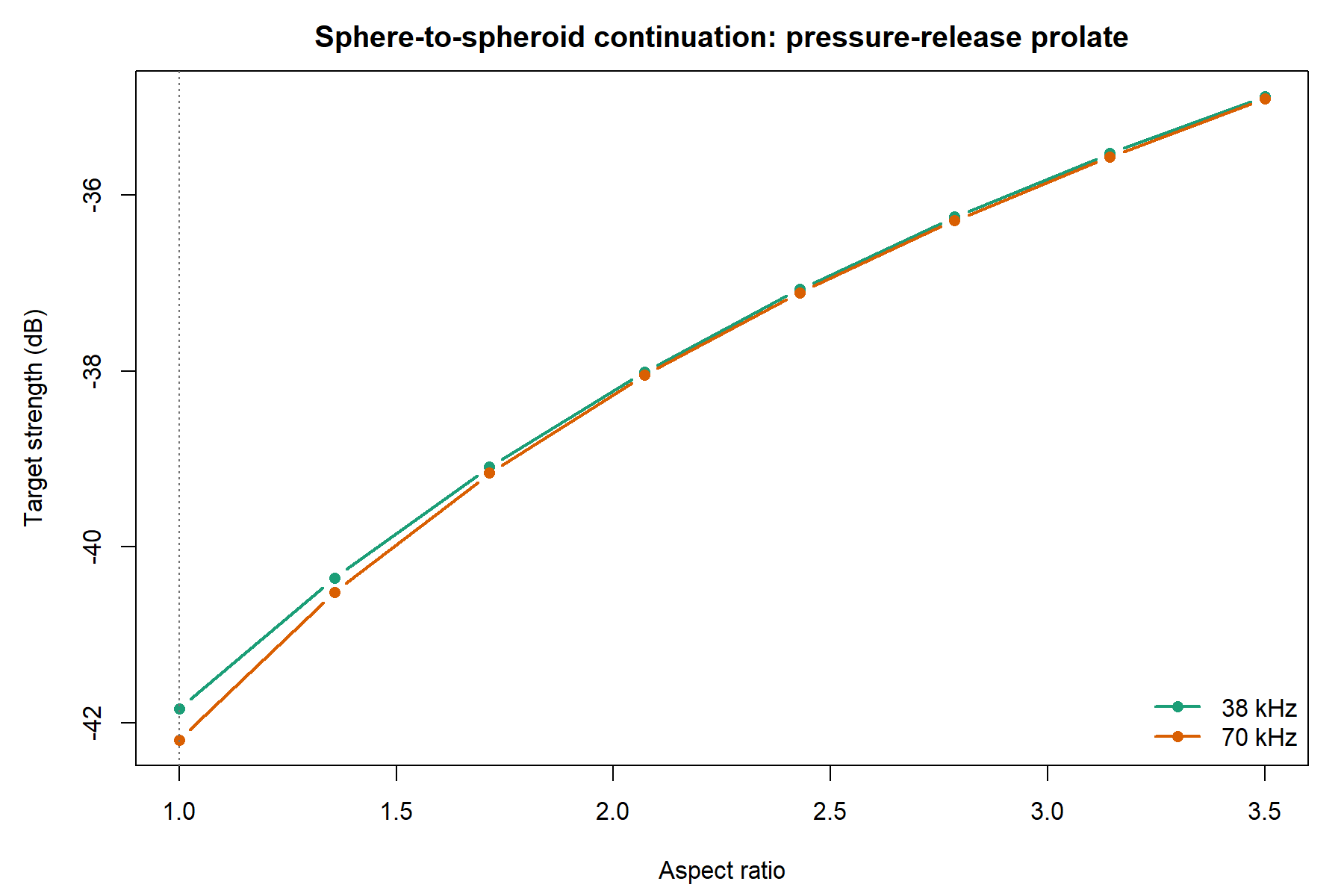
This continuation check can reveal an unstable retained branch before an external mesh or far-field normalization is introduced.
Exact prolate angular validation
For the retained prolate branch, the most useful validation is not a paper-style sketch and not an external mesh-based comparison. It is a direct check against the exact general-angle spheroidal solution already available in the package for rigid and pressure-release scalar prolates. That is the right apples-to-apples comparison because it uses:
- the same geometry,
- the same incident and receive-angle definitions,
- the same scalar boundary conditions, and
- the same far-field normalization.
The retained prolate operator is checked by comparing
tmm_scattering() with prolate_spheroid_fbs()
at the same frequency and angles.
The figure below shows that check for a rigid and a pressure-release
prolate spheroid with L = 70 mm, a = 10 mm,
broadside incidence, and a 38 kHz equatorial receive-angle
sweep. The line is the exact general-angle spheroidal solution and the
open symbols are the stored-block TMM reconstruction.
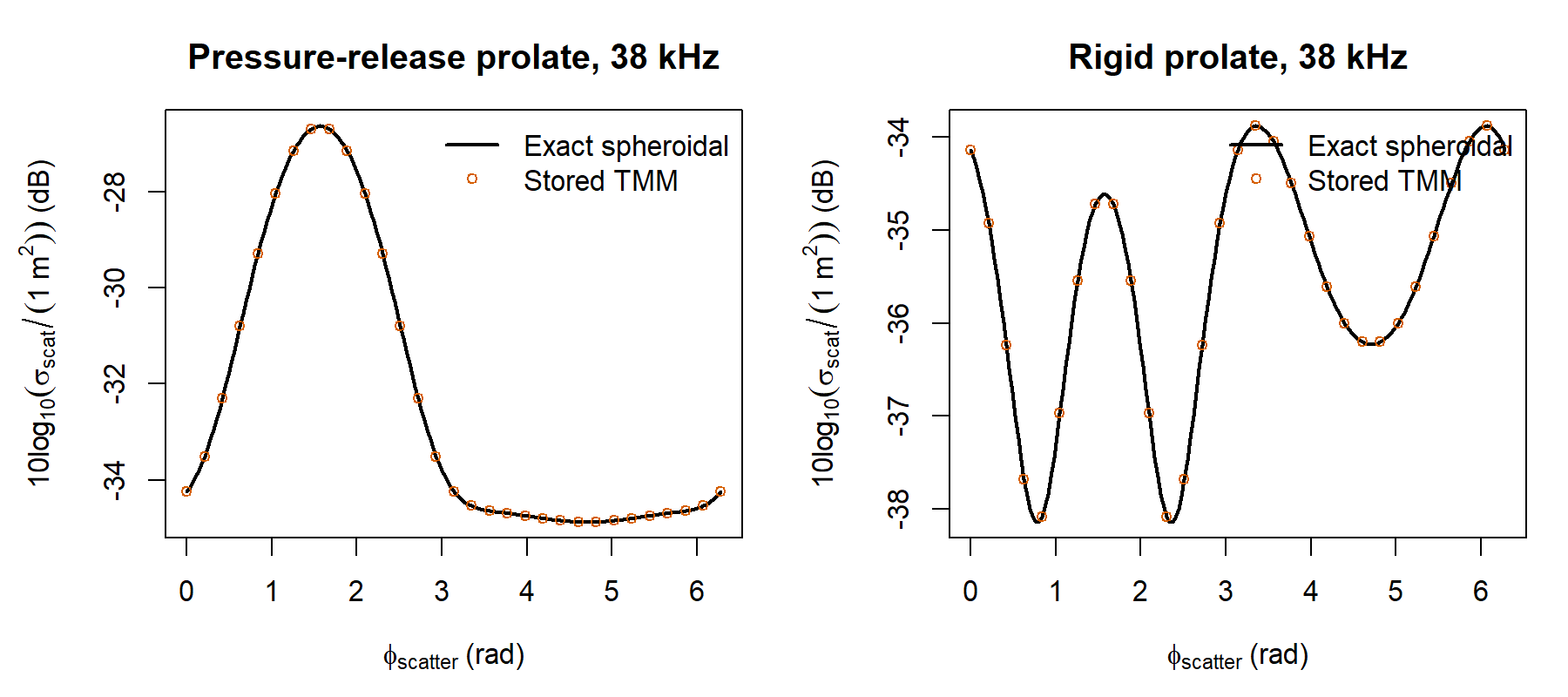
This directly tests the retained angular operator that powers
tmm_scattering(), tmm_scattering_grid(), and
the higher-level post-processing helpers.
That body-fixed angle convention also resolves the mismatch with the exploratory BEMPP prolate slice.
External comparison tables
For the pressure-release prolate case with L = 70 mm,
a = 10 mm, and 38 kHz, the retained
TMM branch and the external BEMPP far-field solution line
up closely across the tested incidence angles:
| World-frame incidence (deg) | Max abs. \Delta amplitude (dB) | Mean abs. \Delta amplitude (dB) | Note |
|---|---|---|---|
0 |
0.0069 |
0.0033 |
pressure-release, BEMPP far-field |
45 |
0.0076 |
0.0031 |
pressure-release, BEMPP far-field |
90 |
0.0078 |
0.0030 |
pressure-release, BEMPP far-field |
The same body-fixed/world-frame conversion is also important for the
nonspherical oblate branch, which uses the spherical-coordinate retained
operator. For a pressure-release oblate with polar semiaxis
c = 6 mm and equatorial semiaxis a = 10 mm,
the corrected BEMPP comparison is likewise tight on the tested
cases:
| Frequency (kHz) | World-frame incidence (deg) | Max abs. \Delta amplitude (dB) | Mean abs. \Delta amplitude (dB) | Validation note |
|---|---|---|---|---|
38 |
0 |
0.0091 |
0.0054 |
pressure-release, BEMPP far-field |
38 |
45 |
0.0083 |
0.0053 |
pressure-release, BEMPP far-field |
38 |
90 |
0.0079 |
0.0051 |
pressure-release, BEMPP far-field |
70 |
90 |
0.0091 |
0.0047 |
pressure-release, BEMPP far-field |
By contrast, the same corrected BEMPP comparison also clarifies why the package does not expose a full retained-cylinder angular operator. Additional pressure-release cylinder checks were run at a second frequency and a second geometry, and the exploratory retained-cylinder angular reconstruction remained much less reliable than the sphere and prolate branches:
| L (mm) | a (mm) | Frequency (kHz) | World-frame incidence (deg) | Stored-cylinder n_max
|
Max abs. \Delta amplitude (dB) | Mean abs. \Delta amplitude (dB) |
|---|---|---|---|---|---|---|
70 |
10 |
38 |
90 |
24 |
1.58 |
0.74 |
70 |
10 |
70 |
90 |
24 |
8.12 |
3.73 |
50 |
8 |
38 |
90 |
24 |
0.71 |
0.29 |
The exact monostatic cylinder branch can also be compared to the same BEMPP slices at the single backscatter point:
| L (mm) | a (mm) | Frequency (kHz) | World-frame incidence (deg) | Backscatter-point \Delta amplitude (dB) | Interpretation |
|---|---|---|---|---|---|
70 |
10 |
38 |
90 |
-0.128 |
broadside is the best tested case here, but it stays
above a < 0.1 dB target |
70 |
10 |
70 |
90 |
-0.063 |
broadside falls below 0.1 dB on this
tested case |
50 |
8 |
38 |
90 |
-0.198 |
the smaller broadside case stays above a
< 0.1 dB target |
70 |
10 |
38 |
45 |
-5.104 |
oblique monostatic agreement is not externally closed |
70 |
10 |
38 |
0 |
-272.091 |
the end-on pressure-release cylinder remains strongly inconsistent with BEMPP |
Those extra checks matter because they show the remaining cylinder issue is not just one broken benchmark file. A retained cylinder angular operator can sometimes be tuned to look better on a low-to-moderate-frequency case, but that improvement does not generalize cleanly once the frequency or geometry changes. So the external benchmark work supports a more precise conclusion: the retained prolate branch behaves correctly, while the cylinder family stops at exact monostatic reuse and orientation-averaged monostatic products until a separate validated retained cylinder angular operator is built.
External BEM validation figures
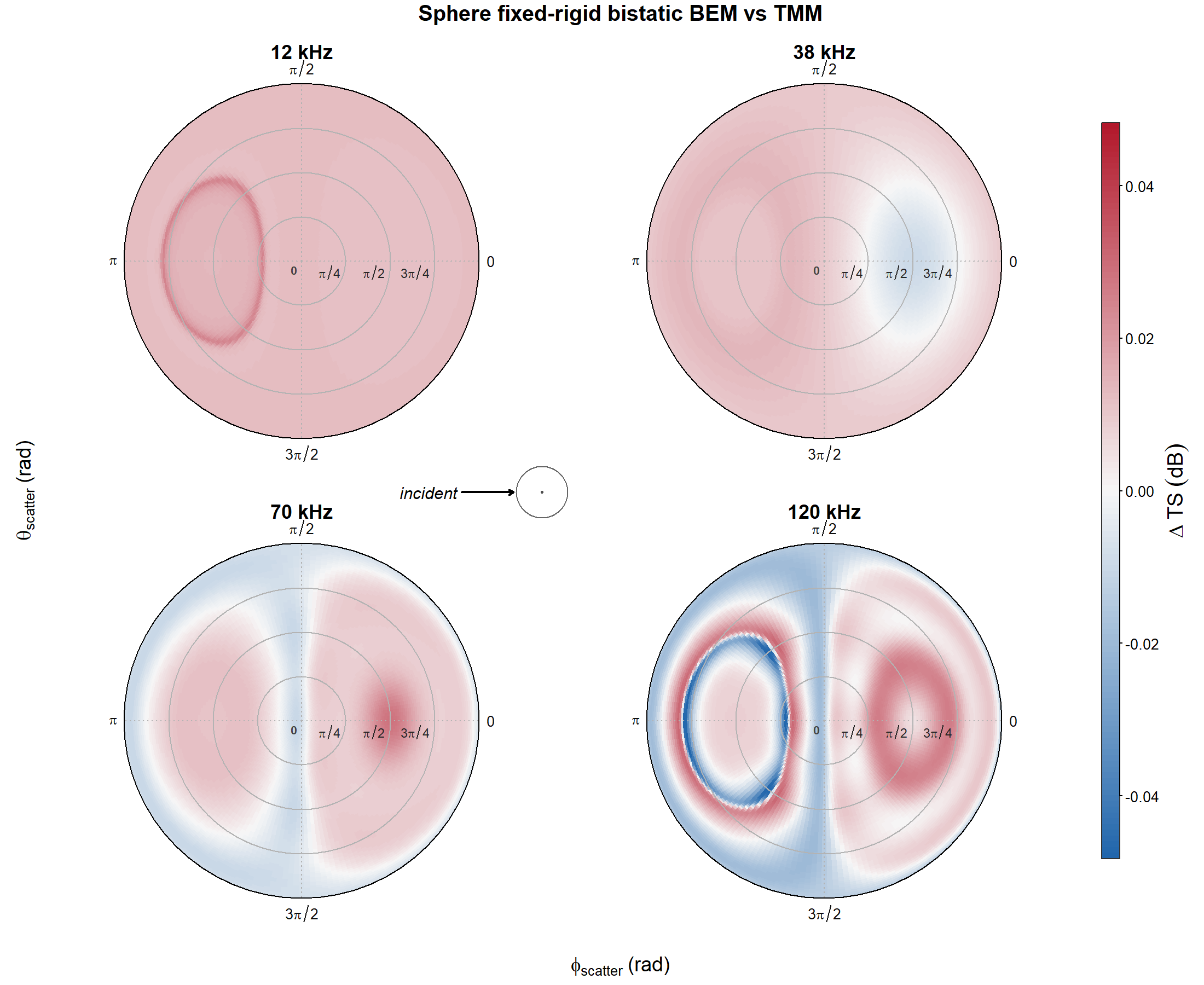
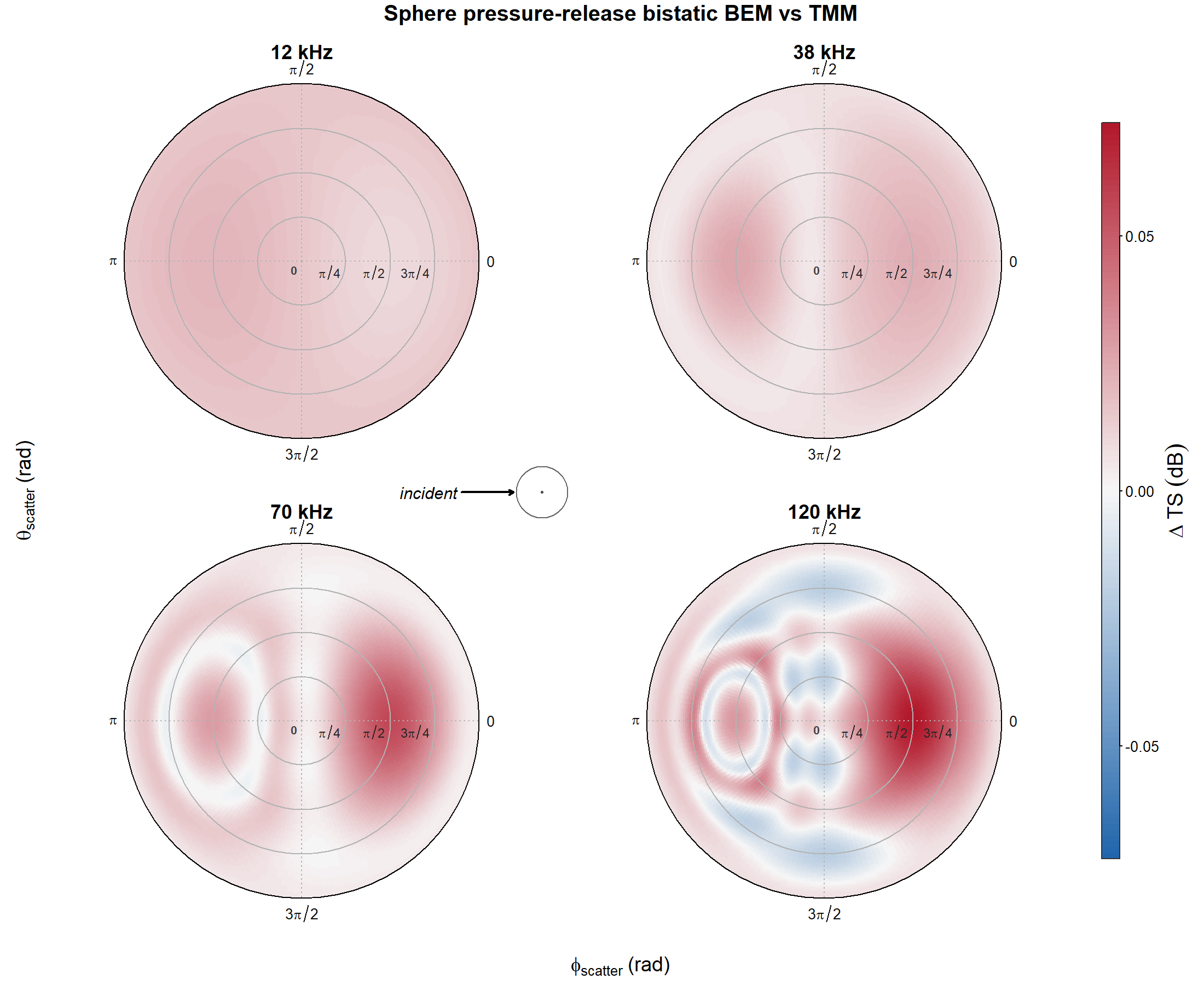
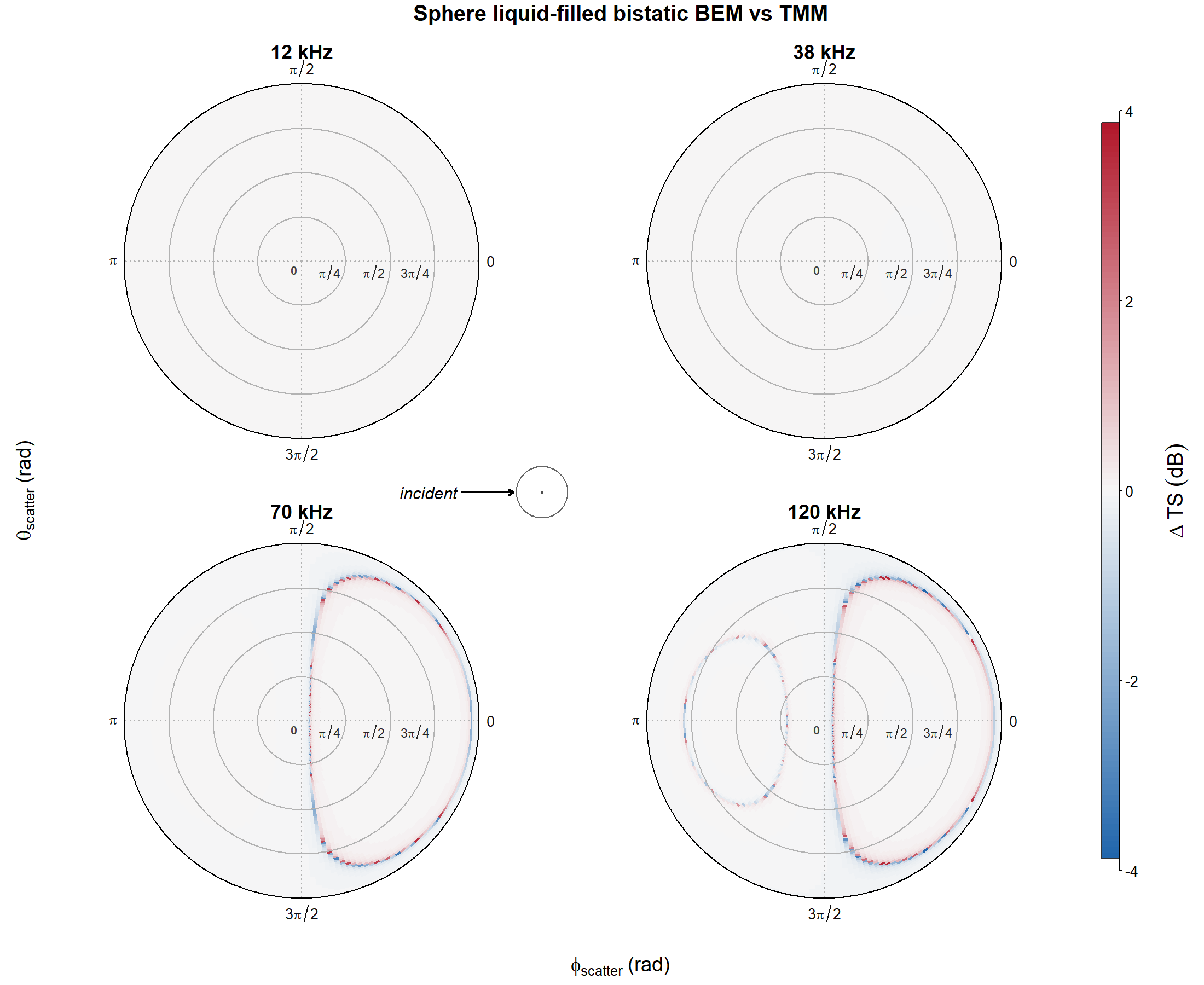
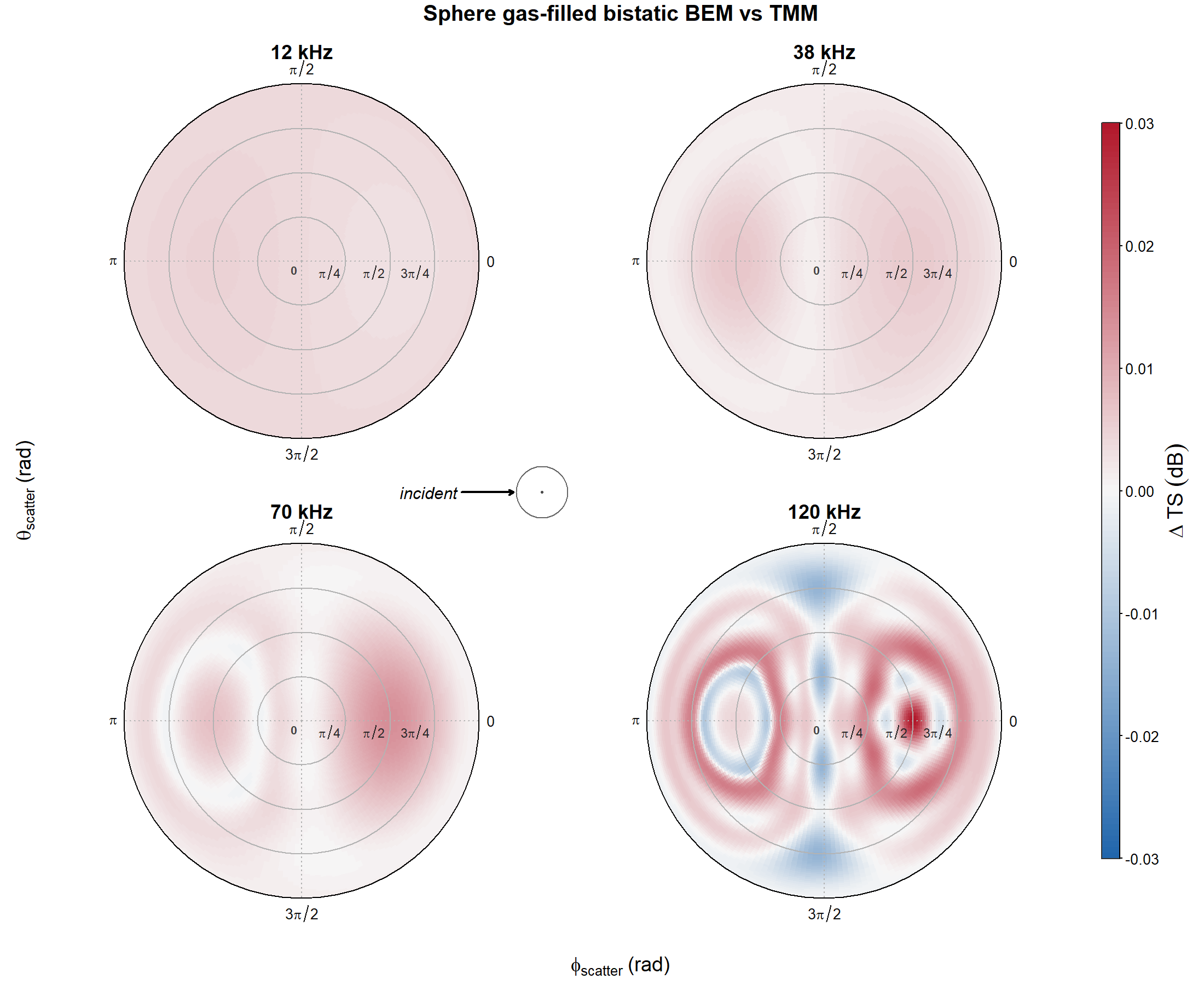
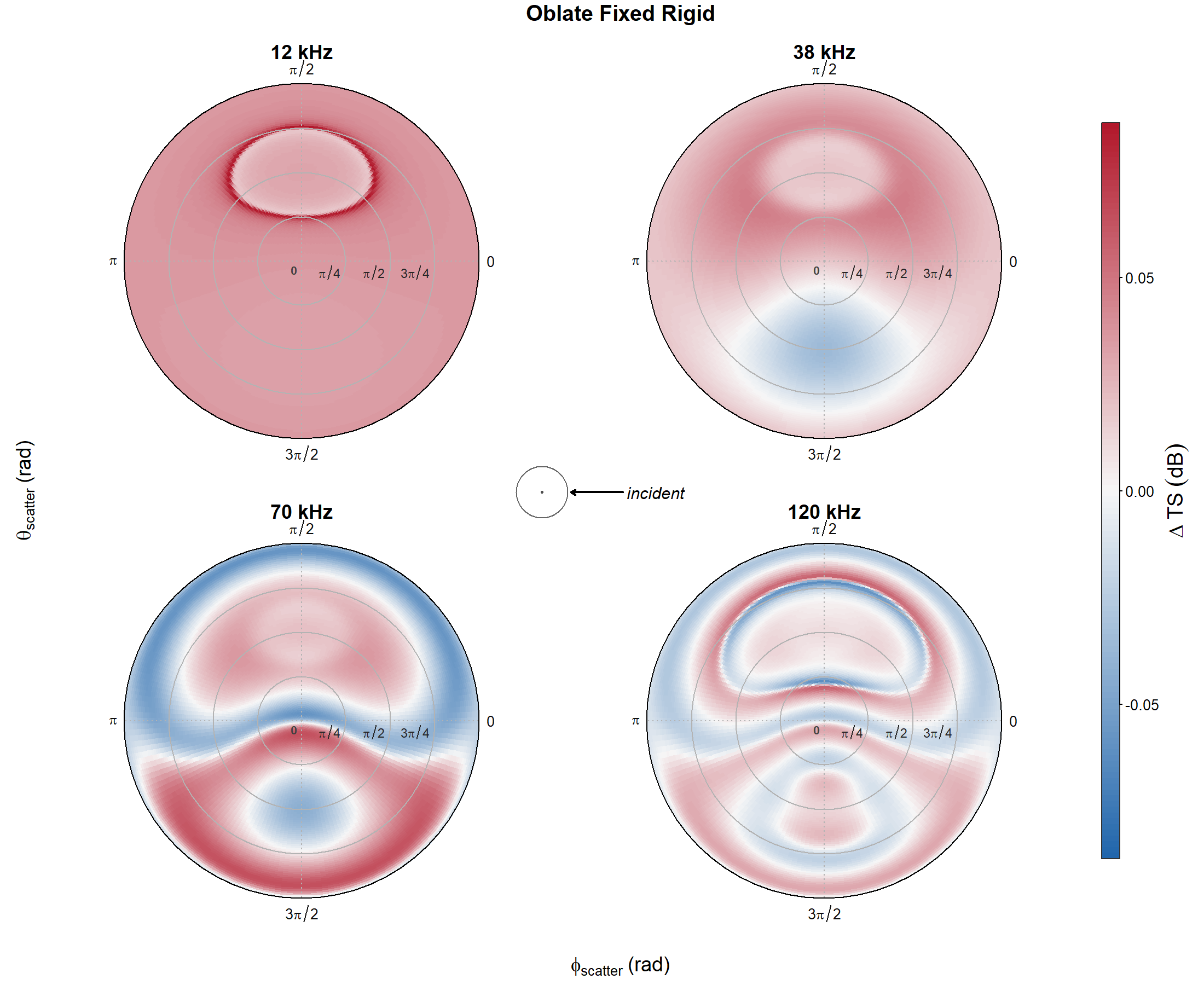
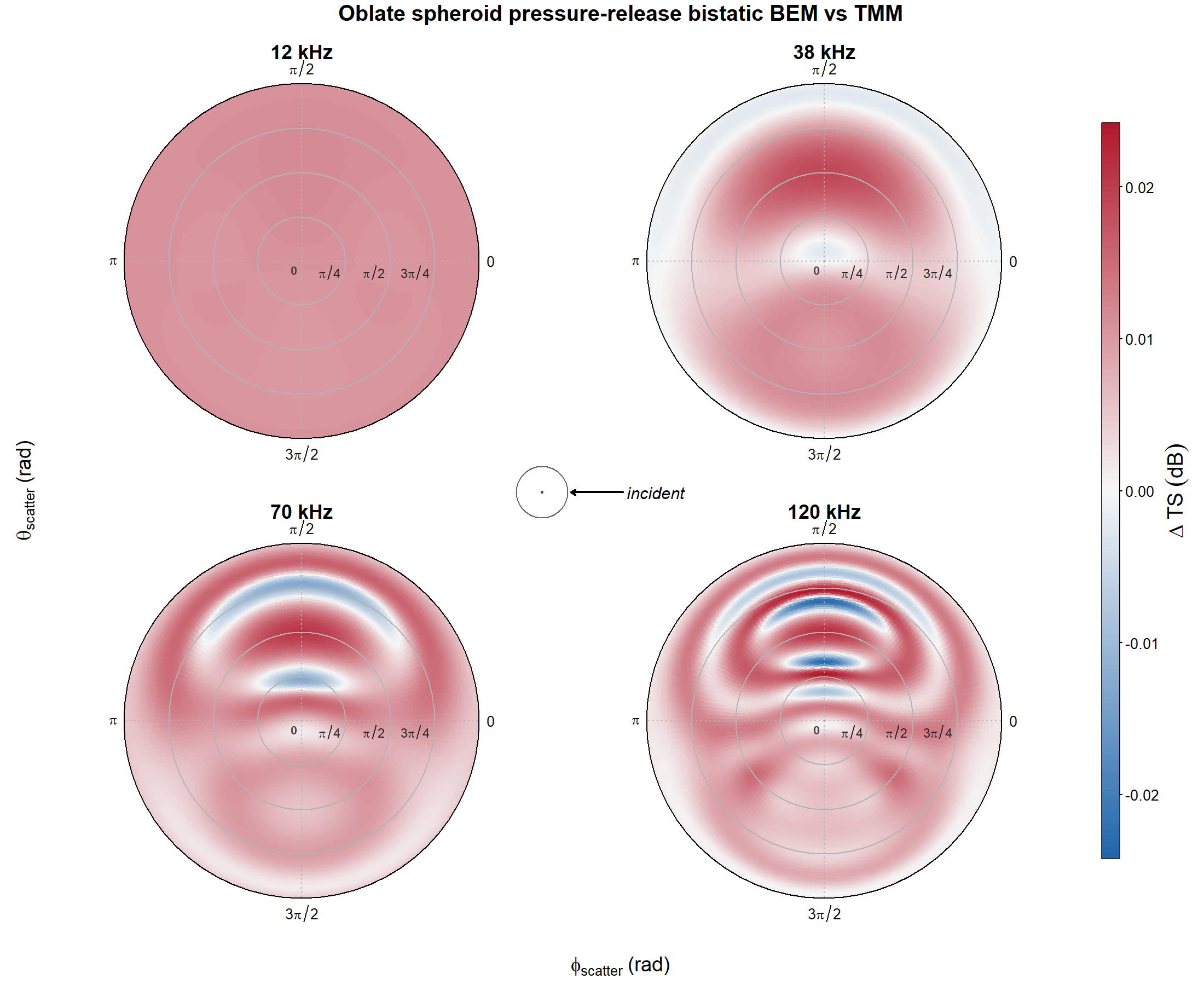
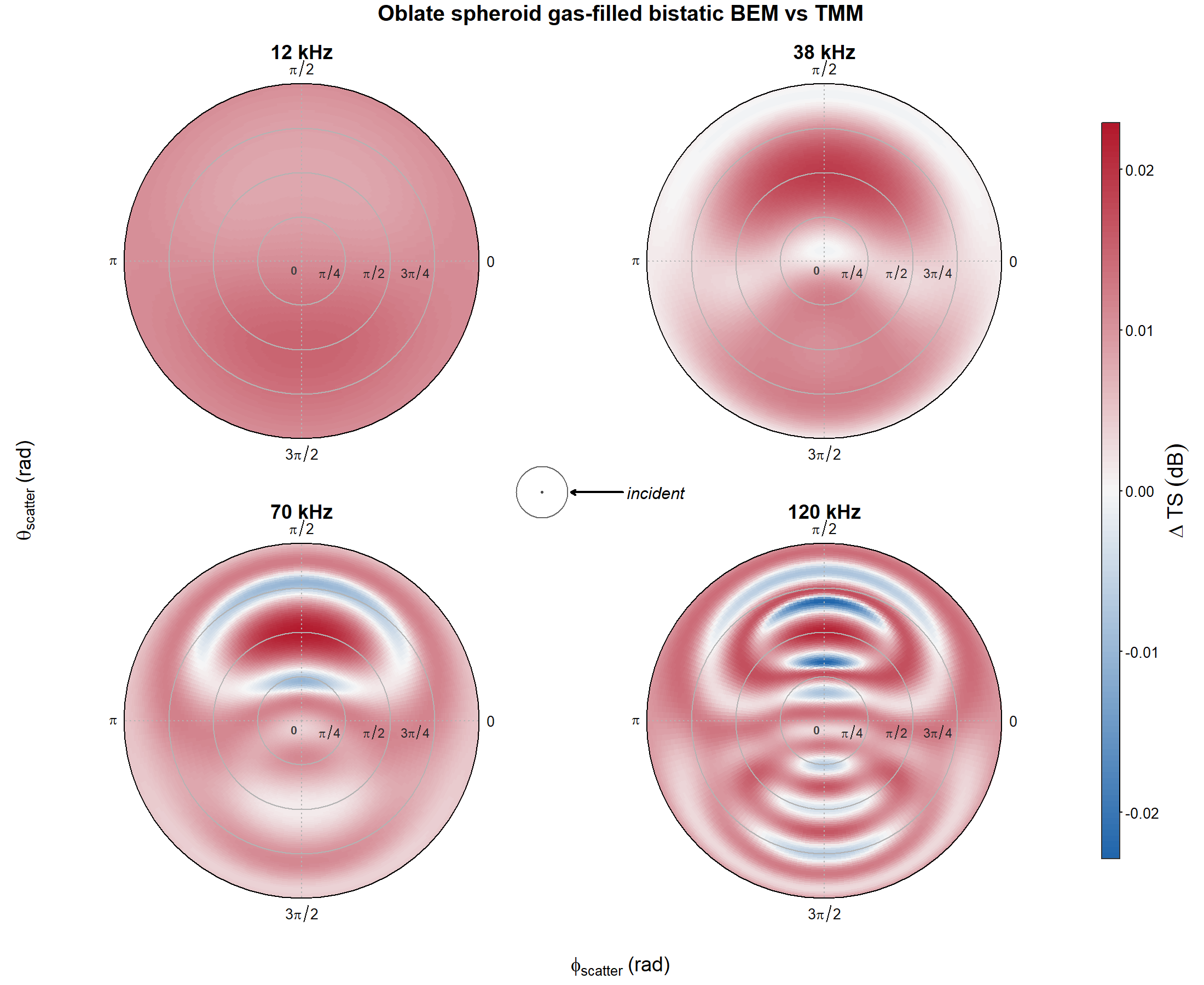
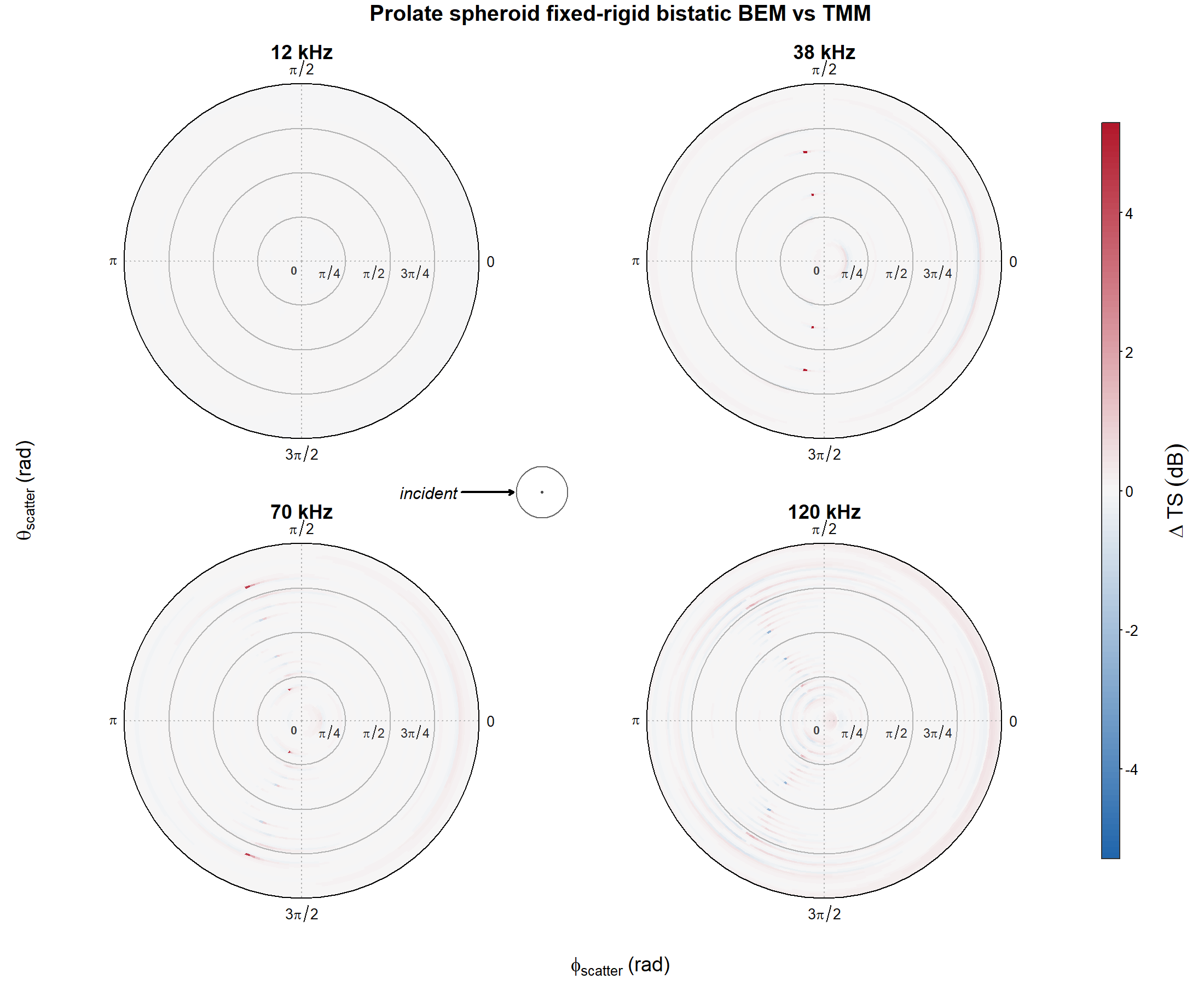
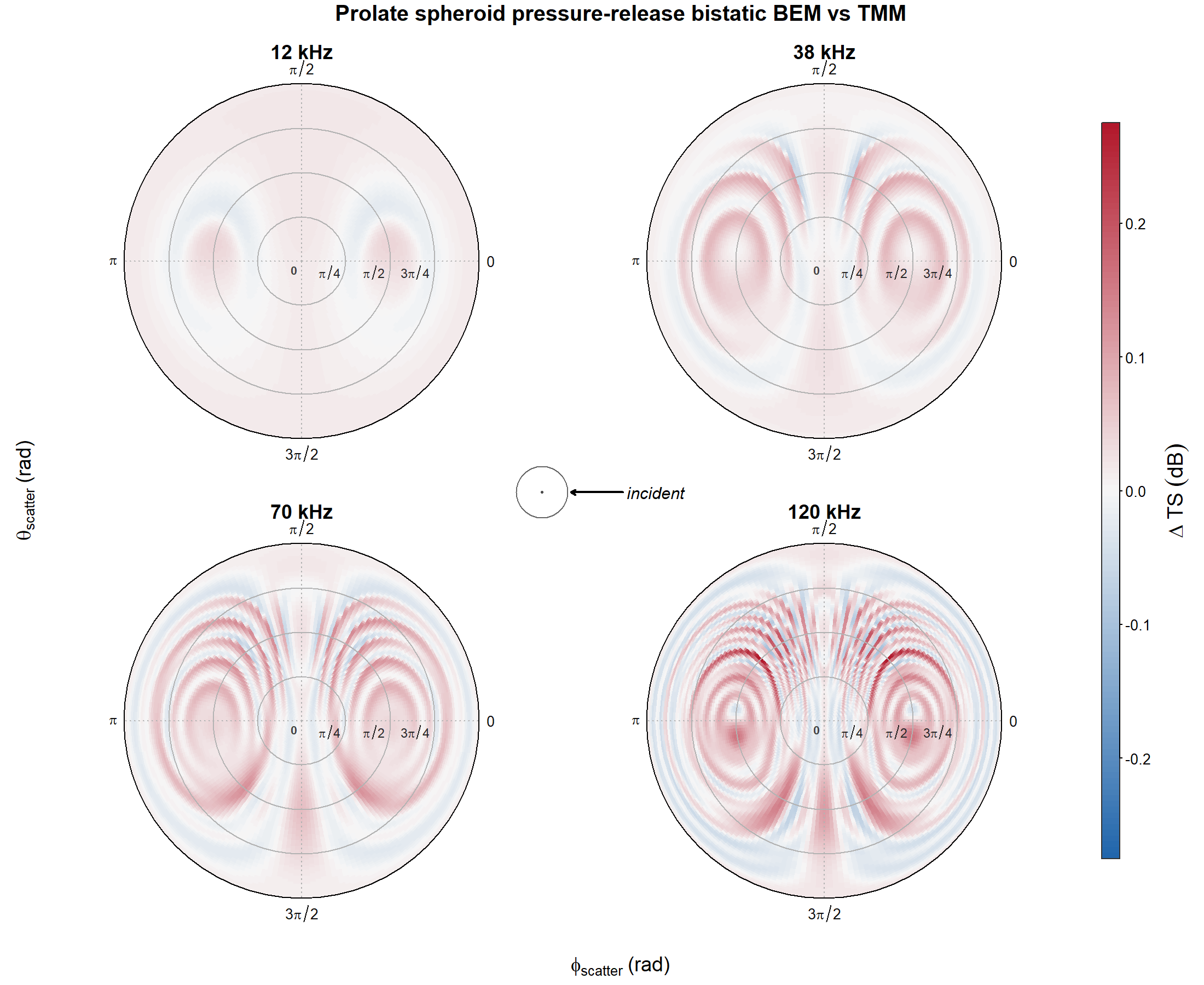
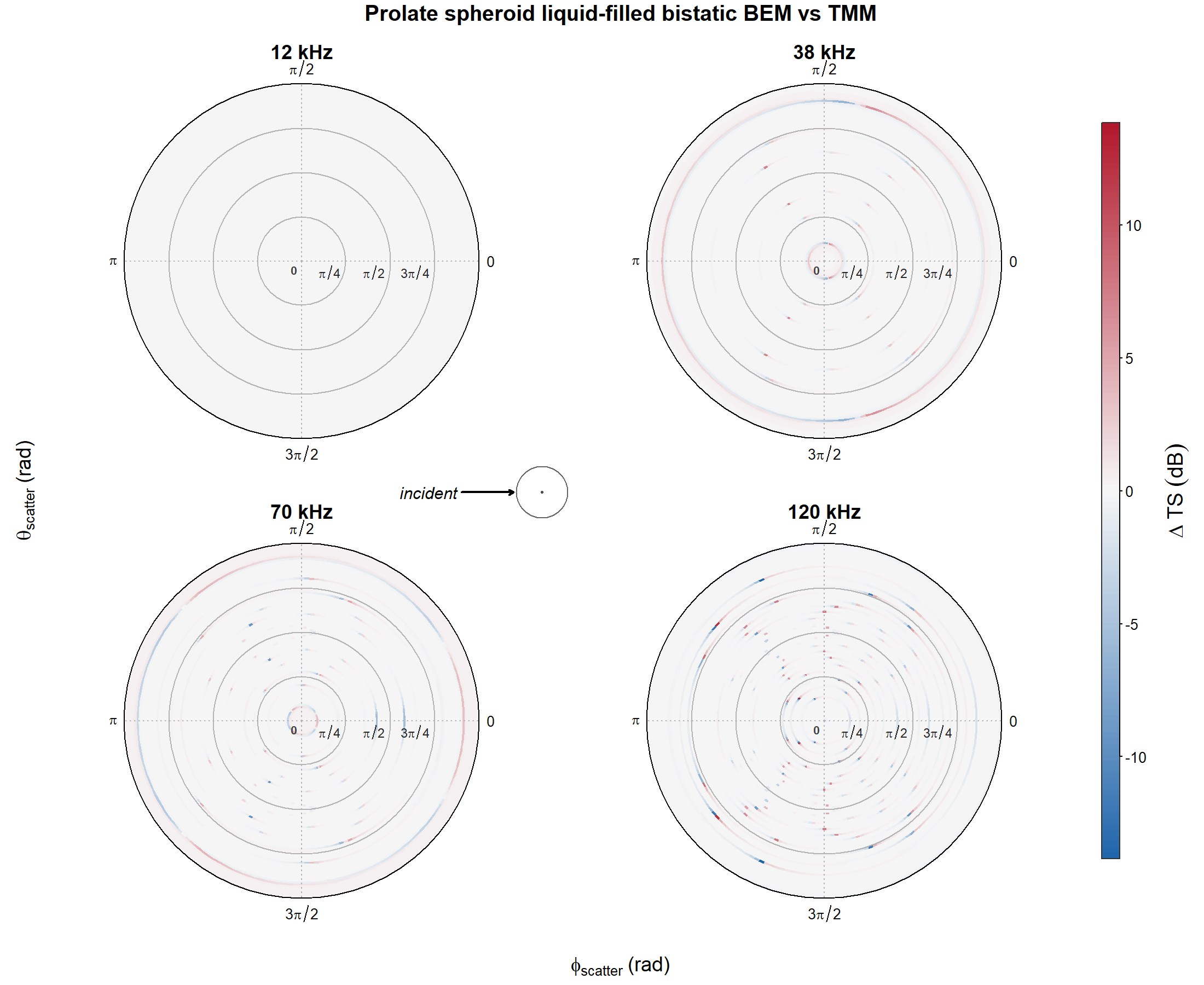
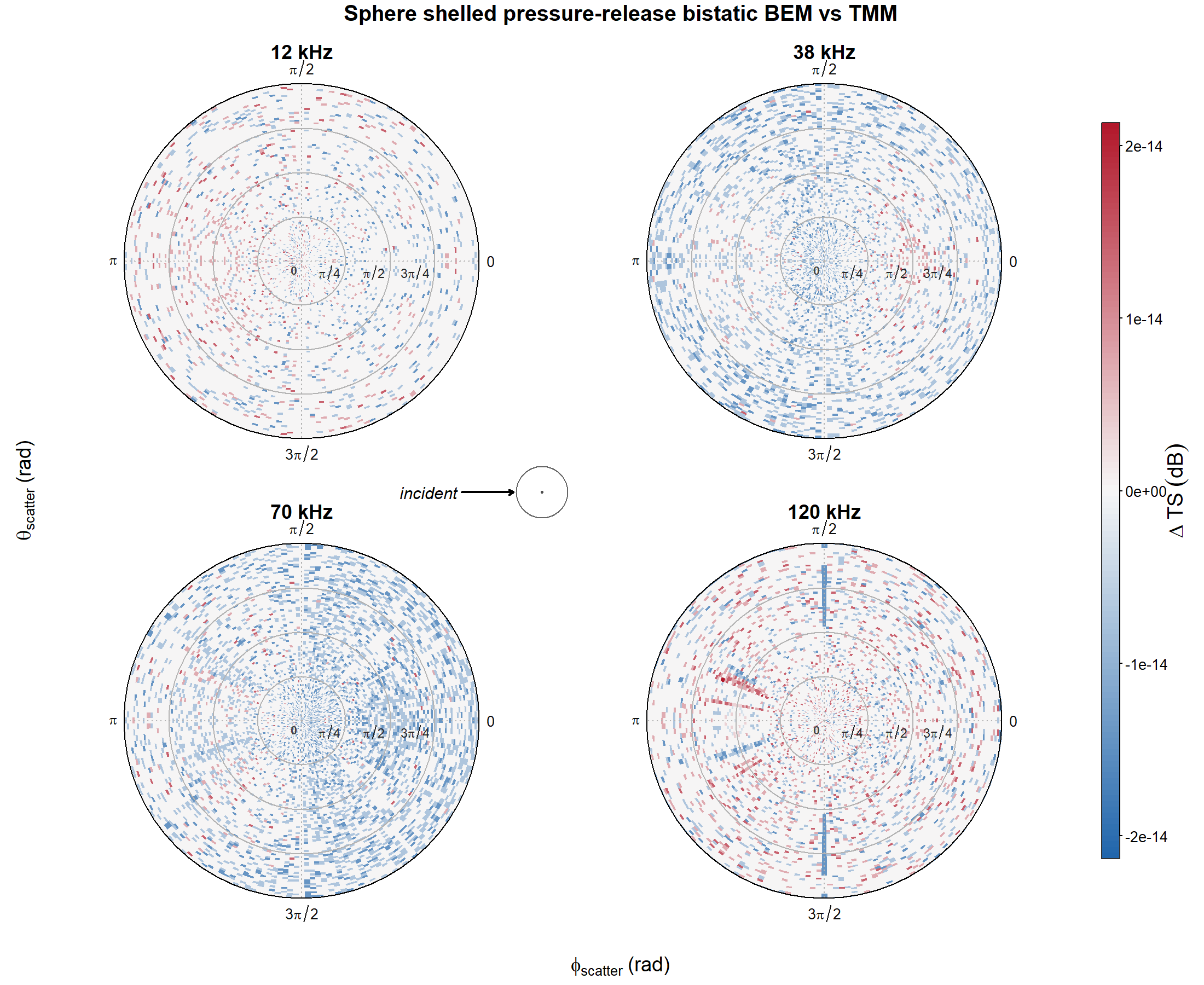
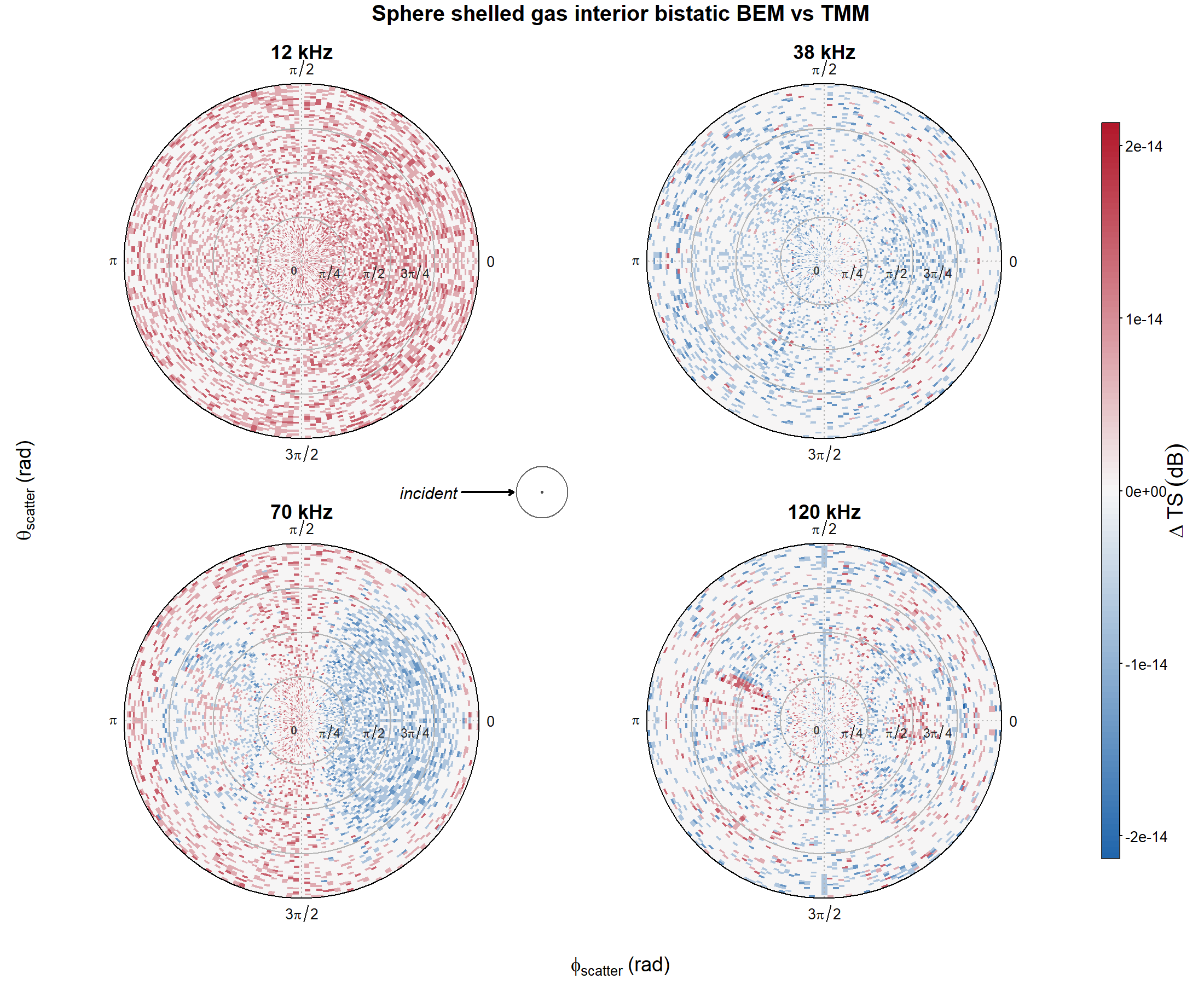
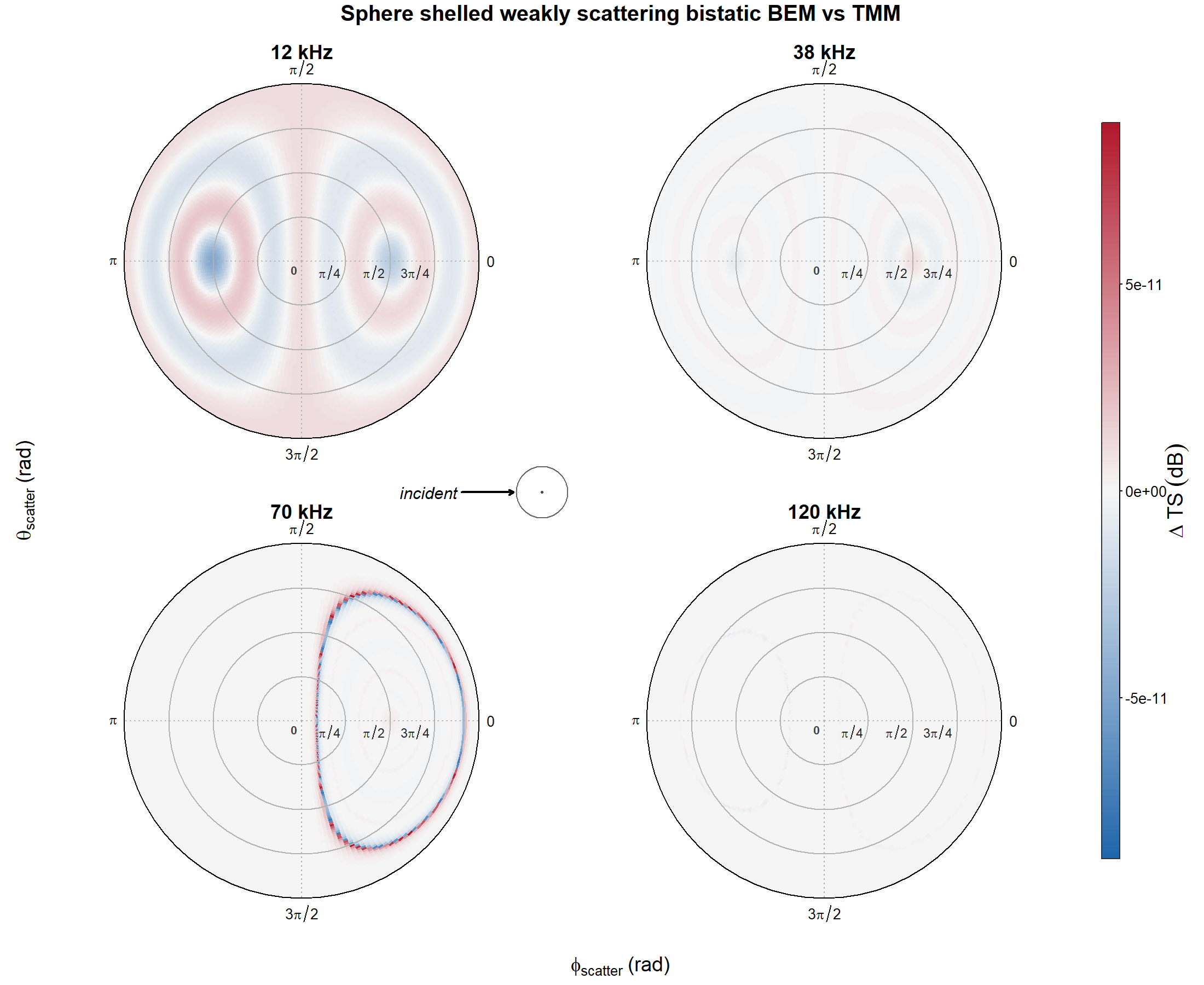
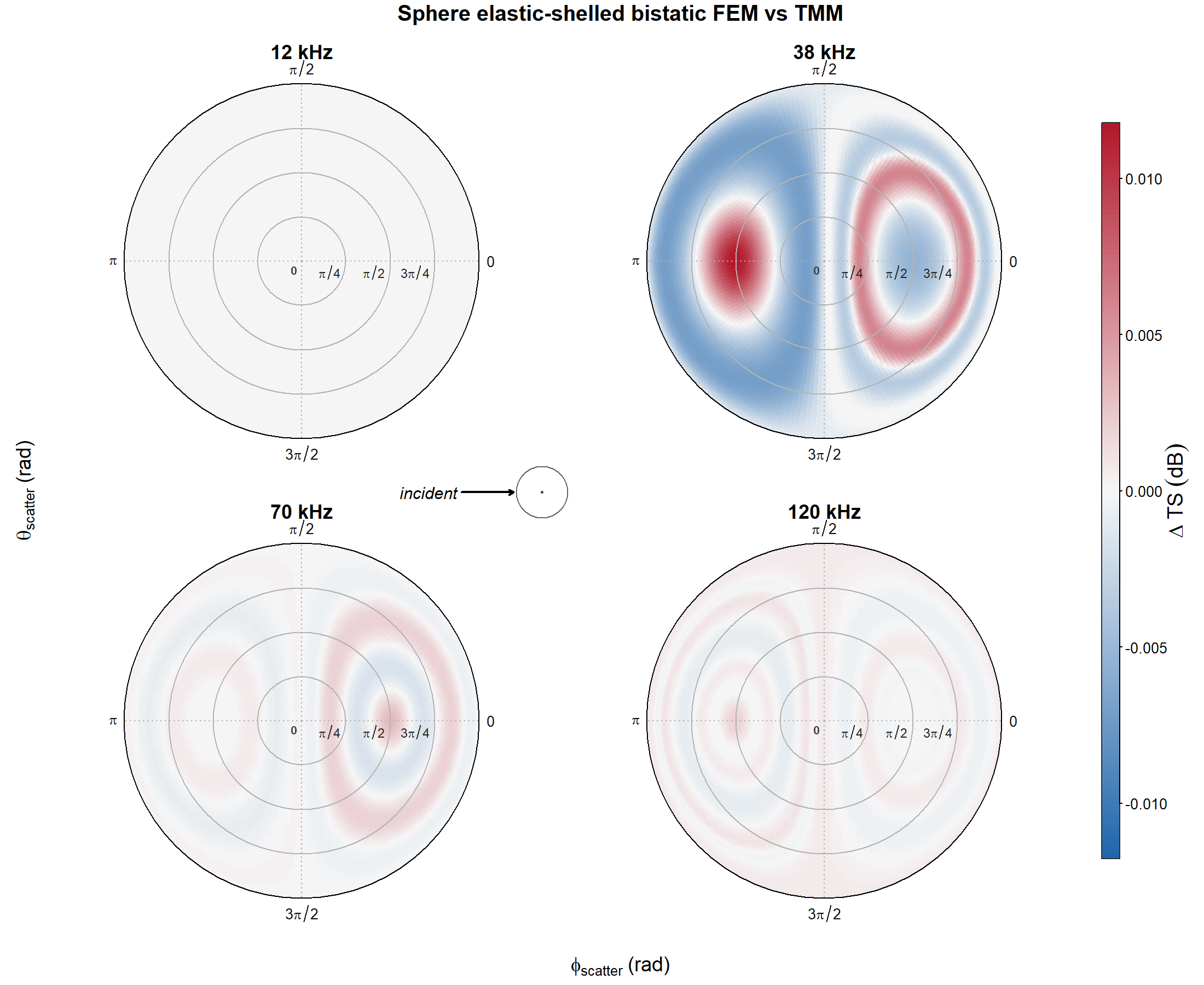
Each figure shows TMM minus the external reference
(ΔTS, dB) across the bistatic grid at 12,
38, 70, 120 kHz. The small
circle-and-arrow marker is a legend marking the incident direction, not
data.
External BEM figures
Fixed rigid
Pressure release
Liquid filled
Gas filled
Fixed rigid
Pressure release
Gas filled
Fixed rigid
Pressure release
Liquid filled
Shelled pressure release
Shelled gas
Shelled liquid
Elastic shelled
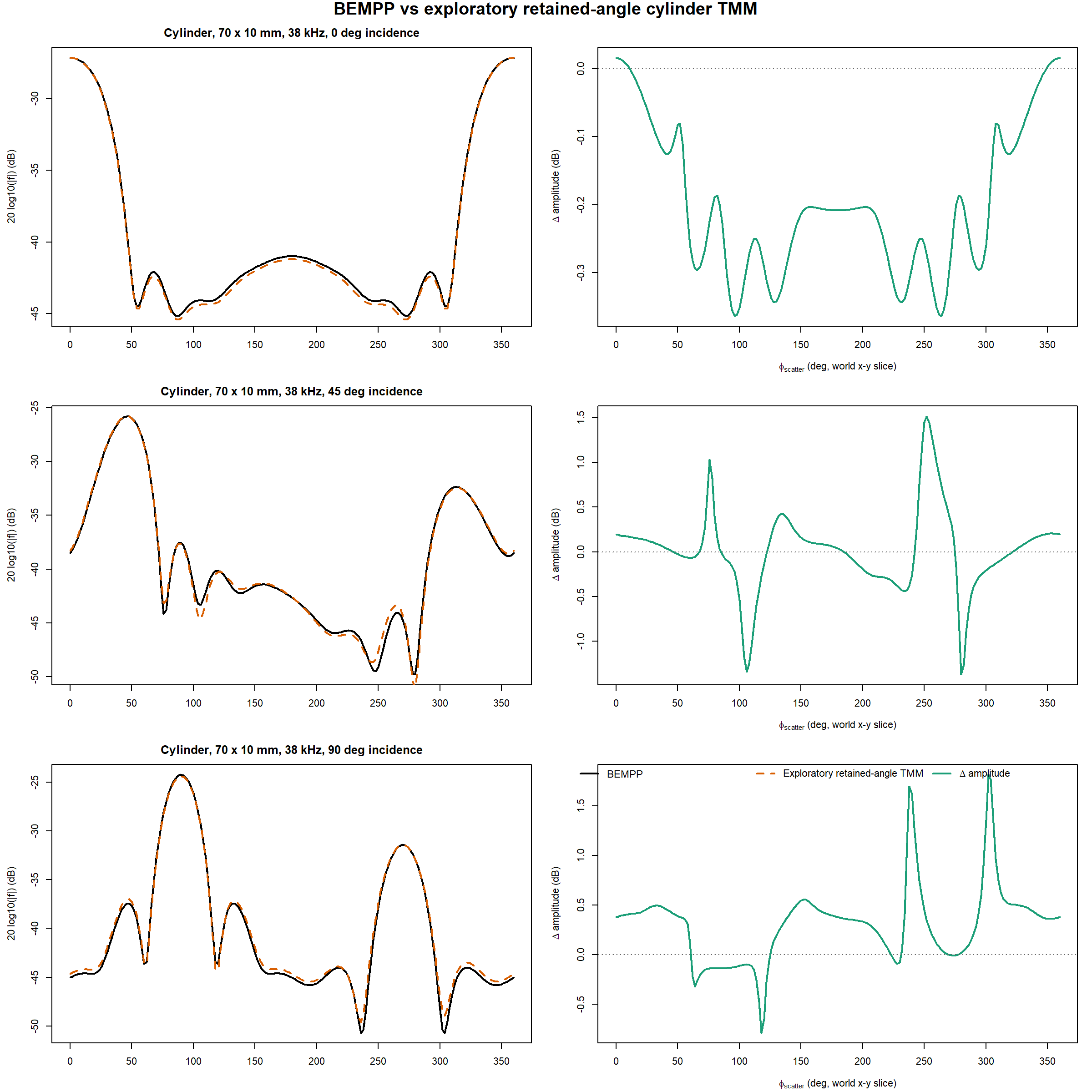
For the cylinder, the analogous full-angle figure is shown here only as a constraint on the exploratory retained-angle cylinder operator. It is not documenting a supported public cylinder workflow. The point of the figure is to show why the package refuses to provide full retained cylinder grids and bistatic summaries instead of pretending they are validated.
The external comparisons support the following conclusions:
- the sphere has been compared with BEM/FEM across all four boundaries,
- pressure-release oblate and prolate angular fields agree closely after the frame convention is matched,
- some penetrable BEM comparisons contain large maxima near nulls and should be interpreted with the exact-family and mean-residual columns,
- the exploratory retained-angle cylinder branch does not agree externally and is therefore not part of the documented public retained-cylinder workflow, and
- even the exact monostatic pressure-release cylinder branch is only
externally close near broadside on the tested cases, so cylinder remains
the least externally constrained
TMMshape family and emits a warning by default when used.
At this point, no direct paper-figure reproduction is claimed here for the prolate angular response. If a future paper-grounded reproduction is added, it needs to match the original paper’s normalization, axes, and geometry conventions exactly rather than only mimicking the general visual style.