Phase-compensated distorted wave Born approximation
Source:vignettes/pcdwba/pcdwba-implementation.Rmd
pcdwba-implementation.RmdacousticTS implementation
PCDWBA follows the phase-compensated weak-scattering formulation for broadside elongated targets (Chu and Ye 1999; Chu et al. 1993).
The phase-compensated distorted wave Born approximation is available
through target_strength(..., model = "pcdwba"). The
implementation is intended for weakly scattering fluid-like bodies and
uses the same curved-cylinder bookkeeping whether the target starts as a
canonical bent cylinder or an arbitrary fluid-like profile.
This page checks the implementation against two source-level references:
- the
pcdwba_fbsroutine in the Python package Echopop (Lucca and Lee 2026) - the bent-cylinder DWBA routines in the R package ZooScatR (Gastauer et al. 2019)
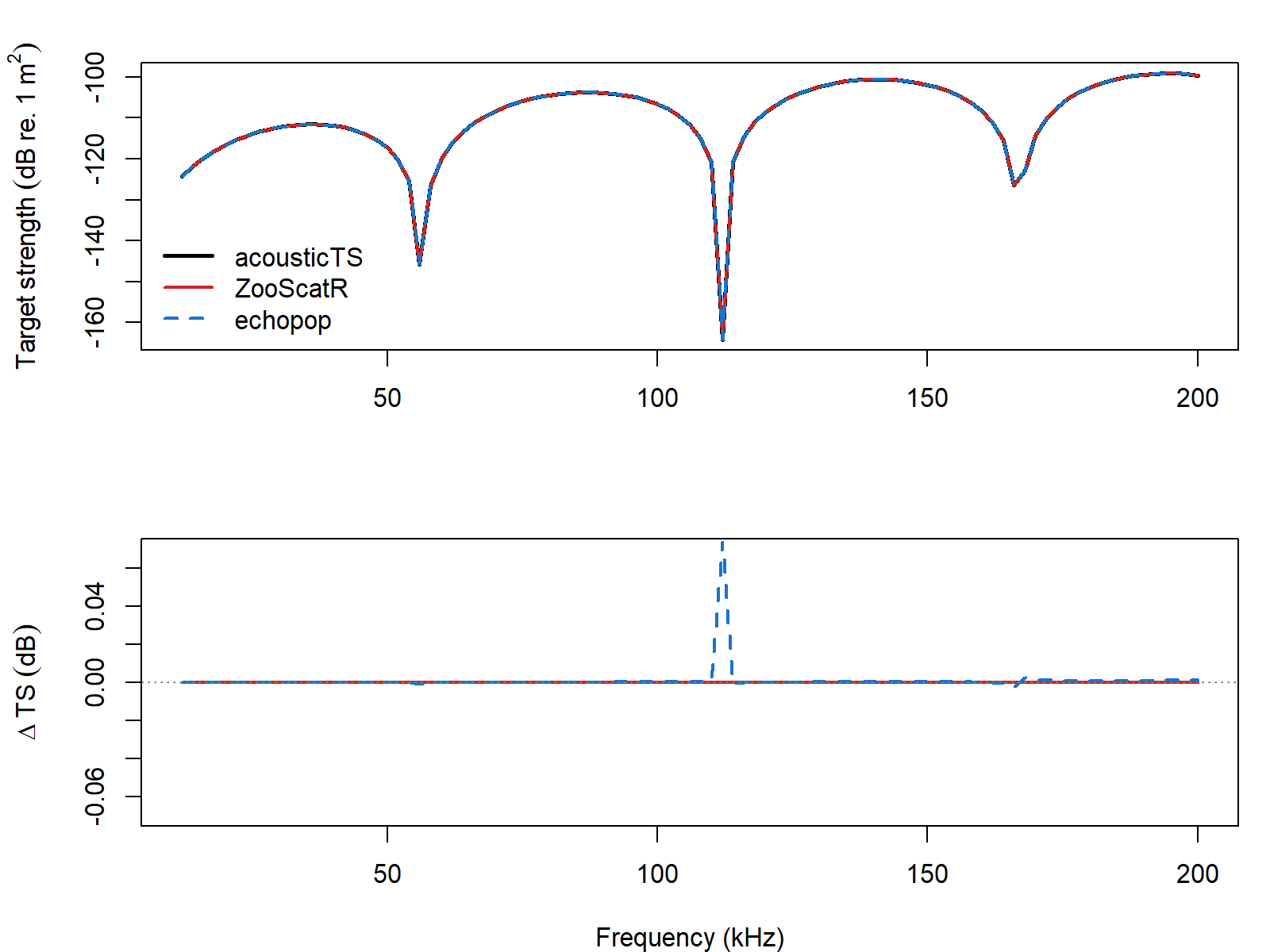
PCDWBA is validated here against source-level reference
implementations rather than against a separate published benchmark
table. The ZooScatR source agrees exactly on the shared case, while the
remaining Echopop drift is attributable to that implementation’s
interpolated Bessel evaluation.
Reference case
The comparison uses a single reproducible bent-cylinder case:
- length
15 mm - radius
1 mm - taper order
10 - curvature ratio
rho_c / L = 3 - density contrast
g = 1.02 - sound-speed contrast
h = 1.02 - broadside incidence
-
12-200 kHzin2 kHzsteps -
51integration nodes in all three implementations
In acousticTS, that target is built as:
library(acousticTS)

pcdwba_object <- fls_generate(
  shape = cylinder(
    length_body = 0.015,
    radius_body = 0.001,
    taper = 10,
    radius_curvature_ratio = 3,
    n_segments = 50
  ),
  g_body = 1.02,
  h_body = 1.02,
  theta_body = pi / 2
)

pcdwba_object <- target_strength(
  object = pcdwba_object,
  frequency = seq(12e3, 200e3, by = 2e3),
  model = "pcdwba",
  sound_speed_sw = 1500,
  density_sw = 1026
)

head(extract(pcdwba_object, "model")$PCDWBA)
## frequency ka f_bs sigma_bs TS
## 1 12000 0.05026548 -6.147156e-07+7.354948e-11i 3.778753e-13 -124.2265
## 2 14000 0.05864306 -8.131273e-07+1.148885e-10i 6.611760e-13 -121.7968
## 3 16000 0.06702064 -1.027176e-06+1.682542e-10i 1.055090e-12 -119.7671
## 4 18000 0.07539822 -1.251059e-06+2.344088e-10i 1.565149e-12 -118.0544
## 5 20000 0.08377580 -1.478570e-06+3.137691e-10i 2.186169e-12 -116.6032
## 6 22000 0.09215338 -1.703221e-06+4.063858e-10i 2.900962e-12 -115.3746Validation outputs
Comparison summary
| Comparison | Max abs. \Delta TS (dB) | Mean abs. \Delta TS (dB) |
|---|---|---|
| acousticTS vs echopop | 0.073947 | 0.001123 |
| acousticTS vs ZooScatR-source | 0.000000 | 0.000000 |
| echopop vs ZooScatR-source | 0.073947 | 0.001123 |
The ZooScatR and acousticTS outputs are indistinguishable on this
grid. Echopop remains close but evaluates the cylindrical Bessel term
through interpolation rather than a direct nodewise call. The largest
mismatch is near 112 kHz. Replacing the interpolated
J_1(x)/x value with a direct call collapses the residual
onto the acousticTS and ZooScatR curve, identifying the drift as
numerical rather than geometrical.