
Elastic-shelled sphere implementation
Source:vignettes/essms/essms-implementation.Rmd
essms-implementation.RmdacousticTS implementation
ESSMS evaluates a fluid-filled spherical elastic shell (Goodman and Stern 1962; Faran 1951; Stanton 1990).
The required ESS object stores the spherical shell, its
internal fluid, and the elastic constants used by the shell
solution.
ESSMS is unvalidated in the package. The benchmark
family exists, but the implementation does not return finite full-grid
TS values across those shell-sphere comparison sweeps, so
this page documents behavior and limitations rather than benchmark-grade
agreement.
Elastic-shelled sphere object generation
An ESS object can be created with
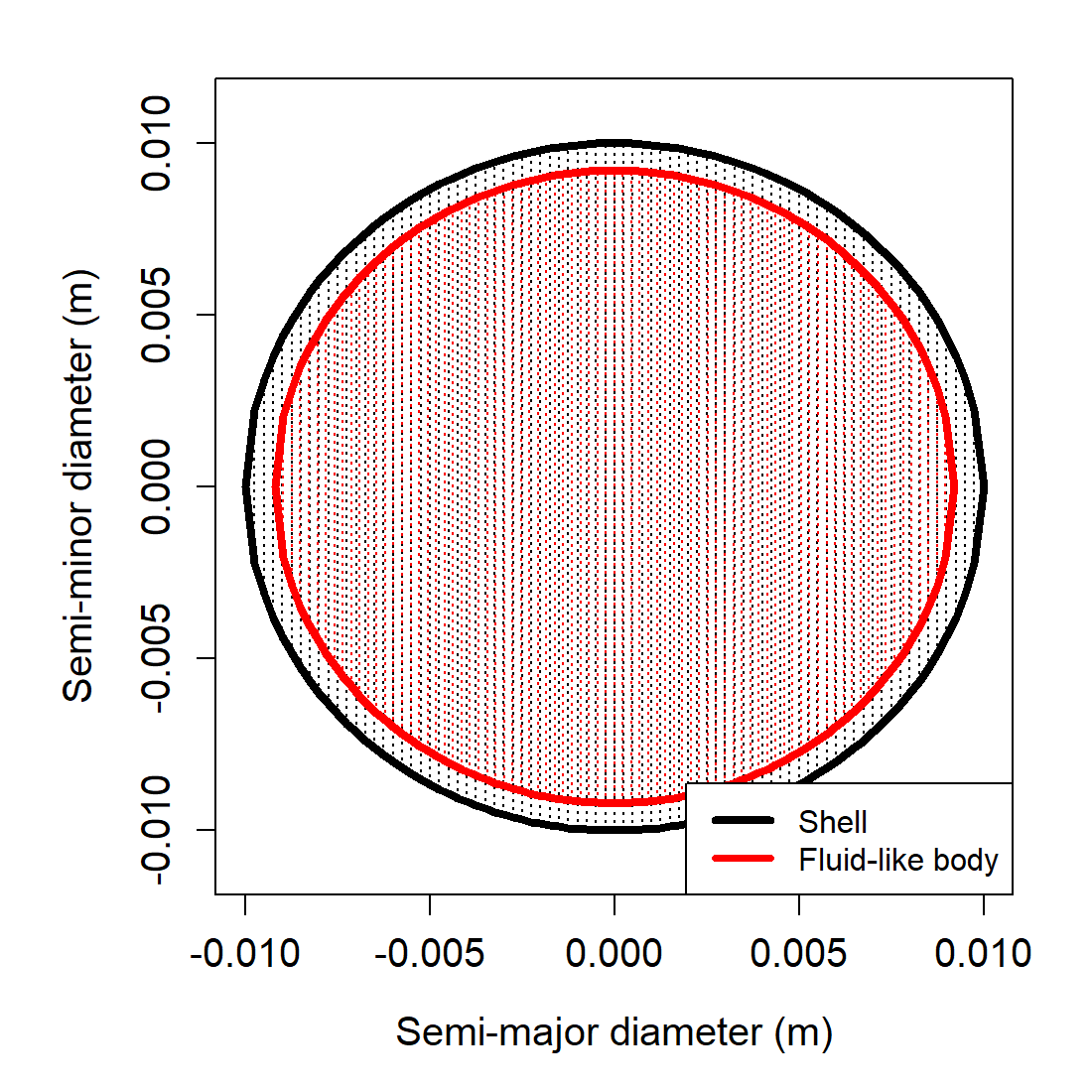
ess_generate(). For the implementation below, the shell is
described by its outer radius and thickness, while the shell material is
described by density, sound speed, and elastic constants. The inner
fluid can be provided using either contrasts or absolute material
properties.
library(acousticTS)

sphere_shape <- sphere(radius_body = 10e-3, n_segments = 80)

shelled_sphere <- ess_generate(
  shape = sphere_shape,
  radius_shell = 10e-3,
  shell_thickness = 0.8e-3,
  density_shell = 2565,
  sound_speed_shell = 3750,
  density_fluid = 1077.3,
  sound_speed_fluid = 1575,
  E = 7.0e10,
  nu = 0.32
)

shelled_sphere
## ESS-object
## Elastic-shelled scatterer
## ID: UID
## Material:
## Shell:
## Density: 2565 kg m^-3
## Sound speed: 3750 m s^-1
## Young's modulus (E): 7e+10 Pa
## Poisson's ratio: 0.32
## Bulk modulus (K): 64814814814.8148 Pa
## Shear modulus (G): 26515151515.1515 Pa
## Internal fluid-like body:
## Density: 1077.3 kg m^-3
## Sound speed: 1575 m s^-1
## Shape:
## Shell:
## Radius: 0.01 m
## Diameter: 0.02 m
## Outer thickness: 8e-04 m
## Internal fluid-like body:
## Radius: 0.0092 m
## Diameter: 0.0184 m
## Propagation direction of the incident sound wave: 1.571 radiansCalculating a TS-frequency spectrum
The target_strength() wrapper initializes the ESSMS
model, performs the modal calculation, and stores the results back
inside the same object. As with the rest of the package, frequency is
supplied in Hz.
frequency <- seq(38e3, 120e3, by = 4e3)

shelled_sphere <- target_strength(
  object = shelled_sphere,
  frequency = frequency,
  model = "essms"
)
Extracting model results
Model results can be extracted either visually or directly through
extract().
Accessing results
## $frequency
##  [1]  38000  42000  46000  50000  54000  58000  62000  66000  70000  74000
## [11]  78000  82000  86000  90000  94000  98000 102000 106000 110000 114000
## [21] 118000
##
## $ka_shell
##  [1] 1.616199 1.786325 1.956451 2.126577 2.296703 2.466830 2.636956 2.807082
##  [9] 2.977208 3.147334 3.317461 3.487587 3.657713 3.827839 3.997965 4.168092
## [17] 4.338218 4.508344 4.678470 4.848596 5.018722
##
## $ka_fluid
##  [1] 1.486903 1.643419 1.799935 1.956451 2.112967 2.269483 2.425999 2.582515
##  [9] 2.739032 2.895548 3.052064 3.208580 3.365096 3.521612 3.678128 3.834644
## [17] 3.991160 4.147676 4.304192 4.460709 4.617225
##
## $f_bs
##  [1]  8.843149e-03-0.0015569837i -3.988748e-04-0.0013454280i
##  [3]  7.933887e-04-0.0020808975i  3.758589e-03-0.0025164450i
##  [5]  1.449933e-03-0.0025584566i  1.445879e-03-0.0027217379i
##  [7]  2.665126e-04-0.0029960130i  1.988643e-03-0.0033577386i
##  [9]  6.537530e-03+0.0004434971i  2.481196e-03+0.0060923410i
## [11] -2.502007e-05+0.0051816261i -1.487989e-04+0.0046774712i
## [13]  3.699388e-04+0.0044661894i  1.356868e-04+0.0043078778i
## [15]  1.445075e-03+0.0040700486i  2.348643e-03+0.0038576369i
## [17]  3.160952e-03+0.0039211202i  3.337304e-03+0.0043504980i
## [19]  3.915986e-03+0.0047782567i  2.212936e-03+0.0050012593i
## [21]  5.261250e-04+0.0046749085i
##
## $sigma_bs
##  [1] 8.062548e-05 1.969278e-06 4.959600e-06 2.045949e-05 8.648005e-06
##  [6] 9.498424e-06 9.047123e-06 1.522911e-05 4.293599e-05 4.327295e-05
## [11] 2.684988e-05 2.190088e-05 2.008370e-05 1.857622e-05 1.865354e-05
## [16] 2.039748e-05 2.536680e-05 3.006443e-05 3.816668e-05 2.990968e-05
## [21] 2.213158e-05
##
## $TS
##  [1] -40.93528 -57.05693 -53.04553 -46.89105 -50.63084 -50.22348 -50.43490
##  [8] -48.17325 -43.67179 -43.63783 -45.71058 -46.59538 -46.97156 -47.31043
## [15] -47.29239 -46.90423 -45.95734 -45.21947 -44.18316 -45.24188 -46.54988
The extracted data.frame contains the modeled frequency,
complex backscattering amplitude f_bs, backscattering
cross-section sigma_bs, and target strength
TS.
Comparison workflows
Shell-thickness sensitivity
Shell thickness strongly affects the resonance structure of the ESSMS solution, so it is a natural first comparison when testing a new parameterization.
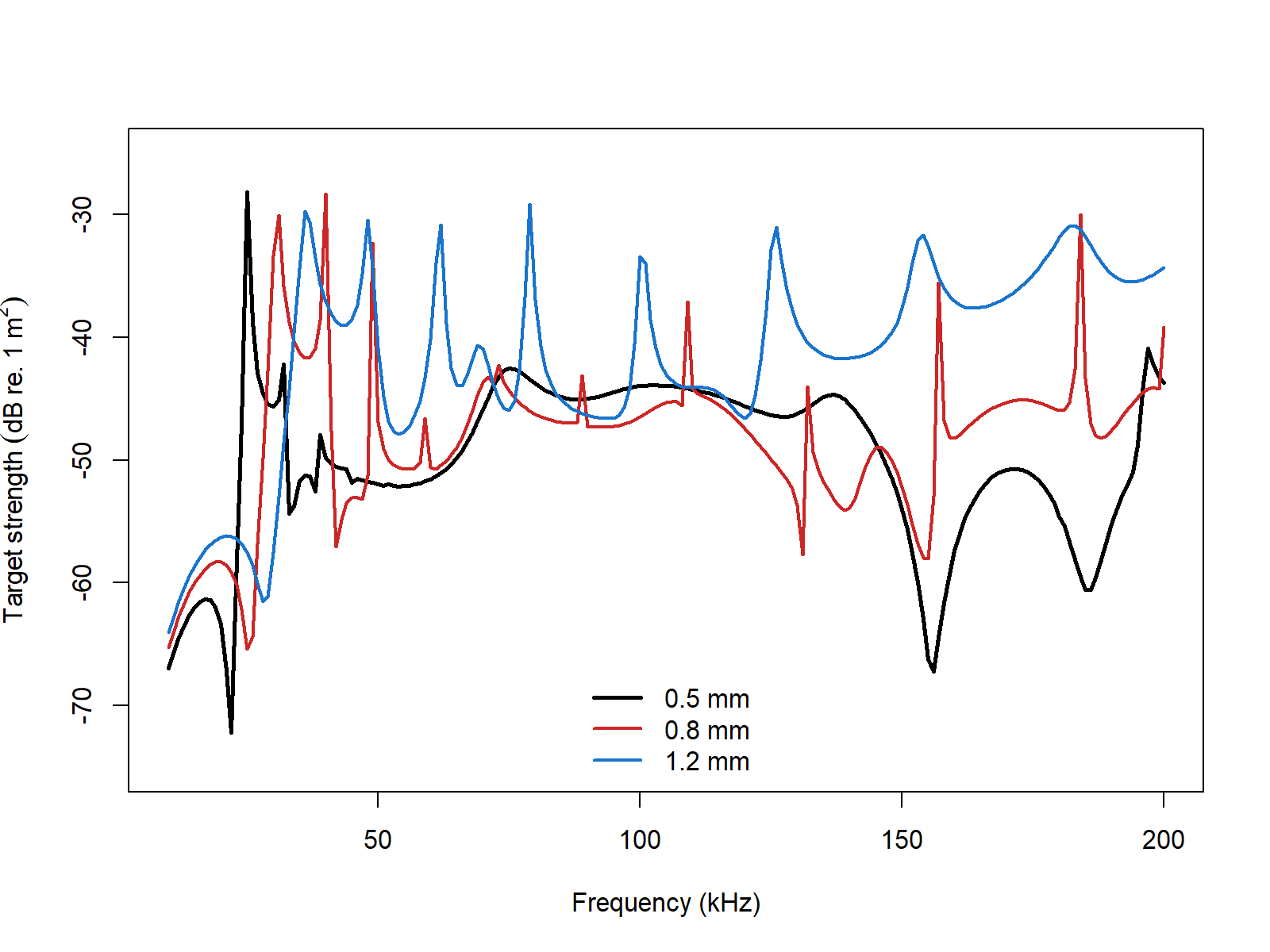
When you move from a tutorial object to a real calibration or biological shell, the next quantities to revisit are the shell elastic constants and the shell-to-fluid property contrast, because those control where the strongest modal features occur.
The current ESSMS implementation is not reliable over the full
benchmark grid. Treat NA, NaN, or infinite
values as a failed numerical evaluation, not as a physical zero or a
resonance estimate. Inspect the result in linear form and reduce the
frequency range before drawing conclusions.