Conventions
This section defines the equations, units, and directions used throughout the examples. Choose a method using Choosing a solver, then read its theory page.
Harmonic acoustic problem
In a homogeneous exterior fluid, pressure satisfies
\[\nabla^2 p + k^2 p = 0, \qquad k = \frac{2\pi f}{c}, \qquad p = p_{\mathrm{inc}} + p_{\mathrm{scat}}.\]
Here frequency is in Hz, sound speed in m/s, and wavenumber in rad/m. The outgoing kernel exp(im * k * r) / (4pi * r) used by the numerical solvers implies the time convention exp(-im * omega * t). The incident plane wave is exp(im * k * dot(direction, position)).
The outgoing pressure at large radius has scattering amplitude of dimension length
\[p_{\mathrm{scat}}(r\hat{\boldsymbol q}) \sim f_s(\hat{\boldsymbol q})\frac{e^{ikr}}{r}.\]
Compare complex values only after matching phase, incident direction, and normalization.
Target strength
\[\sigma_{\mathrm{bs}} = |f_s(-\hat{\boldsymbol d})|^2, \qquad \mathrm{TS} = 10\log_{10}\left(\frac{\sigma_{\mathrm{bs}}}{1\,\mathrm{m}^2}\right) = 20\log_{10}\left(\frac{|f_s|}{1\,\mathrm m}\right).\]
The package's backscattering cross-section convention has no additional $4\pi$ factor. target_strength also evaluates directional scattering strength for bistatic observations. These values describe backscatter only when the observation is opposite incidence. Zero amplitude maps to -Inf dB. If a display clips small values, label that clipping. Keep the underlying numerical result unchanged.
julia> using AcousticScattering

julia> target_strength(0.01 + 0im)
-40.0
Incidence and observation are different
| Input | Meaning |
|---|---|
incidence_angle | Polar angle of the incident direction relative to the body axis |
incidence_azimuth | Azimuth supported by the full 3D BEM path |
angle, azimuth on axisymmetric BEM/MFS results | Observation direction in fixed body coordinates |
direction on full BEM results | Observation unit vector in Cartesian coordinates |
angle on sphere modal | Scattering angle relative to the incident axis |
Body length lies along x, width along y, and height/depth along z. Canonical axisymmetric bodies have their symmetry axis along x. Bent cylinders curve in the xy plane. Supplied meshes retain their Cartesian coordinates. Incidence changes the wave direction, not the geometry.
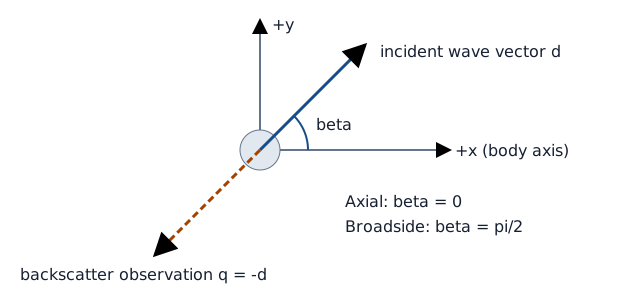
Arrows indicate direction vectors, not positions of transmitter and receiver. The incident wave propagates along d, and monostatic observation is along -d
\[\hat{\boldsymbol d} = (\cos\beta,\sin\beta\cos\alpha,\sin\beta\sin\alpha), \qquad \hat{\boldsymbol q}_{\mathrm{bs}}=-\hat{\boldsymbol d}.\]
Thus axial incidence has beta = 0, while broadside has beta = pi / 2. Azimuth is measured from +y toward +z about +x. For incidence in the xy plane, axisymmetric backscatter requires observation angle = pi - beta, azimuth = pi. These are the default observation angles for axisymmetric BEM/MFS and structural shell FEM. Full BEM's default observation and bent-cylinder MFS's result also use the negative incident direction. Explicit angle/azimuth values remain body-coordinate directions.
The lateral bent-cylinder approximation uses in-plane incidence, direction = (cos(beta), sin(beta), 0), with the same body frame.